
Autonomous tractors are beginning to move from concept to reality, albeit slowly in the local context. In day-to-day operations, precision planting and smart spraying technologies are already reshaping how inputs are applied, while artificial intelligence-driven crop monitoring is advancing rapidly, improving decision-making, yields, and risk control. However, most farmers still rely on service providers to integrate these capabilities effectively.
Underlying these advancements are GPS-guided equipment and data-driven management systems, which are becoming the backbone of modern farming. Yet, there are still barriers to the adoption of digital technology.
To unpack what this shift means in practice, Farmer’s Weekly sought input from researchers, technology specialists, and industry players. Their insights point to a sector in transition, where proven technologies are becoming essential, emerging innovations are gaining traction, and the gap between potential and practical adoption remains a key consideration.
BFAP and the SU-BFAP chair in precision agriculture
Autonomous tractors: the adoption of autonomous tractors in South Africa is likely confined to large-scale, tech-forward commercial operations, where the high initial capital expenditure can be offset by gains in operational precision and productivity.
The shift is expected to transition labour from manual operation to high-skill technical oversight, while improving farm safety by removing human operators from hazardous conditions.
Additional benefits include reduced soil compaction, greater efficiency in input use, and the capability for significantly longer periods of time.
Precision planting technology: precision planting can help to improve yields and reduce input costs while supporting soil and sustainability through targeted management. However, through our Data-intensive Farm Management and On-Farm Precision Experimentation (OFPE) projects, which have been running since 2019, we have seen that the scale of these benefits varies significantly by farm, season, and crop.
We recommend that farmers conduct two to three seasons of OFPE trials on their own farms to quantify the potential benefits before committing to widespread investment.
Smart sprayers: in theory, smart sprayers are shifting crop protection from broadcast-based applications to the high-precision treatment of individual plants. This evolution has the potential to significantly reduce chemical waste and environmental impact, while lowering input costs by ensuring expensive products are only applied where they are biologically necessary.
Artificial intelligence-driven crop monitoring: some technologies and farm management platforms are making progress in integrating artificial intelligence (AI) into their recommendations based on high-frequency, high-resolution data, including weather, spectral, and remote-sensing data. Farmers subscribed to these services are already benefitting from more informed and accurate management decisions.
Given that farmers typically lack the expertise to incorporate AI throughout their systems themselves, they are likely to remain reliant on technology integration from their service providers.
GPS-guided equipment and data-driven farm management systems: GPS-guided equipment is becoming essential for more precise, site-specific management and improved yield monitoring. Without GPS-guided tractors and combine harvesters, site-specific management and precision agriculture would be impractical to implement on a large farm.
Furthermore, without GPS-referenced data, site-specific management and data-driven decisions would not be possible.
Barriers to technological integration: South Africa’s agricultural landscape is defined by three distinct tiers, each facing unique barriers to technological integration.
For subsistence and smallholder farmers (tier one), hardware-heavy precision agriculture is financially out of reach. However, high-impact digital solutions offer significant potential. Low-barrier technologies, such as AI-driven planting schedules and management advice delivered via SMS or mobile app, can provide the data-driven insights necessary to enhance yields without requiring capital-intensive investment.
Emerging and new-era commercial farmers (tier two) often operate with legacy equipment or rely on external contractors for critical operations like harvesting. While machinery upgrades are frequently hindered by cash flow constraints, the main obstacle is data utility. Even when contractors capture harvesting data, farmers often lack the specialised skills needed to clean, process, and analyse it. This technical gap can delay decision-making, often rendering the insights obsolete by the following season.
Large-scale commercial producers (tier three) possess advanced machinery and expansive data repositories, yet they remain constrained by high capital expenditure and systemic fragmentation. Information is often siloed across disparate platforms and devices.
For this tier, the key challenge is not data acquisition but rather the synthesis of these multiple data streams into a unified, practical decision-support framework that can guide farm management effectively.
Christiaan Van Rensburg, MD, Orchard Agri
Autonomous tractors: adoption in South Africa remains in its early stages, held back by high costs and limited readiness. While autonomous tractors can reduce the demand for labour and improve efficiency, precision, and safety, widespread adoption is likely to be gradual.
Orchard Agri distributes OSAM machines, and the anticipated release in 2026 of the cost-effective OSAM 1000 PRO multifunctional tractor could accelerate adoption significantly.
Precision planting technology: precision planting enhances seed spacing, depth control, and variable-rate application, leading to improved crop establishment and higher yields. Before investing, farmers should evaluate costs, data infrastructure, technical support, soil variability, and compatibility with existing equipment.
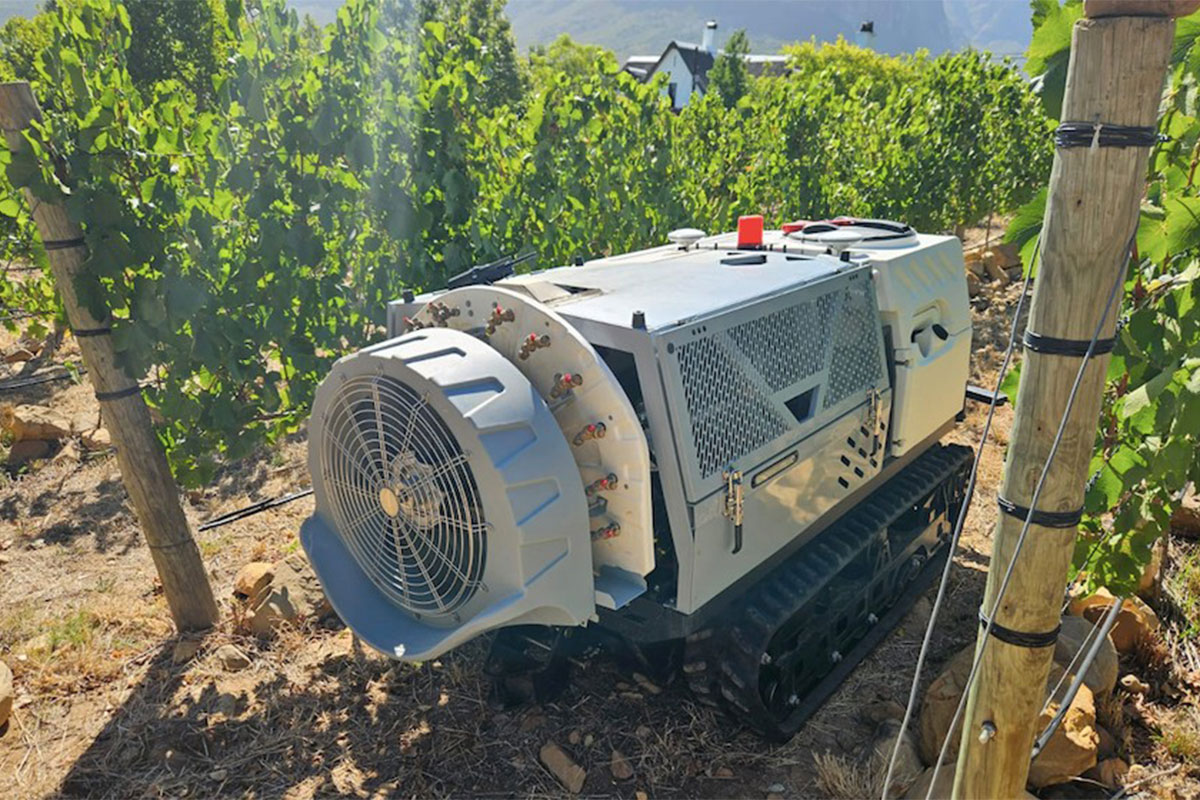
Smart sprayers: adoption in South Africa is also still in its early stages, but the OSAM S500 Pro and OSAM S1000 multifunctional sprayers and OSAM precision spot sprayers are generating strong interest. These cost-effective units improve efficiency, consistency, precision, and safety, while reducing dependence on labour and enabling more reliable, repeatable field operations.
Electrified farm machinery: electrified machinery is gaining traction but remains constrained by high costs, limited charging infrastructure, and range restrictions. Although upfront investment is substantial, fuel savings can offset costs over time, thereby shortening the payback period as fuel prices rise.
Hybrid systems such as the OSAM S500 and S1000 multifunctional sprayers address battery limitations by enabling eight- to nine-hour working days. Electric utility terrain vehicles and all-terrain vehicles offer a practical range of 70km to 100km.
AI-driven crop monitoring: AI-driven monitoring helps improve decision-making, yields, and risk control. OSAM autonomous sprayers can be equipped with cameras and hardware to collect field data during operation, enabling real-time insights, early detection of issues, precision interventions, and more consistent data-driven farm management.
GPS-guided equipment and data-driven farm management systems: these technologies enhance precision and efficiency. OSAM autonomous sprayers and tractors use fused GPS, real-time kinematic, light detection and ranging, and camera systems to navigate accurately, reduce human error, enable consistent operations, minimise overlap, optimise inputs, and improve overall farm performance.
Barriers to technological integration: key barriers include high costs, limited local experience, and resistance to new technology, despite proven success abroad. Overcoming these hurdles will require early adoption, demonstrations, and local validation.
Orchard Agri has invested heavily to ensure solutions meet South African standards and operating conditions.
Pieter Burger, digital agriculture services lead, Syngenta South Africa
Precision farming trends: adoption varies significantly depending on complexity, cost, and perceived value. Some technologies, including GPS guidance and yield monitoring, are already widely used because of their clear benefits.
A second group shows moderate adoption, often requiring more expertise or stronger evidence before uptake increases. These include grid and precision soil sampling; variable-rate fertiliser application based on yield maps, soil maps, or satellite imagery; and farm management and crop monitoring platforms.
More advanced applications typically require higher technical capacity or have a cost-to-benefit ratio that slows uptake. These include variable-rate seedling and fertiliser application using geographic and regional data, as well as spot-spraying technologies, which are becoming more affordable and are gaining traction.
Barriers to technological integration: a major constraint is a lack of awareness and education, particularly where the clear, tangible benefits of technology are not well understood. This is linked to concerns around cost, time, and return on investment, as farmers need to see that technology will either save time or generate additional income to justify adoption.
Limited technical skills and digital literacy also remain a challenge, as many tools are not straightforward to use and often involve complex jargon. Trust is another important factor, with concerns around security, privacy, and data ownership influencing decision-making.
Farmers may also experience choice fatigue, as the growing number of options can make it difficult to identify the ‘right’ tool.
Tools from Syngenta: Cropwise Operations is an example of how digital platforms are supporting farm decision-making. Good agronomic decisions rely on accurate records, and Cropwise Operations provides a structured platform for crop monitoring, field scouting, and record-keeping, ensuring observations are documented, traceable, and actionable across seasons and teams.
Key features:
- Real-time yield estimation for grains by crop and field throughout the season, enabling management based on yield potential
- High-resolution, near-daily imagery
- High-accuracy daily weather and soil moisture data to support input selection and timing
- Collaboration between growers, agronomists, advisers, and value chain members
Daily insights that drive decisions:
- Crop health monitoring using the normalised difference vegetation index, updated daily via satellite imagery
- Soil moisture tracking, with daily monitoring of precise growing conditions
- Weather intelligence, providing hyperlocal forecasts and historical data
- Yield and harvest forecasting, with real-time daily estimates
At its core, precision agriculture within Cropwise Operations covers:
- Daily satellite imagery at 3m resolution for timely, precise insights
- Productivity zones, variable-rate application, yield maps, and soil sampling integration
- In-field offline scouting and recommendations
- Synchronisation with machinery telemetry and other integrations
Operational functions further support efficiency through:
- Inventory management
- Traceability through application records and cost tracking by field
- A cloud-based platform with mobile apps for field teams
- Integration with enterprise resource planning systems, accounting tools, and Internet of Things devices
Although fully autonomous farming may still be some way off for most South African producers, precision technologies, digital platforms, and smarter machinery are already delivering tangible benefits.
As costs decline and local experience grows, adoption is likely to accelerate. For farmers, success will depend on selecting technologies that suit their specific operations and generate measurable returns, rather than simply following the latest trends.