
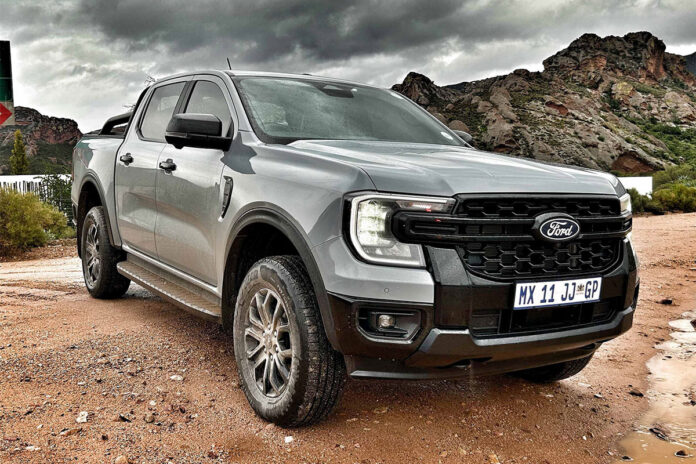
Ford has officially introduced the 2,3ℓ EcoBoost turbo-petrol engine, which produces 222kW of power and 452Nm of torque, to the Ranger. This mill is the sole powertrain in the North American Ford Ranger and was also briefly offered locally in the Mustang.
Effectively replacing the 152kW/500Nm 20ℓ bi-turbo diesel engine, the 2,3ℓ takes its place alongside the 125kW/405Nm 2ℓ single turbo-diesel, the 184kW/600Nm 3ℓ V6 turbo-diesel, and the Raptor’s performance 292kW/583Nm 3ℓ V6 twin-turbo petrol engines. A 10-speed automatic transmission is the sole choice of gearbox on all engine derivatives except for the single turbo-diesel, which also offers a six-speed manual box.
The 2,3ℓ petrol mill is only offered on two models – the Wildtrak and newly-introduced Sport – only in rear-wheel drive guise, and only in SuperCab and double-cab body styles. The Sport slots in between the XLT and Wildtrak in the model hierarchy.
V6 Wildtrak SuperCab
Another tweak to the model range sees the introduction of the 3ℓ V6 to the Wildtrak SuperCab. The Wildtrak X has also been discontinued as a standalone model, but the Wildtrak can be ordered with the X pack as an optional extra at R50 000.
According to Neale Hill, president of Ford Motor Company Africa, the 2,3ℓ petrol forms part of the company’s evolution in a fast-changing landscape. Ford was again the market leader in double-cab sales in 2025 and hopes the tweaks to its model range will put it in good stead ahead of the introduction of the new Toyota Hilux next month. The Hilux is the country’s best-selling bakkie.
Apart from the Ranger’s Silverton production sibling, the VW Amarok, no other non-performance mainstream leisure double-cab bakkie comes with a non-hybrid petrol engine. The engine is only available in the R1 099 000 Amarok PanAmericana 4×4, while the Ford Ranger Sport 2,3ℓ double-cab is priced at R839 600.
Smooth petrol power
Further updates to the Ranger model range include subtle styling changes and tech and safety enhancements.
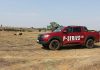
Our launch drive from Oudtshoorn to Calitzdorp in the Western Cape showed the 2,3ℓ petrol engine to be a smooth alternative to a diesel. Acceleration is impressive, and the 10-speed box, which has been continuously refined since its introduction in the previous-generation Ranger, is well-behaved and contributes to a sporty driving feel.
It’s always hard to accurately judge fuel consumption during a launch drive. We averaged around 11ℓ/100km on stretches of open road at an average speed of no more than 100km/h.
What’s the verdict?
With diesel prices where they are at present, Ford’s timing in introducing the 2,3ℓ is perfect. While diesel engines are traditionally more fuel efficient, the 2,3ℓ Ranger is likely to deliver figures similar to some thirstier diesel derivatives, making a petrol option increasingly viable. For the time being, anyway.
Double-cap pricing
XL 2ℓ SiT 6MT 4×2 R621 000
XL 2ℓ SiT 10AT 4×2 R651 500
XL 2ℓ SiT 6MT 4×4 R704 000
XL 2ℓ SiT 10AT 4×4 R735 000
XLT 2ℓ SiT 10AT 4×2 R699 500
XLT 2ℓ SiT 10AT 4×4 R788 500
Sport 2,3ℓ 10AT 4×2 R839 600
Wildtrak 2,3ℓ 10AT 4×2 R899 000
Sport 3ℓ V6 10AT 4×2 R995 000
Tremor 3ℓ V6 10AT 4×4 R1 039 000
Wildtrak 3ℓ V6 10AT 4×4 R1 070 000
Platinum 3ℓ V6 10AT 4×4 R1 179 500
Raptor 3ℓ V6 Twin R 1 299 000
Pricing includes a four-year/120 000km warranty and six-year/90 000km service plan.