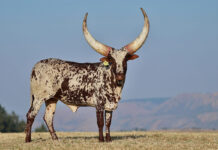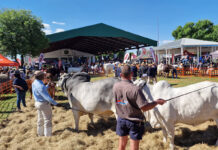

Lot 8, Q 210011 HH, known as Mucho, topped the sale at R120 000.
Lochner Eksteen of Exsteen Ngunis, one of the main sellers and host of the auction, said buyers appeared increasingly selective about the breeding animals on which they were prepared to spend money.
“Buyers are no longer simply buying and taking a chance. That is a trend I am seeing,” Eksteen said.
Mucho’s catalogue figures reflected above-average genetic merit for several production traits. His direct weaning estimated breeding value (EBV) was 117, his maternal weaning EBV was 113, his post-weaning growth EBV was 114, and his cow-fertility EBV was 111.
His maternal record also stood out. His dam had produced 10 calves, with nine recorded at weaning, and had an average inter-calving period of 371 days.
“Bulls with a good story, strong maternal lines, and a proven record, including bulls already used by breeders, fetched good money,” Eksteen said.
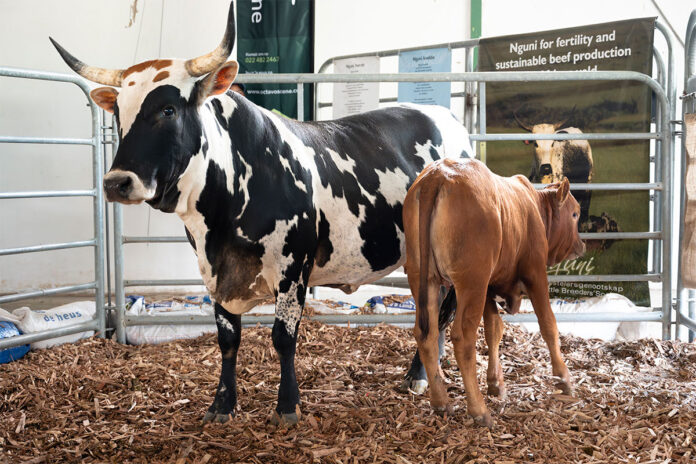
The same preference for proven reproductive value was evident among the female offering. Five Regainer 3-in-1 females averaged R43 200, with the highest-priced animal selling for R47 000. Seven cow-and-calf units averaged R35 142 and reached a top price of R57 000, while nine pregnant heifers averaged R22 111.
The R57 000 top-priced cow-and-calf unit, Lot 15, EX 220231, was a four-and-a-half-year-old cow with her fourth calf at foot. Her catalogue recorded an age at first calving of 16 months, together with EBVs of 145 for heifer fertility, 111 for cow fertility, and 114 for longevity.
The R47 000 3-in-1, Lot 7, EX 240059, first calved at 22 months and had a maternal weaning EBV of 125 and a cow-fertility EBV of 115. She was offered with a female calf at foot and was recorded as one month pregnant.
Among the Western Cape Nguni Club stud offering, three bulls averaged R45 666 and reached R55 000, while seven 3-in-1 females averaged R40 571 and topped at R49 000. In the commercial section, 11 cow-and-calf units averaged R17 454, and 24 open heifers averaged R9 937.
Eksteen said he believed the breed’s fertility and ability to perform under extensive conditions were becoming increasingly relevant as producers faced economic pressure and greater climatic variability.
“I think demand for Ngunis is growing. I think it is a breed that has already proved itself in parts of the country,” he said.
The focus on maintaining productive cattle continued during a technical presentation by Dr Bronwen Martin of MSD Animal Health, who highlighted liver fluke as a potentially hidden drain on cattle performance.
“Your liver is your engine. Without the engine, nothing else can function in your cow,” Martin said.
She explained that immature liver flukes migrate through the liver before maturing in the bile ducts, causing tissue damage and eventual fibrosis or scarring. Losses may include poorer growth and reproductive performance even in the absence of obvious clinical disease.
“You’re not going to see many dead animals. It’s this massive production drain that we see,” she said.
Martin said freshwater snails form an essential part of the parasite’s life cycle, making wet areas, poorly drained ground, and leaking water infrastructure important areas to monitor.
“By controlling these snails, or knowing their habitats and knowing where they are, it’s an important part of the management of the liver fluke itself,” she said.