
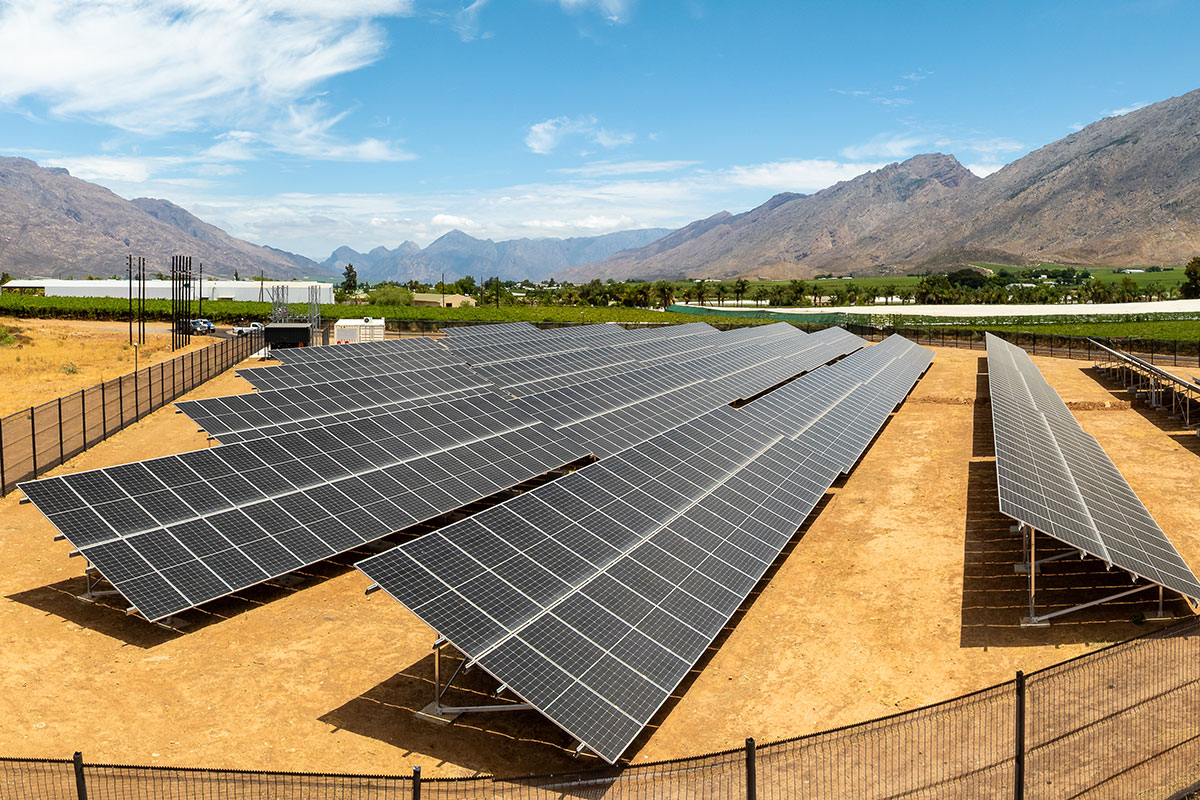
Last year, table grape exporter Mooigezicht Estates in the Hex River Valley of the Western Cape took a major step towards energy independence by installing a large-scale solar system to cut electricity costs and reduce its environmental footprint.
The plant, designed and implemented by 2Zero50, includes 1 152 solar panels delivering 691,2kWp, backed by 100 lithium-ion batteries with 1 433,6kWh of storage.
At its heart is a containerised unit housing two 500 kW hybrid inverters, which convert solar energy into usable electricity and integrate seamlessly with the batteries, the grid, and backup generators.
The system was designed to meet most of Mooigezicht’s electricity demand, which has a theoretical peak of 950kW and an expected real peak of around 670kW. To carry power across five of the farm’s 10 production units, 11km of medium-voltage (MV) line was installed, feeding 18 step-down transformers and forming a private microgrid.
Resilience and design
Reducing reliance on the national grid was a key goal. Mooigezicht cut the number of Eskom connection points from 20 to a single 315kVA connection, which now serves as backup when solar production is insufficient.
Two diesel generators, rated at 500kVA and 250kVA, provide additional backup. One generator starts if battery reserves run low and the Eskom connection cannot carry the full load, while both start automatically in the rare event of a total system failure.
Power management along the MV network was carefully engineered. Energising 18 transformers simultaneously can create high inrush currents, so MV reclosers bring the network online in stages, starting with the step-up transformer and continuing through the line.
This staged approach protects infrastructure and allows the network to run entirely on generators if necessary. The result, according to 2Zero50, is a stable, reliable electricity supply that significantly reduces reliance on the national grid.
Living with the microgrid
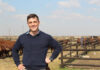
Francois Rossouw, director and production manager at Mooigezicht, says the system has performed largely as expected since it went into operation in November last year. “It is still early days, but so far, we haven’t experienced any major glitches or hiccups, and we are happy with the system, the service and the structuring of the project. Our energy generation calculations have also proved fairly accurate.”
At the time of writing, the farm was in peak production season, traditionally its period of highest electricity demand. Rossouw expects the winter off-season to place far less pressure on the system and potentially allow electricity to be fed back into the grid.
Currently, the system is being used to supply electricity to packing facilities and orchards for irrigation, as well as worker houses on one of the production units. Plans are to extend power to worker housing on the four other production units after a year of monitoring.
Together housing on these five farms represent two-thirds of Mooigezicht’s 340 farmworker houses.

Strategic partnerships
Rossouw emphasises that the decision to invest in solar followed a lengthy and considered process. “We spent more than three years researching different options and consulting experts on the system design. One of the key challenges was the complexity added to financial modelling due to seasonal production.”
Choosing a reputable, long-term partner was critical. “This is a large, customised system built around our specific needs. You want a company that won’t disappear after commissioning, but will assist with fine-tuning, maintenance and repairs as required. Our local electricians won’t be able to work on this system, as it requires specialised knowledge that only the service provider can assist with,” he says.
Mooigezicht ultimately partnered with 2Zero50, whose presented the best fit to their needs and whose role extended well beyond installation. “They assisted us with Eskom-related processes, including the closing of multiple accounts, which is often underestimated,” Rossouw explains.
The company also monitors the system remotely from Paarl, often identifying and addressing issues before Rossouw is aware of them, and consulting with the manufacturer in China to refine programmes and operations.
The remote monitoring service is included in the first-year sales package, after which Mooigezicht can renew the contract.
Financing
The team considered power purchase agreements (PPAs), under which a third party would build, own and maintain the system while Mooigezicht purchased the electricity generated. In the end, however, they chose to finance the project through their existing bank.
“We wanted the system to remain ours, without long-term contractual obligations to a third party,” Rossouw explains.
He adds that banks are generally positive about solar investments. “As long as the system generates electricity, it is producing value. Banks view this more favourably than capital projects that must be repaid purely from operational profits.”
While there are no direct government subsidies for farmers investing in solar, tax allowances have improved project feasibility. Up until 28 February 2025, producers could write off 125% of the investment in the first year. Thereafter, this reverted to a 100% first-year write-off. By comparison, most other capital investments depreciate over three years.
Mooigezicht is also selling carbon credits generated thanks to the solar system to offset costs. “Carbon credits won’t generate large amounts of income, but over the long term it should make a difference,” says Rossouw.
Financial and operational benefits
According to Mooigezicht’s calculations, the first year is the most expensive, after which the system begins to deliver a return. The project should pay for itself within four to five years, depending on Eskom tariff increases.
Electricity quality is another key benefit. Grid power in the Hex River Valley is often unstable during peak season, while the microgrid produces cleaner, more consistent electricity, protecting equipment and machinery from surges, including those linked to load-shedding.
The largest saving to date came from reducing Eskom connection points from 20 to one, eliminating substantial fixed costs. The system also allows electricity use to be monitored accurately, enabling the farm to draw power from Eskom more strategically and avoid peak tariff periods.
While the shift has not yet translated into a direct market advantage, it strengthens the farm’s environmental performance within broader ESG considerations.
Rossouw notes that pressure to comply with ESG standards is increasing across agricultural value chains, particularly from retailers.
“As these requirements become more formalised, systems like this will become a real advantage. European retailers are already paying closer attention to carbon footprints and energy use, and that pressure will increasingly reach producers.”
Future plans
For Rossouw, the shift to solar was never just a financial decision. It forms part of a broader drive to make Mooigezicht more self-reliant, reduce pressure on the national grid and farm in a way that is more environmentally responsible.
Crucially, the system was designed with the future in mind. Capacity can be scaled as needs grow, whether that means replacing farm bakkies with electric motorbikes charged directly from solar power, or further down the line, electrifying heavier machinery such as tractors, with several Chinese electric models already being trialled.
“We didn’t want to build something that only solves today’s problem,” Rossouw says. “This system gives us options. It allows us to adapt as technology changes, as costs shift, and as expectations around sustainability increase.”
He adds that the project has already changed how the business thinks about energy. “Once you take control of your own electricity, you start seeing it as part of your farming system, not just another input cost.”