
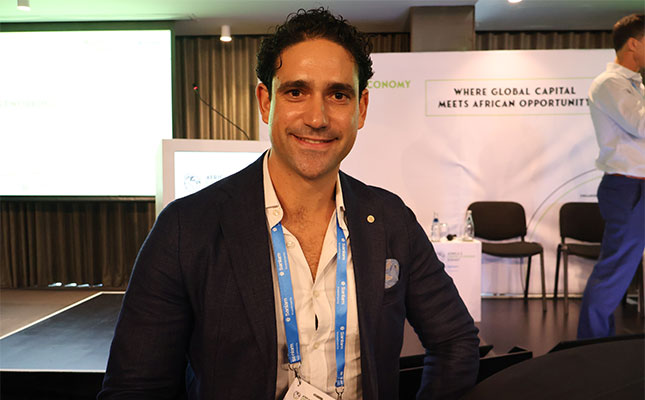
“If you’re not using technology to measure your conservation impact, you’re falling behind,” Marios Michaelides, director of the AMES Habitat Fund, warned in a panel discussion ahead of the Africa’s Green Economy Summit 2026, held in Cape Town earlier this year.
This tech-driven approach underpins every move made by the Germany-based Africa’s Most Endangered Species (AMES) Foundation. It aims to protect one million hectares in Southern Africa by 2035 by using technology in its conservation and investment activities.
The foundation is currently protecting two biodiversity hotspots in South Africa: the 7 500ha Mkambati Nature Reserve on the Eastern Cape’s Wild Coast, and 2 000ha in Limpopo’s Waterberg region. Two more are in the pipeline: 12 000ha north of Hluhluwe in KwaZulu-Natal, and 16 000ha in the Kalahari.
South African-born and an engineer by training, Michaelides is based in Sweden as part of a team of nine people who are looking for sustainable ways to finance their conservation projects.
“We are trying to find entrepreneurial solutions to conservation. We have a mission of making nature profitable and scalable. Because we are such a dynamic group, and we have strong financial backing, we are able to think outside the box and be a little more agile than most,” he told Farmer’s Weekly after the discussion.
Three tech pillars
The AMES model is built on three key tech pillars: carbon credits, blockchain-powered securities, and technology that measures their impact on the ground.
“We’re essentially turning nature into something investable,” Michaelides explained.
“We secure land, protect biodiversity, and then develop business models to finance the reserves in the long term. That allows us to deliver returns for our investors and move on to the next project.”
Carbon credits
The foundation layers returns generated by nature-positive businesses, such as ecotourism, with returns from carbon credits.
This dual-income model is already in play at Mkambati Reserve, which is collectively owned by seven villages via the Mkambati Land Trust.
“First, we have a high-end lodge that delivers fantastic returns. GweGwe Beach Lodge is built on the northern concession of the reserve and, alongside creating jobs and developing skills in the neighbouring villages, it also shares profits with the community. This means that as nature benefits, so does the community,” Michaelides said.

The second revenue stream is carbon credits generated through grassland rehabilitation, earning Verra VM42 accreditation.
“The grasslands are burnt and overgrazed. We will manage grazing better, stop the over-burning, and improve soil carbon sequestration, from which we can generate carbon credits,” Michaelides explained.
The carbon credits will finance AMES’s immediate biodiversity goal of doubling the reserve to 17 000ha and protecting up to 100 000ha in the Pondoland Centre of Endemism. The Maputaland-Pondoland-Albany biodiversity hotspot, which stretches along the eastern coastline, is one of the three recognised biodiversity hotspots in South Africa.
AMES is also pioneering the development of biodiversity credits alongside the Landbanking Group, a move that could revolutionise how conservation is financed going forward.
“A biodiversity credit is just a robust way of measuring our nature improvements. It dissects a healthy ecosystem into all of its components, from plants to animals and soil health.
“If indicator species are present and recovering across trophic layers, we can demonstrate that we are achieving our conservation goals,” Michaelides said.
The credit framework introduces verification and auditing, which adds accountability for investors.
“Conservation is all about cash flow. You need cash to invest in communities and biodiversity. And you need transparency and measurability to attract investors. Tech gives us that,” he added.
Blockchain-powered securities
To attract investors, AMES set up the AMES Habitat Fund, an investment model built on new blockchain technology. The blockchain functions as a secure, transparent ledger. It reduces administrative costs, simplifies cross-border investment, and allows investors to participate in equity-like conservation products without having to navigate complex tax and legal structures in South Africa.
“Digital security was a game-changer for us. Historically, setting up funds was expensive and complicated. This prevented smaller conservation projects from accessing capital.
“Financial technology makes it leaner and cheaper to bring projects to market,” Michaelides said.
For European investors, this digital structure provides regulatory security and transparency.
For AMES, it opens access to a group of like-minded investors with a passion for wildlife preservation but who also want to see a return on their investment.
Tech on the ground and in the sky
The use of technology helps AMES demonstrate the impact of its work. Satellite surveillance monitors vegetation changes and land use, while drones assist in the fight against poaching. On the ground, artificial intelligence-enabled camera traps track wildlife and detect human intrusion, while antipoaching units are equipped with modern monitoring tools.
“Data is incredibly valuable for conservation. It strengthens management, adds layers of transparency and accountability, and allows us to demonstrate our impact to third-party auditors. We compile it all and use this data to share the story of our success,” Michaelides added.
AMES’s story has convinced a community of investors in Germany and Switzerland to go on a pioneering adventure with the foundation. In return for their annual contribution, each member receives access to a unique network and the opportunity to visit the AMES reserves in South Africa.
“It’s not easy to incentivise people to invest in nature, even when the goal is as compelling as biodiversity conservation,” Michaelides said.
“Despite these conservation projects having an enormous impact, investors will assess any investment on the financial returns it generates. Therefore, we need to be innovative to ensure that nature can be investable and continue to attract the kind of capital we need to protect it.
“We have built an incredible community that challenges the status quo and has allowed us to develop a new way to invest in nature.”
For more information email Marios Michaelides at [email protected], or visit ames-foundation.com.