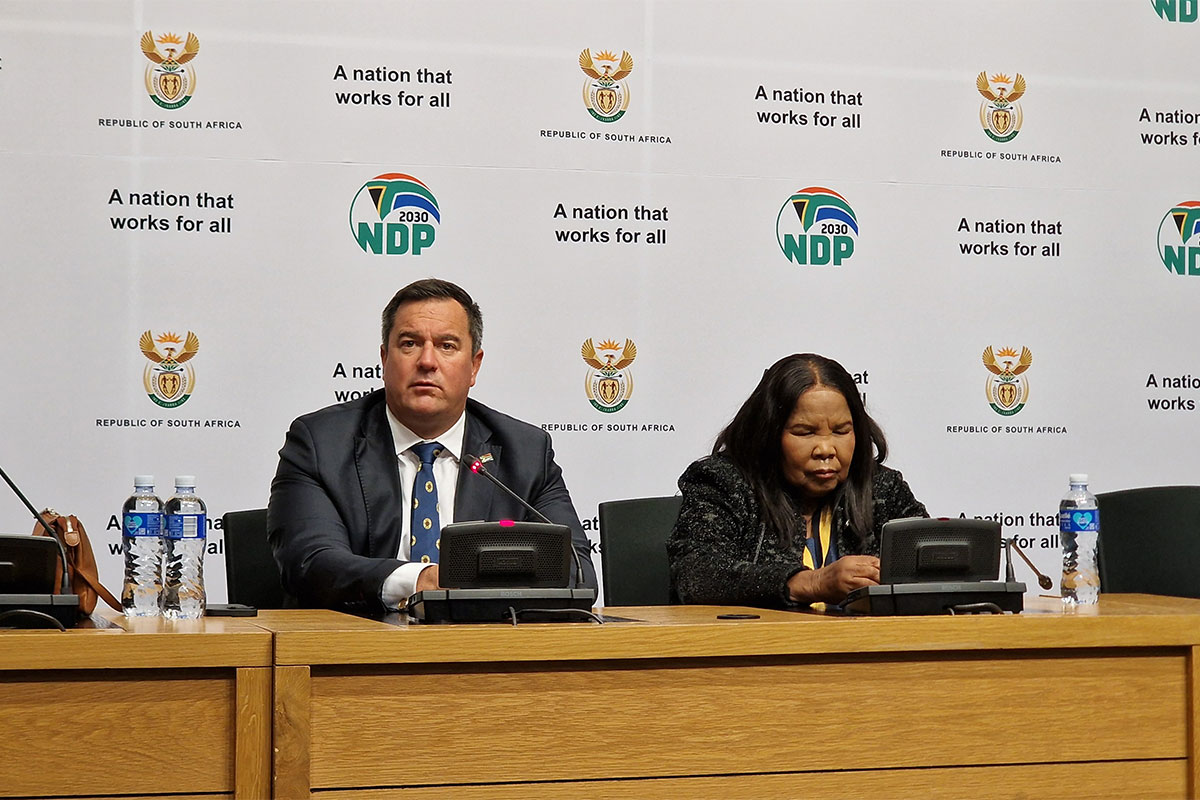
Steenhuisen positioned agriculture as central to South Africa’s economic growth, backed by strong recent performance.
“Agriculture must sit at the centre of our economic strategy, not at its margins. Across the value chain, the sector supports nearly 950 000 jobs and contributes about 14% of [South Africa’s total] economic activity,” he said during the tabling.
At the core of the biosecurity spending strategy is a shift towards domestic manufacturing capacity for foot-and-mouth disease (FMD) vaccines, led by the Agricultural Research Council (ARC), alongside expanded vaccination campaigns in affected provinces.
The ARC has already started producing hundreds of thousands of FMD vaccine doses using its upgraded mid-scale production system. This is being further expanded through new infrastructure, including the procurement of a 1 000ℓ fermenter, which is expected to increase output to around 960 000 doses per production cycle.
Steenhuisen said additional capacity expansion at these production facilities is already under way.
“This marks a deliberate expansion of local manufacturing capacity,” he said, adding that the rollout is aimed at strengthening long-term national resilience rather than relying on short-term emergency supply procured internationally.
The vaccine drive is supported by multiple budget streams, with R2,5 billion allocated to Programme Two, which includes biosecurity, research, and natural resources. A further R120 million is ring-fenced for FMD response through the Comprehensive Agricultural Support Programme (CASP).
Steenhuisen said the aim is to contain outbreaks and “stabilise export markets, especially for red meat and livestock products”.
Capa highlighted key interventions, including “reviving the dipping tank culture and infrastructure in communal areas, animal identification and branding systems to improve traceability, and stronger collaboration with traditional leaders and municipalities”.
Growing exports through market expansion
Exports remain a key growth driver, with shipments reaching R268,7 billion in the fourth quarter of 2025, up 9% year-on-year, Steenhuisen noted.
He said government continues to prioritise market expansion, supported by a R924 million allocation to Programme Four, which covers economic development, trade, and marketing.
This funding is aimed at opening and servicing export markets, addressing tariff and non-tariff barriers, and integrating more producers into higher-value trade.
“Recent gains include expanded citrus access to China, the entry of South African [into China] stone fruit under a multivariety protocol, the first table grape shipments to the Philippines, and strengthened agreements with Vietnam,” Steenhuisen said.
He emphasised that diversification is critical in a volatile global environment: “A diversified export footprint is not a luxury, it is a necessity.”
At the same time, he stressed that the policy focus is shifting beyond simply opening markets.
“The question before us is whether the benefits of market access flow through the entire value chain, from the exporter to the emerging farmer.”
Increased support for black farmers
Transformation remains a central theme of the budget, with the Agriculture and Agro-processing Master Plan positioned as the main delivery vehicle.
While the share of value generated by black participants in commercial agriculture has increased from 11% to 13% in recent years, progress remains uneven and concentrated in high-value industries such as horticulture.
“The challenge now is to move from incremental progress to meaningful scale,” Steenhuisen said, warning that growth without inclusion will not be sustainable.
Capa underscored this by highlighting targets to expand participation across commodities by 2030, including increasing black participation in grain production to 20% and fruit to 10%.
“We are committed to mainstreaming women, youth, and persons with disabilities in the agriculture sector,” she said.
The largest allocation goes to Programme Three, food security and support, which receives R3,2 billion.
Through CASP, R2,3 billion of this allocation will support approximately 33 000 black producers, with plans to bring 40 000ha into production and assist 58 000 households with food gardens by 2030.
“Without basic finance, the dream of becoming a farmer would die for many,” Capa said.
Steenhuisen added that the blended finance scheme continues to scale, with R9,8 billion approved since its inception in 2021 to support 627 black commercial deciduous fruit producers.
A key shift in the budget is the move towards modernising extension services through digital tools. Government is developing a hybrid extension model that combines traditional on-the-ground support with digital platforms to provide real-time information on weather, pests, input use, and market opportunities.
“We are exploring a hybrid model that expands reach and enables real-time support,” Steenhuisen said.
He added that the aim is not to replace extension officers but to enhance their effectiveness. This comes alongside R306 million allocated over the medium term to expand frontline extension capacity, including the deployment of assistant agricultural practitioners, with 370 already in place to assist farmers.