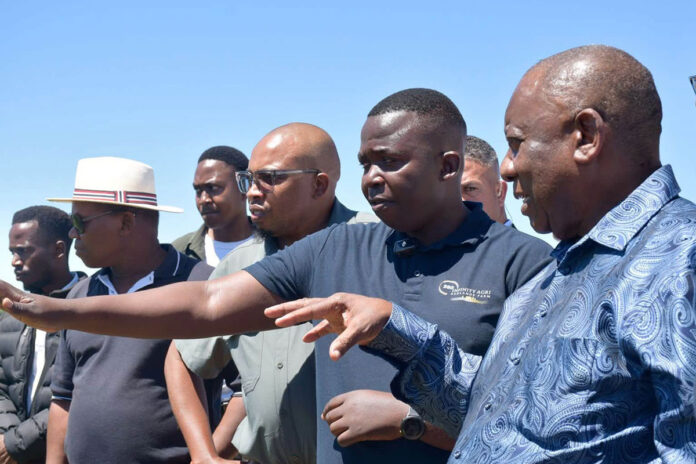
During a visit to Redlands Dairy Farm (Redlands) in Stutterheim, Eastern Cape, on 8 October, Ramaphosa pointed to the black- and youth-owned enterprise as an example of what financial support could achieve, despite the challenges posed by the high cost of entering the dairy industry, foot-and-mouth disease (FMD), and inadequate rural infrastructure.
The president said that Redlands, owned by 38-year-old Tshilidzi Matshidzula and his wife, Adivhano, demonstrated how young black farmers could establish successful commercial enterprises when given access to finance and the necessary skills.
The farm has benefitted from funding via the Blended Finance Scheme (BFS), implemented by Land Bank in collaboration with the Department of Agriculture (DoA).
“What we have seen is really outstanding: two young people, a couple, all the way from Limpopo, performing extremely well in dairy farming here in the Eastern Cape,” Ramaphosa said.
He added that the couple had demonstrated determination in building their business, and that their achievements provided a model for other young farmers.
“They are a model team of young farmers who we want to see replicated around the country,” Ramaphosa.
According to the president, Redlands produces about 8 000ℓ of milk a day from almost 500 cows. The operation also grows its own grass for feed.
He said the enterprise’s success demonstrated the role that development finance institutions, commercial banks, and established farmers could play in supporting emerging producers.
“We would also like more established farmers to come to the assistance of emerging farmers such as these,” Ramaphosa added.
Access to finance remains a barrier
For Matshidzula, however, establishing a commercial dairy operation has been a long journey, with foundational work beginning in 2007.
He said the farm started with limited resources and required substantial work before it could become the operation it is today.
“We started pretty much with nothing. We started with a farm that needed a lot of work to be done with very little resources,” Matshidzula said.
He credited Land Bank’s support with helping his business grow, but said that accessing finance from commercial banks and other institutions had been one of the challenges along the way.
“With the work that has been done with Land Bank, we were able to build from where we were.”
Matshidzula added that the capital required to enter commercial dairy farming remained a significant obstacle for prospective farmers.
“If you look at where we are as an industry now, we’re talking about between R90 000 and R120 000 [per cow], and I’m sure in some instances, it’s even higher,” he said.
According to Matshidzula, while some emerging producers had managed to start small and grow their operations, moving into commercial production remained difficult because of the investment required.
His experience reflects the challenges facing emerging farmers, who need substantial capital to acquire livestock, establish infrastructure, and expand production.
Ramaphosa acknowledged the need for broader access to agricultural finance and called on commercial banks to reconsider their lending restrictions.
“Commercial banks are swimming in money, and we want them to ease their restrictions and allow emerging farmers to be able to get funding on a competitive basis but also on a basis that supports transformation,” he explained.
He added that government would continue to make funding available to Land Bank as the bank’s financial position stabilised, although further support would depend on the country’s fiscal position.
According to information provided to the media ahead of Ramaphosa’s visit, Land Bank disbursed more than R1,7 billion during the previous financial year, including approximately R700 million through the BFS.
The bank administers several funding instruments in collaboration with the DoA: the BFS, the AgriBEE Fund, and the Agro Energy Fund.
FMD outbreak puts pressure on production
Ramaphosa’s visit also highlighted the impact of FMD on livestock farming, with both the president and Matshidzula calling the outbreak a “major challenge” for Redlands.
“The recent outbreak of foot-and-mouth [disease] almost put us down on our knees,” Matshidzula said.
Ramaphosa added that the disease had affected the farm’s production, which had fallen to 35% of its normal level, and resulted in the loss of cattle. The farm had since recovered.
Poor roads affect farmers’ access to markets
Infrastructure was another concern raised during the visit, with Ramaphosa acknowledging that poor gravel roads continued to affect farming operations.
He said road conditions became particularly challenging after rainfall, making it difficult for farmers to transport products to processing facilities and markets.
“The gravel road is a challenge. It’s more of a challenge for farms like Redlands, which have to produce a product that must go to processing centres quickly and then to market,” the president added.
He warned that poor road conditions could affect production, employment, and the availability of agricultural products.
Ramaphosa said government needed to consider alternative road construction technologies, noting that building tarred roads was expensive.
Eastern Cape wants to develop more young farmers
Eastern Cape MEC for Agriculture Nonceba Kontsiwe welcomed the Ramaphosa’s visit, saying the provincial Department of Agriculture (the department) wanted to support more young people to establish productive agricultural businesses.
“The Eastern Cape is encouraged by the president’s visit to the province. The department is looking to incubate more young people to drive productivity in the province,” Kontsiwe told Farmer’s Weekly.
She said Redlands provided an example of what could be achieved through support for youth-owned agricultural enterprises.
“The youth-owned business at Redlands is a great example and good model of what can be achieved. We support the president’s sentiments that we should replicate what is happening at that business and create more [people like] Tshilidzi,” she said.
Ramaphosa said young people should be encouraged to acquire the skills needed to enter different industries in the sector, including dairy, beef, sheep, and goat production.