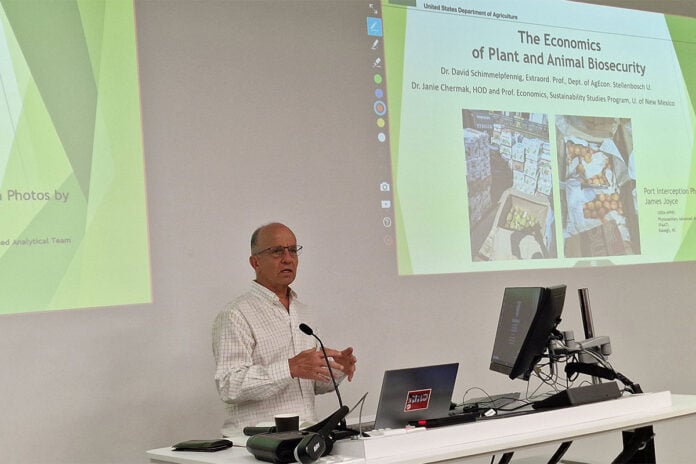
On 30 October, Schimmelpfennig delivered a lecture on the economics of plant and animal biosecurity at Stellenbosch University (SU), where he is an extraordinary professor in SU’s Department of Agricultural Economics.
According to him, South Africa needs to use data more effectively to stay ahead of costly biosecurity threats.
“We’re looking for a proactive rather than a reactive command response,” Schimmelpfennig said.
The former director of advanced analytics at the US Department of Agriculture’s Animal and Plant Health Inspection Service warned that early action was crucial to preventing invasive pests from becoming established.
Schimmelpfennig’s warning is particularly timely as South Africa battles widespread foot-and-mouth disease outbreaks and authorities work to contain a confirmed African horse sickness (AHS) case near Clanwilliam.
The AHS case has placed renewed focus on surveillance and control measures needed to protect the Western Cape’s internationally important disease-free zone.
At the same time, invasive and quarantine pests continue to threaten fruit production and are closely monitored in export markets.
Schimmelpfennig said traditional biosecurity controls often involved randomly testing imported consignments, detecting a pest and then suspending the affected imports while authorities investigated the source.
“With increased trade, higher infestations are coming from novel pathways,” he noted.
Schimmelpfennig advised that inspection records, statistical models, as well as environmental and geographic information systems could instead help authorities identify high-risk commodities, trade routes, and operators before an incursion developed into a costly outbreak.
“Can we go further and try to predict the next invasive species or pest before it happens?” he asked.
Lanternfly arrived on shipments from Asia into US
Schimmelpfennig used the spread of the spotted lanternfly (Lycorma delicatula) in the US to illustrate how invasive pests could arrive through unexpected pathways.
The insect entered the US on shipments of structural stone or slate from Asia, rather than on fruit or another agricultural commodity, and became established in Pennsylvania.
“Every time we drew a new line about the delimitation of the outside area of what the spotted lanternfly had been able to establish, we found out there were satellite populations that got further away,” he explained, adding that that pest could attach itself to railway wagons and move into new areas.
“Before you knew it, they were in the next state,” Schimmelpfennig said.
Target repeat offenders
Schimmelpfennig said risk-based sampling could direct limited inspection capacity towards companies and pathways with poor compliance records.
“If you’ve been bad in the past and sent us garbage that had pests in it, then we’d sample even more,” he said.
However, he warned that authorities should avoid unnecessarily delaying consistently compliant businesses.
“We didn’t want to penalise companies that had never sent us pests. So, we reduced the amount of sampling for those [companies], and we increased the amount of sampling that took place on companies that sent us infected goods,” Schimmelpfennig explained.
He added that the US had also stationed inspectors in important supplying countries, including Chile, to inspect certain products before export.
“It works quite well because we’re there, and if there’s a problem, we can address it before it gets put on a ship.”
Waiting creates a bigger problem
Delayed intervention by government authorities could change both the scale of an infestation and the most appropriate response, Schimmelpfennig noted.
“If you wait, the pest might increase the size of its population in the time you wait. So, what happens is you end up with a bigger problem than if you’d done something right away.”
He said a pest detected early might still be eradicated or contained, but once it was established, eradication could become too difficult or expensive.
“The optimal effort to control the invasive species may change depending on the population.”
In follow-up comments, Schimmelpfennig told Farmer’s Weekly that South Africa needed to adapt its safeguards to changing trade patterns and an expanding list of potential pests and diseases.
“Biosecurity must work with commodity trading and provide safeguarding in a trade-facilitated environment,” he said.
However, Schimmelpfennig cautioned that making information available did not necessarily mean it would be used by decision-makers.
“It just means it’s available for people to decide if they want to,” he said.