
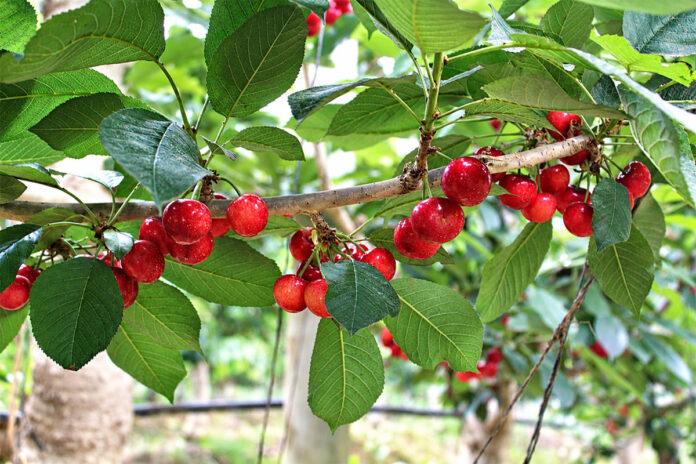
Karien Bezuidenhout, manager of Hortgro’s CherriesZA, told Farmer’s Weekly that the industry had enjoyed an excellent 2025/26 season, with production increasing by 111% compared with 2024/25. However, weather conditions had created a less favourable outlook for the current season.
“Both the northern production regions and the Western Cape started harvesting earlier than usual. Heatwaves followed by cold fronts also negatively affected fruit set, while fruit quality has not been as good as we would have liked. We are concerned that shelf life could be shorter than usual,” she said.
Bezuidenhout said that although production was expected to increase over the coming years as younger orchards matured, the industry was unlikely to repeat the previous season’s exceptional growth. She added that approximately 30% of South Africa’s cherry orchards were not yet in full production.
Export window under pressure
Clive Garrett, marketing manager at ZZ2, which produces cherries in northern South Africa, said the company had experienced a reasonable season, although results had fallen short of expectations.
ZZ2 was among the earliest South African producers to supply cherries to international markets, but unusually early harvests elsewhere had reduced its traditional marketing advantage.
“The Western Cape started harvesting earlier than usual, which meant we faced competition from southern producers sooner than expected. Chile also entered the market earlier, so we lost some of the window we would normally have had,” Garrett explained.
He added that ZZ2’s fruit quality had been good, with exports destined for the Middle East, Far East, EU, and UK.
All the company’s cherries are transported by air, including shipments to the United Arab Emirates and Saudi Arabia. Garrett said these markets had not been disrupted by the Middle East conflict, although rising airfreight costs were putting pressure on profitability.
“Prices have remained largely unchanged from last year, but our input and freight costs have increased significantly. This is putting pressure on margins, particularly as there has been no corresponding increase in selling prices,” he said.
Despite these challenges, Garrett said international demand remained strong.
Access to China comes too late for northern SA growers
The opening of the Chinese market was a significant development for the industry, following the signing of a market access protocol on 8 September 2026.
However, outstanding administrative processes between the South African and Chinese governments have prevented exporters from shipping fruit to the country.
Garrett said ZZ2 had started harvesting in early October, expecting the market to be operational.
“We had around six importers lined up to take our cherries, so the demand was certainly there. Had the market opened in time, we could have entered China ahead of Chile,” he said.
With producers in the northern parts of South Africa expected to finish harvesting by the end of October, Garrett considered it unlikely that they would benefit from Chinese access this season.
Bezuidenhout said Western Cape producers could still have an opportunity, provided the outstanding processes were finalised in time.
“However, exporters will have to consider shipping costs and competition from Chile before committing fruit to that market.
“Our advantage is that our harvest starts slightly earlier than Chile’s, but once [Chile’s] volumes reach the market, South Africa’s production will be very small in comparison,” she explained.
Bezuidenhout added that South Africa’s cherries had excellent eating quality, while the later arrival of Chilean sea freight shipments in Europe created an opportunity for local exporters. However, congestion and delays at Cape Town harbour, together with escalating costs associated with the Middle East conflict, remained concerns.
According to a Hortgro’s Key Deciduous Fruit Statistics 2025 report released in September, South Africa had 802ha under cherries in 2025, of which 352ha were in Ceres in the Western Cape.
The report states that, of the 3 306t of cherries produced during 2024/25, 33% were exported, 57% were supplied to the domestic market, and 9% were processed. The UK accounted for 60% of exports, followed by the EU at 18%, the Middle East at 12%, and the Far East and Asia at 9%.
Garrett remained optimistic about the industry’s longer-term prospects, particularly the opportunities presented by China. However, he said orchard expansion was likely to remain gradual because of high establishment costs and the technical expertise required to produce cherries successfully.
“Cherries are a difficult crop to manage, with a steep learning curve. We’re seeing existing producers expand gradually rather than large numbers of new entrants. But the potential is there, and China will give us another market through which to spread our risk,” he said.