

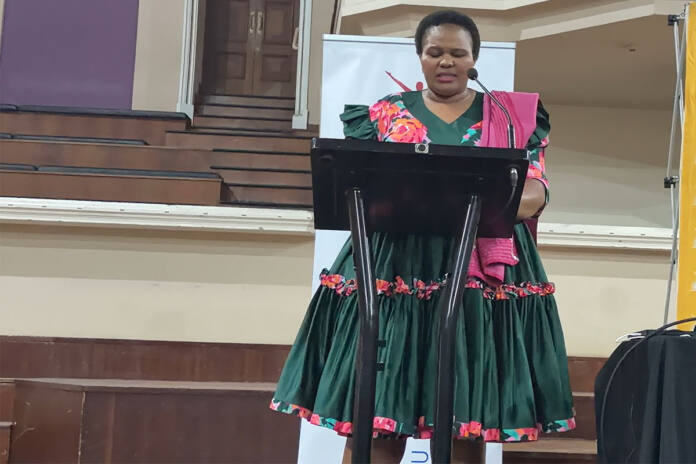
The summit brought together government departments, development agencies, financial institutions, agricultural organisations, and private sector stakeholders to connect the youth with resources aimed at supporting their participation in the agricultural economy.
Addressing delegates, Nelson Mandela Bay Executive Mayor Babalwa Lobishe said about 2 000 young people had benefitted from municipal economic development programmes during the previous financial year, with youth-focused initiatives accounting for a significant share of the municipality’s support.
The municipality has also allocated R4 million for agricultural equipment and facilities, while a partnership with the Eastern Cape Department of Agriculture has resulted in equipment valued at R8 million being made available to farmers.
Lobishe added that the municipality is focused on achieving measurable outcomes through its agricultural support programmes and ensuring that resources reach the intended beneficiaries.
Access to land and infrastructure
Access to land was a key topic of the summit, particularly for young people seeking to establish or expand farming enterprises.
Lobishe said the municipality is connecting government departments to secure unused properties that could be repurposed for agricultural production and leased to emerging farmers.
“We are currently engaging the [provincial] Department of Public Works to [identify] vacant schools so that we can repurpose them and make the land available for long-term leasing for [young people’s] businesses to thrive there,” she said.
Municipal officials added that the initiative forms part of broader efforts to unlock underutilised assets and create opportunities for agricultural development in Nelson Mandela Bay.
Support beyond land ownership
Nelson Mandela Bay MMC for Economic Development, Tourism and Agriculture Bassie Kamana said access to land alone will not guarantee success in agriculture, adding that young farmers also require support services, finance, and market access.
The summit, therefore, focused on connecting participants with institutions and organisations that could assist with funding, training, and enterprise development.
“Today is not merely about speeches. It is about creating practical opportunities. It is about introducing young people to funding institutions. It is about exposing young farmers to support programmes. It is about building agricultural networks and sharing knowledge,” Kamana said.
Agriculture’s role in economic growth
Speakers at the summit described agriculture as a sector capable of addressing unemployment, food insecurity, and inequality while creating opportunities for entrepreneurship.
Kamana said young people should see agriculture as more than primary production and recognise the opportunities available throughout the agricultural value chain.
“The future of agriculture belongs to those who are prepared to innovate. The future belongs to those who can combine technology with production. The future belongs to those who can create value beyond the farm gate,” he concluded.