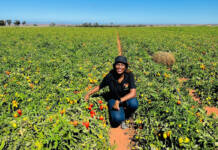

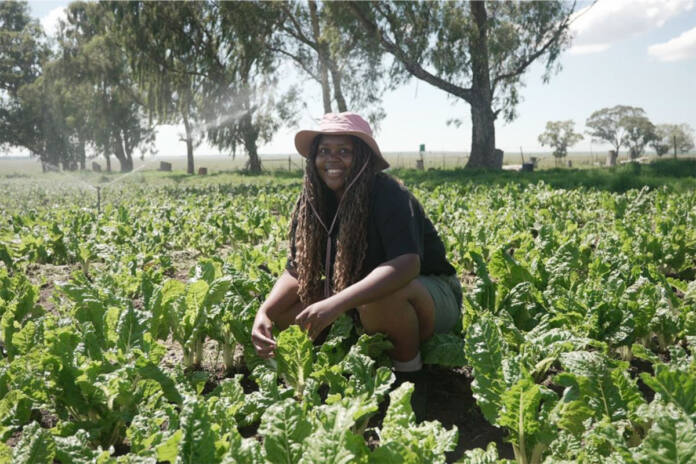
At just 25, Lesego Mpho Mohube is part of a new generation of South African farmers who are reshaping the image of agriculture, not as a fall-back career, but as a deliberate, strategic business choice.
Operating near Heidelberg in Gauteng, Mohube has, in fewer than three years, moved from student to commercial producer, building a vegetable enterprise grounded in precision, planning, and market alignment.
Her journey into agriculture was not linear. After completing matric, she spent two years uncertain about her direction.
“I wasn’t even an applicant at first,” she recalls of her entry into the Potchefstroom College of Agriculture in 2022. With assistance from a mentor, she secured a place, an opportunity that would define her career trajectory.
That initial exposure quickly evolved into intent. Through short courses with AFGRI and engagement with African Farmers’ Association of South Africa North West structures, Mohube began to understand agriculture not just as production, but as a system of inputs, markets, and relationships.
By her third year, she had already made a strategic decision: she would not leave college without starting a business.
“I realised most of my peers had a plan. That pushed me to not only learn, but to start something,” she says.
Starting with a single tunnel
Mohube’s entry into farming was modest. During her work-integrated learning phase in 2024, she gained exposure to potato production in the Eastern Cape before returning to Gauteng, where a landowner provided her with access to a single tunnel. That tunnel became her first production unit, and the seed of a broader enterprise.
Using bursary funds to procure seedlings and inputs, she began producing vegetables for the Johannesburg Fresh Produce Market. With mentorship support and a developing relationship with market agents, her production expanded rapidly.
Within a year, she had scaled from tunnel production to leasing 5ha of land under a 50/50 arrangement.
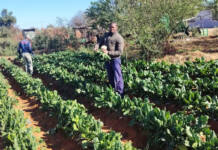
Today, Mohube produces a diversified range of vegetables, including tomatoes, green peppers, carrots, onions, spinach, cabbage, potatoes, lettuce, and herbs. Her operation employs four permanent workers and runs year-round production cycles.
Precision over expansion
Mohube describes her model as “precision-driven and market-oriented”. In practical terms, this translates into disciplined input management and tightly controlled production cycles.
She places strong emphasis on soil testing, correct fertiliser application, and timing, ensuring that planting aligns with market demand windows rather than simply seasonal norms. Crops are washed, graded, and prepared to meet higher-value market standards, even though she currently sells through market agents rather than directly to retailers.
A key component of her system is staggered production. Instead of planting entire fields at once, Mohube sequences planting to ensure continuous harvesting and supply. This allows her to maintain a presence in the market over extended periods, an advantage that many small-scale producers struggle to achieve.
“The goal is consistency. If you can supply continuously, you become reliable. That changes how the market sees you,” she explains.
The results have been tangible: improved yields, reduced pest and disease pressure, better crop uniformity, and lower labour intensity.
Critically, the business has reached a point where it is self-funding, with expansion driven by reinvested income rather than external capital.
Navigating the fresh produce market
Mohube’s primary route to market is the Johannesburg Fresh Produce Market, where she sells through agents. While access to the market is straightforward, profitability is not guaranteed.
“The market can be a gamble,” she says. “When supply is high, prices drop, and with crops that don’t have a long shelf life, this can be a problem.”
To mitigate this, she has focused on building relationships with agents, ensuring better placement and faster movement of produce. Her production planning also takes market cycles into account, aiming to supply when demand is stronger.
This level of market awareness is unusual for a farmer at her stage and reflects a broader shift among younger producers towards integrated value chain thinking.
Growth ambitions
Despite her progress, Mohube’s business faces familiar constraints, chief among them access to land. Leasing provides a foothold but limits long-term security and investment.
“Not owning land is one of the biggest challenges,” she says. “You never know when a lease might change.”
Her growth plans are nevertheless ambitious. In the short term, she intends to expand production to include 3ha of tomatoes, 2ha of cabbage, 3ha of potatoes and 1ha of peppers in summer, followed by 5ha each of onions and carrots in winter.
Labour will scale accordingly, with plans to employ up to 20 permanent staff and incorporate agricultural graduates into the operation. Longer term, her vision includes owning land, investing in tunnel infrastructure, and supplying major retailers directly.
Within 10 years, she aims to be operating on between 50ha and 100ha, with a fully developed production system and integrated technology.
Lessons from the ground
If there is a consistent theme in Mohube’s experience, it is the importance of fundamentals.
“Start small,” she advises. “Even a 10m by 30m plot can show you if you’re capable.”
She emphasises hands-on management, cautioning against delegating too early. Record-keeping, covering finances, planting schedules, and expected yields is another non-negotiable.
“You need to know your numbers before you plant. That is how you manage your risk.”
She also highlights the value of mentorship and networks. Access to information remains uneven in the sector, particularly around higher-value markets such as retail.
“Surround yourself with people who want to see you grow,” she says.
A different kind of ambition
Mohube is unapologetic about her ambitions. She speaks of competing with large-scale commercial producers such as ZZ2, particularly in tomato production, and envisions a future that includes exporting and advanced mechanisation.
Her motivation is partly personal. Coming from a family of professionals where entrepreneurship is not the norm, she sees her success as a way to challenge assumptions about career paths.
“In today’s economy, jobs are scarce. We need people who can build businesses,” she says. She describes herself, half-jokingly, as a “Land Cruiser farmer with a helicopter”.
Behind the imagery lies a more substantive point: agriculture, for her, is not about subsistence, it’s about building a commercially viable enterprise that can compete, grow, and create employment.