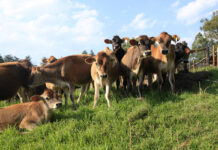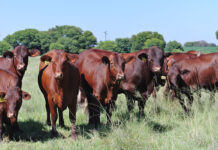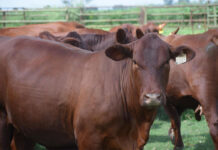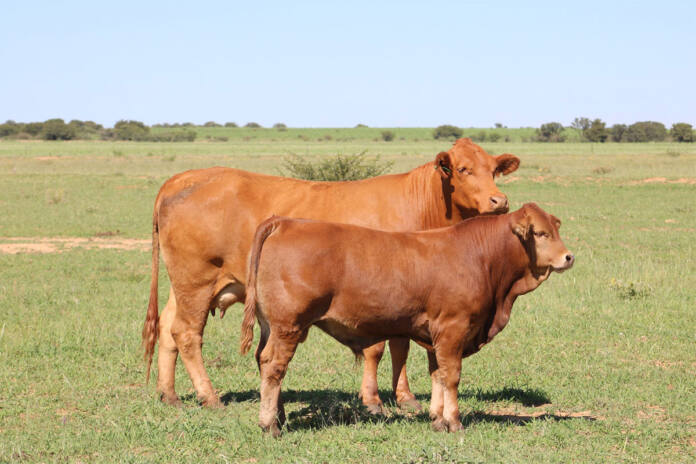
Few cattle studs have shaped the development of the Beefmaster breed in South Africa as profoundly as Bos Blanco near Kroonstad in the Free State. Built on a philosophy that places functionality, fertility and profitability ahead of fashion, the operation has become one of the country’s most influential sources of Beefmaster genetics.
What began as a traditional crop farming enterprise has evolved into one of South Africa’s most respected stud breeding operations, producing elite Beefmaster and Brahman cattle that have left their mark across the country and beyond.
Today, brothers Dennis and Burnie Staal continue a family farming legacy stretching across four generations. Through disciplined selection, relentless hard work, and an unwavering focus on economically important traits, Bos Blanco has become synonymous with high-performing cattle that deliver results where it matters most – in the veld, in the feedlot, and ultimately on the producer’s bottom line.
“Bos Blanco has grown through discipline, hard work and by the grace of Jesus Christ into one of the largest stud operations in South Africa,” says Dennis.
More than a sale venue
The growth of Bos Blanco has extended well beyond cattle breeding.
In 2014, the Staal brothers, together with the Steyl family and veterinarian and businessman Dr Paul Pienaar, commissioned the Kroon Boma auction complex alongside the N1 outside Kroonstad. The facility was developed to provide livestock and game producers with a professional, centrally located marketing platform capable of serving buyers and sellers from across Southern Africa.
The complex accommodates between 800 and 900 guests and features air-conditioned facilities, large-screen televisions for live auction viewing, 90 covered cattle and sheep pens, 100 covered game bomas, and four large open wildlife enclosures.

From the outset, the vision was to create a world-class venue capable of hosting stud and commercial livestock sales, while also serving as a hub for agricultural gatherings and industry events.
Today, Kroon Boma has become synonymous with some of South Africa’s premier livestock auctions and serves as the home of Bos Blanco’s annual production sale, where approximately 160 Beefmaster bulls are offered each year. The venue regularly attracts buyers from across South Africa and neighbouring countries, reflecting both the strategic location of Kroonstad and the reputation the Staal family has built through decades of genetic improvement.
A passion rooted in the land
For Dennis, farming was never merely a career choice. Some of his earliest memories involve the smell of wet soil after a summer thunderstorm and the sound of tractors preparing fields after the first rains.
His father’s example played a defining role in shaping both his character and approach to farming. “I remember his commitment, his faith that everything would work out, his rough hands and his unbelievable work ethic. Most importantly, he never gave up.”
Like many farm children, Dennis initially developed a fascination with machinery. Over time, however, livestock became his true passion. “Tractors are everything to a young boy, but cattle grew deeper into my heart. When Burnie and I took over the purchasing of bulls while still at school, the farming bug bit properly.”
The values that continue to guide him today remain unchanged: faith, honesty, integrity, self-discipline, hard work, and respect for others. “My parents were my greatest mentors,” he says. “Nothing comes by itself and nothing grows unless your own footprints are there.”
Discovering the Beefmaster advantage
The Staal family’s path to Beefmaster breeding began long before they acquired their first registered animals. Like many commercial cattle producers, they experimented with various crossbreeding systems in search of the ideal beef animal.
They combined Brahman cattle with Simmentaler, Sussex, Hereford and Angus genetics, each selected for specific strengths. The Brahman contributed hardiness, parasite resistance, adaptability and walking ability. Simmentaler added growth and milk production, while the British breeds offered fertility, early maturity and superior fleshing ability.
The family was effectively trying to create a complete and balanced beef animal.
Then they discovered Beefmaster. “We were already trying to combine all these qualities when Beefmaster crossed our path. It was exactly the package we were looking for and fitted our breeding philosophy like a glove. We’ve never looked back.”
Developed in South Texas during the 1930s by cattleman Tom Lasater, the Beefmaster breed was founded on the principle of the Six Essentials: fertility, weight, conformation, milk production, hardiness and temperament.
Nearly a century later, those same principles continue to underpin selection decisions at Bos Blanco.
Profitability starts with fertility
While many breeders become distracted by cosmetic traits, Dennis remains firmly focused on economics. His philosophy is simple: cattle must generate profit.
“Every passion can only remain a hobby if it doesn’t make money. Beef farming is our livelihood. The passion must pay.”
According to him, profitability begins with one trait above all others. “Fertility and functionality come first. Without a calf there is nothing. Without functionality there is no milk or growth. These are the real money-makers.”
This philosophy influences every breeding decision at Bos Blanco. The stud’s primary selection criteria include fertility, adaptability, milk production, growth, structural correctness and temperament.
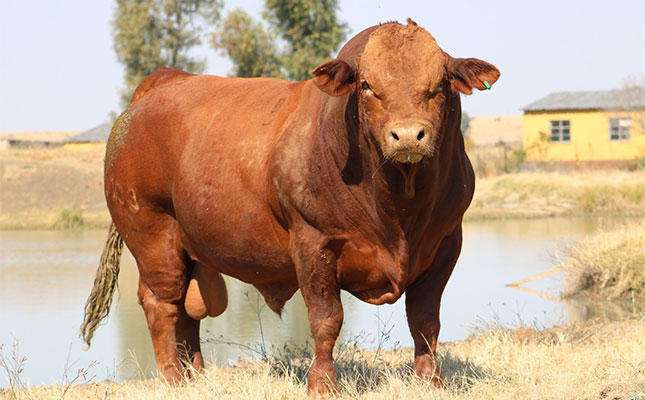
Visual appeal alone is never enough. “We select for economic traits. Fancy points stand at the back of the queue.”
Dennis believes one of the biggest mistakes breeders make is focusing too heavily on breeding bulls, while neglecting the cow herd. “The factory is the cow herd. Your cows are your bank and your insurance policy. Without a healthy, functional factory you breed nothing.”
The goal is therefore to create productive, feminine cows capable of weaning heavy calves under extensive veld conditions with minimal supplementation.
Adaptability remains non-negotiable
Bos Blanco cattle are expected to perform under practical commercial conditions.
The Staal family farms in an environment where efficiency is measured not by showring success but by kilograms of calf weaned per kilogram of cow maintained.
“Our cattle must perform on the veld throughout the year. Adaptability has never been negotiable.” Dennis explains that animals poorly adapted to their environment quickly become economically inefficient. “An animal that is not adapted cannot breed back, cannot grow properly, and cannot lay down fat efficiently.”
This focus on adaptability has helped establish Bos Blanco genetics in a wide range of production environments across South Africa and elsewhere in Africa. The stud has exported animals, semen and embryos to numerous countries across the continent, and remains actively involved in agricultural ventures in Namibia, Botswana and Mozambique.
Selecting the complete package
Although fertility sits at the top of the priority list, Bos Blanco does not believe in single-trait selection. Dennis repeatedly emphasises that successful cattle breeding requires balance. “All the traits must form one package.”
When evaluating breeding animals, he looks for a combination of fertility, adaptability, growth, milk production, sound structure, and good temperament. “A bull must also look like a bull. Masculinity must be evident.”
Dennis places considerable emphasis on head characteristics, believing they provide valuable clues about functionality and maturity patterns.
“A strong masculine head is very important. Width between the eyes often reflects width throughout the animal. A short, strong nose bridge indicates early maturity. Strong eye banks and a broad muzzle are valuable traits.”
Structural soundness remains equally important. “We want cattle that are balanced, with depth, length, capacity and width.”
Genetics that leave a legacy
Bos Blanco’s success has been built on a relentless pursuit of superior genetics. The operation was among the early adopters of artificial insemination and invested heavily in imported bloodlines from the US and Australia.
However, Dennis is quick to point out that not all imported genetics delivered the desired results. “Some bloodlines made a significant impact and others did not. The important thing is to cull the weaker lines completely. The first knock is often the best knock.”
Pedigrees remain a cornerstone of the Bos Blanco breeding philosophy. “Before performance data comes genetic composition. Family is everything.”
According to Dennis, exceptional individual performance means little unless it can be reproduced consistently in future generations. “There are many animals that perform exceptionally well themselves, but can they repeat it? Without the pedigree behind them, very few can.”
Over time, locally developed South African genetics have increasingly dominated the Bos Blanco herd. Animals bred and selected under local environmental conditions have proven particularly effective in maintaining productivity and adaptability.
Record-breaking cattle
The influence of Bos Blanco genetics extends far beyond the farm gate. The stud has established numerous national records and has consistently produced some of South Africa’s highest-priced Beefmaster cattle.
Among Bos Blanco’s achievements are the highest-priced Beefmaster bull and female ever sold in South Africa, while nine of the ten most expensive Beefmaster bulls sold nationally were bred by the operation.
At one National Beefmaster Sale, approximately 40% of all bulls offered by various breeders traced back to Bos Blanco genetics. Among the operation’s most influential sires are BOS 4451 and his son BOS 7146. Both bulls left a profound mark on the herd.
BOS 4451 became the second-most expensive semen sire in the breed’s history, with semen selling for R19 500 per straw.
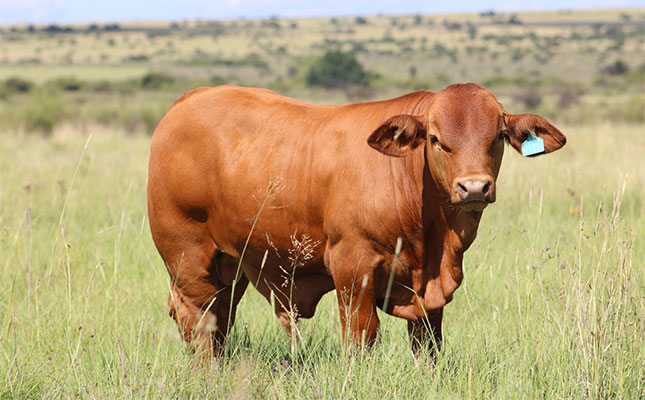
His son, BOS 7146, subsequently became one of the most influential Beefmaster bulls ever bred by Bos Blanco.
“For me personally, BOS 7146 had the greatest legacy because of the impact he had on our herd,” says Dennis.
Another standout was BOS 8154(top gun), which sold for a then-record price of R1,65 million and went on to influence herds throughout the country. More recently, BOS 8495 established a new Beefmaster semen record at R20 000 per straw.
These achievements reflect decades of focused genetic improvement rather than short-term marketing success.
Data drives decisions
Dennis is passionate about objective measurement. He believes producers should use performance information wherever possible to evaluate breeding decisions. “If you’re serious about cattle farming, pull the data.”
One of the most useful indicators, he says, is the relationship between cow weight and kilograms of calf weaned. Dennis places particular emphasis on kilograms weaned per kilogram of cow maintained, arguing that it remains one of the clearest indicators of biological efficiency and profitability in a cow-calf enterprise.
Ultimately, every breeding programme should focus on producing more kilograms of weaned calf from fewer resources. According to Dennis, Beefmaster consistently performs exceptionally well when measured in this way.
The breed’s combination of fertility, milk production, growth and adaptability creates a powerful formula for profitability.
“Beefmaster puts fertility, calving ease, milk production, adaptability, weaning performance and temperament into one package. That’s money in your pocket,” adds Dennis.
Looking to the future
Bos Blanco continues to embrace technology as part of its breeding programme. All stud bulls undergo genomic testing and artificial insemination remains a key component of genetic improvement. Between 250 and 500 females are inseminated annually.
While Dennis believes genomic technology still has room to mature, he expects its value to increase significantly as more information becomes available. What excites him most, however, is the remarkable progress already achieved within the breed. “The genetic progress has been unbelievable.”
Looking back on more than three decades of Beefmaster breeding, Dennis believes the breed has undergone extraordinary transformation. Yet despite advances in genomics, artificial insemination and performance recording, the fundamentals remain unchanged:
- Functional cattle;
- Fertile cows;
- Adaptability;
- Integrity.
Those principles transformed Bos Blanco from a family farming enterprise into one of South Africa’s most influential Beefmaster studs. Judging by the demand for its genetics and the continued growth of the breed, they are likely to remain just as relevant for the next generation of Beefmaster breeders.
As Dennis sums it up: “There are many good breeds and there are better breeds. But there can only be one breed in first place. From the veld to the feedlot, where profitability really matters, Beefmaster remains number one.”