
As food safety standards become increasingly stringent, even trace detections of residues in food can trigger costly investigations. Each residue test costs about R5 000, and multiple rounds of analysis may be needed before the source of a residue can be determined.
For South Africa’s rooibos industry, the implications extend well beyond laboratory costs. Unresolved residue detections can delay shipments, create uncertainty for buyers, and potentially threaten access to premium export markets.
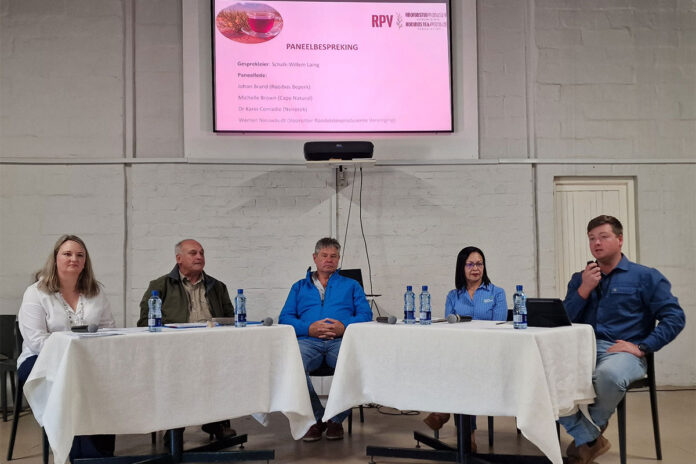
These issues came under the spotlight during a panel discussion moderated by Rooibos Tea Producers Association (RTPA) board member and rooibos farmer Schalk-Willem Laing.
Panel members comprised Werner Nieuwoudt, chairperson of the RTPA; Dr Karen Conradie, laboratory manager at NviroTek Laboratories; Michelle Brown, quality assurance manager at Cape Natural Tea Products; and Johan Brand, technical manager at Rooibos Beperk.
Key is sampling, not laboratories
One of the strongest messages from the panel came from Conradie, who urged producers not to immediately blame laboratories when residues are detected.
“I think the challenge is not so much in the laboratory. The challenge is more to get the right sample – and an authentic one – to the lab,” she said.
Conradie explained that modern analytical equipment is capable of detecting extremely small traces of substances, adding that sampling needs to be precise even in cases where samples are sent to different labs.
She added that South Africa is fortunate to have ISO-accredited laboratories capable of testing rooibos against internationally recognised standards.
“All ISO-accredited laboratories follow the same procedures,” Conradie noted.
She also reminded delegates that a residue detection does not automatically mean a sample has failed market requirements, as export destinations and customers often apply different tolerances.
Laing added that residue management requires cooperation throughout the value chain.
“This is not only a producer issue. It involves everyone in the value chain,” he noted.
Costly consequences
The financial impact of repeated residue testing and the delays involved in getting results featured prominently during the discussion,
“It becomes really frustrating, doing all of that retesting,” Brown noted.
Nieuwoudt added that the financial impact was felt by both producers and processors.
“It has a significant impact on our industry finances,” he said.
According to panel members, repeated testing can also delay shipments and increase the administrative burden and costs throughout the value chain.
Protecting market access
While much of the discussion focused on testing and protocols, panellists agreed that maintaining access to export markets remains the ultimate objective. Protecting customer confidence and the reputation of rooibos in premium international markets is the key driver for the industry.
Brand said customer requirements and market expectations continue to evolve, placing greater emphasis on compliance, traceability, and consistent quality throughout the value chain. This includes not exceeding minimum residue levels (MRL).
He noted that his company exports 95% of its rooibos to markets with the most stringent requirements and the strictest maximum residue limits.
Brand added that industry participants ultimately face many of the same requirements.
“At the end of the day, everyone plays in the same market. So the needs are the same, and the knowledge is the same,” noted Brand.
Brown agreed, saying: “Every year, there’s something new on the list of prohibited substances, as well as the reduction of tolerance levels.”
Several panellists referred to EU requirements as a useful benchmark, as they are among the most rigorous standards facing exporters.
Nieuwoudt said the industry needs a more consistent approach to testing and compliance.
“I think we need a standard protocol,” he said, adding that the industry should decide for itself what standard it wants to uphold.
Drift remains a concern
Discussions also centred on chemical drift and contamination originating from outside of rooibos production systems.
“This year, many organic farms had residues on their rooibos, but those residues didn’t come from those farms,” Nieuwoudt said.
He suggested that neighbouring agricultural activities could contribute to residue contamination, adding that this was becoming a more serious concern for the rooibos industry.
Brown cautioned, however, that contamination does not always originate in the field.
“It’s not only spraying. It’s not only drift. It’s also how you handle the product,” she noted.
She cited several examples where investigations pointed to unexpected sources of contamination.
“Sometimes it’s mosquito repellent used by workers in the field. Sometimes it’s hand sanitiser. Sometimes it’s the marker pen on packs during packing, which we tell growers not to use anymore,” Brown explained.
Nieuwoudt argued that earlier monitoring and testing would be more effective than investigating problems after tea entered the processing chain.
“Let’s be proactive. We need to provide a protocol to minimise the risk of drift before we harvest,” he advised.