Stara has been present in the South African market since around 2006, initially through an importer. However, about 18 months ago, it decided to strengthen its local presence by operating directly in the country and working closely with local dealers.
Under the new structure, Stara is working with dealers to improve service continuity and accountability, while also ensuring faster access to parts and technical support. The company maintains parts stock in Johannesburg, with additional supply support from Brazil.
Daniel Kleemann, Stara’s international marketing coordinator, told Farmer’s Weekly at Nampo in Bothaville, Free State, that the company’s approach is aimed at reducing downtime, ensuring farmers are not left waiting for critical components during peak production periods, while also staying closer to farmers and providing specialised support throughout the season.
Dutch roots
Stara’s origins date back to 1953, when it began as a small agricultural machinery repair workshop in Brazil through a partnership between Dutch immigrant Johannes Bernardus Stapelbroek and Gerrit Jan Rauwers.
The business initially focused on assembling and servicing agricultural machinery and implements imported from Europe to support Brazil’s growing farming sector.
However, the partnership ended in the 1960s, after which Stapelbroek & Cia was established as a small family-run workshop, where Stapelbroek and his family repaired and adapted agricultural machinery to suit local farming conditions.
A major turning point came in 1968 with the launch of Brazil’s first steerable weeder with a suspended arm, marking the beginning of the company’s long-standing focus on engineering practical and increasingly technology-driven agricultural solutions.
Over the decades, Stara expanded from a regional machinery workshop into an international agricultural equipment manufacturer, building a strong presence across South America and exporting machinery to Australia, Africa, and parts of Europe.
According to Kleemann, the company’s growth has been driven largely by close collaboration with farmers and a focus on developing equipment tailored to real production challenges in the field.
Another key contributor is Stara’s expertise in proprietary technology, as the company was a Brazilian pioneer in developing precision agriculture technologies.
South African market
Kleemann said Stara is strengthening its presence in South Africa because it views the country as a key growth market, driven by its relatively advanced commercial farming industry, widespread use of mechanised production systems, and growing demand for precision agriculture technologies that can reduce input costs and improve efficiency.
South Africa also serves as a strategic gateway into the wider Southern African Development Community region.
He added that South African production conditions are, in many respects, very similar to those in parts of Brazil, particularly in terms of climate, crop production systems, and the challenges farmers face in the field.
“South African farmers face many of the same challenges as producers in Brazil, so we believe a lot of the solutions and technologies we’ve developed there can work well here, too,” he said.
However, the company is not simply importing machinery from Brazil. According to Kleemann, Stara has started adapting equipment specifically for South African production conditions, particularly where row spacing and crop systems differ from those in Brazil.
For example, its EVA planter, showcased at Nampo, was configured specifically for the South African market. Designed for row crops such as maize, soya bean, and sunflower, it is available in four- and six-row configurations, with adjustable row spacing to suit different farming systems and crop requirements.
Precise seed placement
A key engineering feature of Stara’s planting systems is DPS-E (Stara Precise Seed Meter – Electric), a precision metering and vacuum-based seed delivery system designed to reduce power requirements and improve planting accuracy.
Kleemann explained that the system uses a simplified vacuum mechanism with fewer discs than conventional designs, reducing mechanical resistance and lowering the tractor’s power demand.
It also incorporates multiple singulation points to prevent double or triple seed drops, ensuring consistent spacing within rows.

A row-by-row shut-off system further improves efficiency by automatically disabling seed distribution in areas where they have already been planted.
“This eliminates overlap, achieving estimated seed savings of up to 4%,” Kleemann added.
Spraying technology
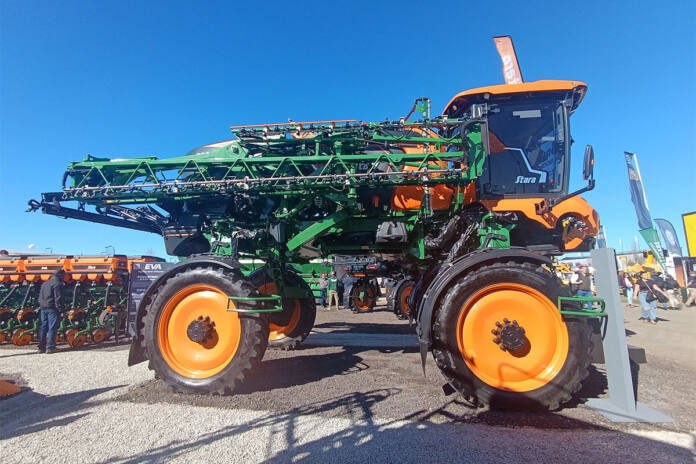
Stara’s sprayer line was also showcased at Nampo. The line-up included the Imperador 3.0 (223cv [metric hp] or 164kW with turbocharger), which the company claims is the only three-in-one self-propelled sprayer in the world; the Imperador 2500, powered by a 213cv (157kW) turbocharged Cummins engine; and the Imperador 4000, which delivers up to 295cv (217kW).
All models are designed to deliver strong field performance while maintaining relatively low noise levels, reduced vibration, and improved emissions efficiency.
One of the machines’ standout features is the patented central boom design, where the spray boom is mounted in the centre of the sprayer rather than at the rear.
According to Kleemann, this improves stability and balance during operation, particularly on uneven terrain, while also reducing boom movement and the risk of impact damage when working on slopes or contours.
The sprayers also feature a smart four-wheel steering system, where the rear wheels automatically follow the same tracks as the front wheels through computer-controlled steering compensation. This reduces crop trampling and overlap while improving manoeuvrability in the field.
“Our Smart 4-Wheel Steering System allows for a turning radius of up to 42% shorter than conventional systems,” Kleemann said.
Another key feature is the Up & Down Hydraulic Lift System, which can increase the chassis clearance on the Imperador 4000 by 40cm, taking it from 1,6m to 2m. This allows farmers to continue spraying later into the growing season, when crops such as maize and sunflower are taller and more susceptible to physical damage from conventional sprayers.
At the same time, the spray application height on the Imperador 4000 can be increased to 3m, improving coverage and allowing the operator to work above taller crop canopies.
The Imperador series incorporates the Nozzle-by-Nozzle Control System, where individual nozzles automatically switch off when passing over areas that have already been treated, helping to reduce chemical overlap, minimise waste, and improve application accuracy.
The Twin Row Spraying System automatically adjusts nozzle output according to travel speed, helping to maintain a consistent application rate under changing operating conditions.
The machines also feature Stara’s Continuous Recirculating System, which keeps chemicals moving through the spray lines at all times, helping to prevent sediment build-up, blocked nozzles, and uneven application.
Operator systems and digital integration
Stara’s machines are integrated with the Topper controller, allowing operators to monitor field data, adjust settings, and manage precision farming tasks in real time.
Through Topper, farmers can integrate and manage several Stara technologies aimed at improving field productivity, including Telemetria, Conecta, variable-rate application, and other precision agriculture features.
Telemetria allows farmers to monitor machines remotely in real time, while Conecta allows technicians to access machines remotely for diagnostics, software support, and operational guidance. In more complex cases, technicians are dispatched to farms for on-site intervention.
“Thanks to Stara Conecta, technicians can remotely diagnose machines and support farmers faster. As such, the system helps to reduce downtime and improve responsiveness, particularly in large farming regions where distances between dealers can be significant,” Kleemann explained.
According to him, so far, South African farmers have responded positively to Stara technology, particularly its adaptability and precision capabilities.
“South African farmers have shown strong interest in our technology, particularly because it improves efficiency and reduces input costs,” he concluded.
For more information, email Stara at [email protected].