Justin Stirk has been farming in the Bathurst district of the Eastern Cape on the farm Goodwoods for more than three decades. The area is known as frontier territory
and is characterised by various diverse biomes, including dense Albany thicket, rugged kloofs, and lush valleys, as well as high tick and disease burdens.
Rainfall generally comes throughout the year, with the norm being greater amounts in the summer months. However, this can vary, with some years providing wet summers and dry winters, or the other way around, or dry throughout or wet and soggy year-round.
“We never know when it’s going to rain; it can be green in winter and dry in summer, and vice versa,” he says.
For this reason, there is no one-size-fits-all plan, with management practices adapted to what the season is doing at the time.
“We generally farm by gut feel that has been gained over years.”
The operation
The Goodwoods operation has three main branches, namely stud and commercial Bonsmara cattle, Boer goats, and a macadamia component first established more than two decades ago.
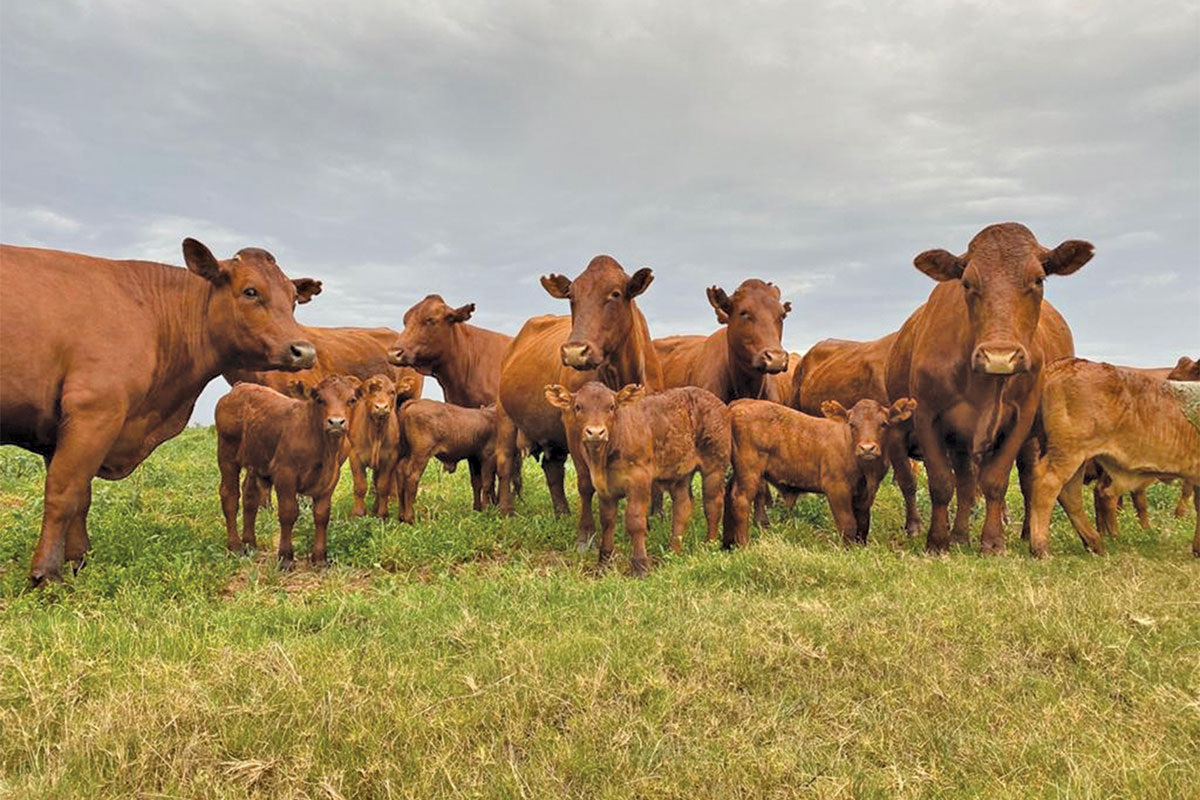
Stirk runs about 340 cows, of which around 280 are stud animals and the rest commercial.
“I run my stud cows exactly the same as my commercial herd. They only get what they need and are expected to produce off the veld,” he says.
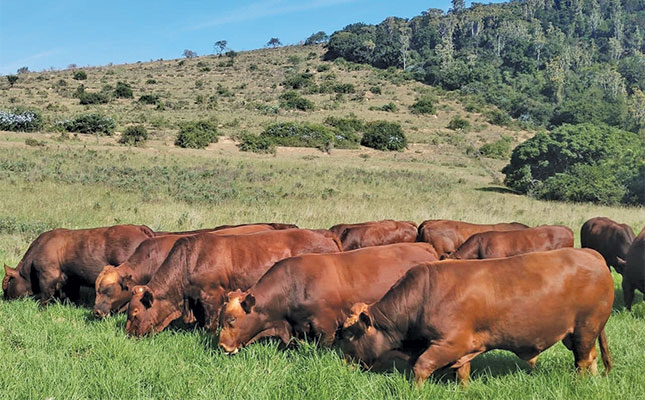
As mentioned, the area is known for its dense Albany thicket, but several other biomes are prevalent. On his farm specifically, Stirk says there is sourveld grazing, valley sweetveld, thicket and bush biomes, and planted pastures.
Cattle receive a phosphate lick in the summer months, or when the veld is green, and a 45% protein lick in winter ,or when the veld is brown and dry.
“The whole of South Africa is phosphate deficient, and animals need that – it is very important for bone density, and especially skeletal growth in young animals, and fertility and so forth,” he says.
Other than that, the animals are expected to flourish on the veld, and Stirk breeds and selects in accordance with this.
Selection
Although Stirk’s breeding principles rely on all relevant genetic markers and indicators, he depends heavily on phenotypic selection criteria specific to his region and goals.
“You need to find an animal that is going to do well in your area and flourish on grass and nothing else.”
He selects for an early to medium-maturing animal that is a little bit shorter on the leg, with lots of volume and capacity.
“We talk about a two-thirds/one-third principle, where if you look at an animal from the side, you want to see two-thirds animal and one-third light underneath it.”
Calves are weaned at 205 days at a weight of 240kg to 245kg for bull calves, with heifers coming in about 10kg lighter. It is at this stage that the first round of selection takes place.

“All calves are weighed at weaning and indexed. Anything that doesn’t measure or conform to the Bonsmara standard is discarded.”
Stirk also does a visual appraisal and removes any animal with obvious flaws or that is not conforming to the type he is aiming for in terms of the two-thirds/one-third picture. He is especially strict with the bulls.
“If I get 150 bull calves in a year, I will probably test about 60 of those in a growth test [Phase D]. You generally lose about 40% of those, leaving you with 30 to 40 bulls that are eligible for sale.”
These numbers may be whittled down further in terms of specific quality criteria required for participation in the annual Frontier Bonsmara Group sale.
Heifers are evaluated at weaning, at which stage any with obvious faults, including those maturing too late or with conformation faults like bad shoulders or devil’s grips, for example, are removed. The remainder are run together until 18 months of age.
“We then put them up for inspection, and any animal that doesn’t make it will be downgraded and sold as a commercial female at our auction.”
Stirk keeps back 50 to 60 replacement heifers per year for the stud, and markets 70 to 90 female animals as commercial mated cows or heifers.
Calves from the commercial cows are all marketed as weaners.
Two breeding seasons
Stirk has summer and winter breeding seasons of 90 days each. He follows a multi-herd sire mating approach, putting three bulls to a group of about 50 cows. He will use up to four bulls on his heifer groups. Identification of the sire is then done through DNA verification.
“We [Stirk and other breeders with whom he partners] are using young 14-month-old bulls that we rate as good offspring bred from the new genetics we have brought in,” he says.
In addition to live coverings, Stirk also sometimes uses fresh semen to impregnate cows via artificial insemination (AI), synchronising a group and impregnating them with a selected bull and allowing those that don’t take to then be serviced by another bull.
Stirk says he used to follow the more traditional approach of single-herd sire mating, putting one bull to 30 cows. Although he still uses this approach in specific breeding plans, he believes the use of multiple bulls mitigates risk.
“You run the risk of a complete disaster if that bull goes infertile in the middle of the season.”
He says he generally uses bulls that are the result of a structured AI breeding approach. He explains that this will often happen in partnership with other breeders.
“We go out and find a bull we really like. A group of us will buy him together and we will then breed sons from that bull to carry on with that bloodline.”
Calving happens in spring (September/October/November) and autumn (February/March/April), with roughly 80% of cows dropping calves in spring and the remaining 20% in autumn.
Pests and disease
Cattle reared in frontier territory need to be hardy and resilient to cope with high tick burdens, and numerous other vector-borne diseases.
Stirk says the health of animals is paramount, and for this reason he provides vitamins and trace elements three times a year through a product like Multimin, as well as vitamins A, D and E.
“That helps immensely with animal health, fertility, and immune system support,” he says.
He then adheres to a strict annual vaccination programme to prevent major diseases. This includes anthrax, botulism, Clostridium, and so forth.
“Something that is becoming more and more prevalent is brucellosis, and you should be vaccinating your heifers against this.”
He says there are two different vaccines, and stresses that it is extremely important to use the chosen one at the correct time.
He also guards against bovine viral diarrhoea (BVD), which he says causes losses in the form of weak or premature calves.
“[BVD] is also a disease that is raising its head more and more, so there are live and [inactive] vaccines we can use throughout the year.”
He says he injects heifers with a live BVD vaccine a few months prior to mating, with good results.
Redwater, heartwater, and gallsickness are also problem diseases. “Asiatic redwater is becoming a huge problem in our area.”
He says it is a virulent disease that doesn’t leave much opportunity for intervention.
“Asiatic redwater is extremely deadly. It doesn’t give you a chance. An animal can be grazing in the field and an hour later it is dead.”
For this reason, he now vaccinates all cattle after weaning. Although it is expensive, he says it is much cheaper than absorbing the potential losses.
He says the African redwater strain is not as deadly and “generally gives you an opportunity to pull the animal through”.
Heartwater, another tick-borne disease, is always present. Stirk says he seldom gets heartwater in mature animals, with the disease affecting mostly young animals.
“In our case, we only dip our calves from around five to six months of age. This subjects them to the heartwater tick and helps them to build up resistance.”
This is only viable because he is managing and checking his cattle daily and can therefore intervene quickly and inoculate if a calf shows signs of illness. This technique keeps losses below 1% and means he doesn’t need to blood his cattle against heartwater, which can be a complicated process best done by experts, as you inject directly into the vein.
Gallsickness is also endemic in the area, but according to Stirk, it is easily managed if cattle are checked regularly. He has blooded for gallsickness in the past and says this is a far easier process than that required for heartwater.
He says the other challenge for blood vaccines is that they are only available through Onderstepoort Biological Products. He says their supply is too unreliable, meaning he has had to adapt management strategies to overcome this.
“My advice to anyone who is farming extensively and can’t get to their animals regularly is to do the blooding to give more of a chance to pull your animal through.”
Tick control, he says, is a nightmare.
“Tick resistance to the active ingredients available on the market is now nearly 100%. There are very few (if any) of us who don’t have an issue.
“One has to be so careful of how you are using products, especially the injectable ivermectins. If you overuse them, you are going to build up resistance so quickly.”
He advocates sticking to a product with a single active ingredient rather than the newly emerging combination active products. He also urges a move away from rote dipping (for example, on a two-week cycle) to a system where you lengthen intervals by dipping based on what you see on the animal.
Stirk says it also doesn’t get cold enough in his area in winter to stop reproduction of ticks, as well as other bugs and midges, with months like May and June often marked by high parasite burdens.
“It’s got nothing to do with seasons here – it’s all about management. You can’t dip or dose today and think you don’t need to worry for the next few months. It’s all about observation.”
The region is often a challenge for new farmers, or experienced farmers used to different conditions. It is also a challenge in terms of bringing animals in from other parts of the country, taking as long as 18 months for an animal to adapt to a new environment.
“If you are going to buy breeding stock, buy from someone close to you. Don’t go looking for diamonds in an area far away from you,” advises Stirk.
Managing drought conditions
As of February this year, ongoing drought conditions and possible interruption of water provision in the Eastern Cape, Northern Cape, and Western Cape resulted in the classification of a national disaster.
Head of the National Disaster Management Centre Dr Elias Sithole signed a declaration in terms of Section 23 of the Disaster Management Act (No. 57 of 2002) into effect on 5 February 2026.
Stirk is experiencing one of the driest periods in his farming career, saying there have been at least two other severe droughts over the last 30 years but not, to his memory, as bad as this.
“I have only had 167mm of rain since July last year.
“We are currently in a complete and absolute drought. We are having to buy in roughage and feed it to those groups that need it.”
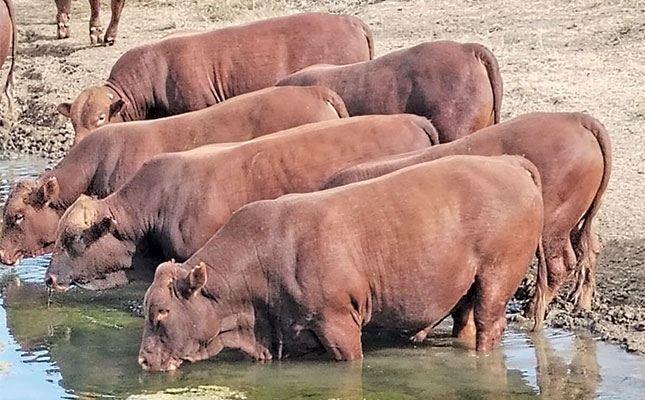
Feed is being provided to younger cows with calves to try to help them conceive again. Others are having to make do on the veld with a 45% protein lick.
Stirk used to run more cattle, but since 2019, he has systematically reduced his numbers by roughly 200 large stock units.
More recently, he has again taken proactive steps to preserve his genetics and grazing resources as far as possible.
“I saw the drought coming and decided to get rid of all the animals that were older or performing poorly. I put them in a feedlot to save the grazing and sold them in November and December.”
Stirk started buying in feed to sustain his animals last year already but says feed is scarce in the region by now, and the cost of importing from other parts of the country has driven prices up.
“I will not be able to keep doing this much longer,” he says.
Stirk does not believe the drought classification will provide him with any form of government intervention or support, saying it is up to him to manage the survival of his animals and business.
The Bonsmara shows its value in the bad years
Stirk says he is often asked why he farms Bonsmara. His view is that every breed has a place, and it is up to each individual farmer to make his or her choice. That said, he feels the current drought conditions have shown the ‘true colours’ of the Bonsmara breed.
“When you see what a Bonsmara does in times like this, you understand why it is the breed of choice in South Africa in terms of numbers.”
He says if one looks at the history of the breed, it was specifically bred to cope with South Africa’s tough conditions. He describes it as a “breed for all reasons and seasons”.
“The Bonsmara compares well with any other breed in a good season, but in a poor season, it really shows its true colours.”
He says it handles heat and has outstanding tolerance against ticks.
“There is no such thing, in my mind, as a tick-resistant animal – only animals that are more tolerant.”
Frontier Bonsmara group
Stirk says one of the guiding principles followed by the Frontier Bonsmara Group is quality.
“We believe in breeding quantity from quality, so in the female lines we keep only the animals that fit our philosophy rather than paying stud fees for a whole lot of animals, because we might get a whole lot of bulls out of them,” he says.
The group currently comprises four breeders, namely Stirk, Andrew van Kerken, Gerrit Meyer, and Glenam Knott.
Stirk says between the four of them, they have a pool of about 1 300 cows from which they will select about 80 bulls for offer at the annual sale.
They have capped the number of bulls sold per year, and he emphasises that it is not a numbers game, but rather a quality game.
“If I have 40 bulls for auction but only 20 are good enough, only 20 will go on sale.”
One of their key selling points as the Frontier Group is diversified genetics, and for this reason they will often partner with breeders outside the group to further this goal.
Members of the group must conform to the selling principles, but other than that, they are autonomous.
By partnering with breeders outside the group, Stirk says they are better able to achieve the goal of truly diversified genetics.
It’s a way of life
Going forward, Stirk intends to phase out his commercial component to focus exclusively on his stud animals. It is in part about economics, with a good stud animal potentially adding more value to a smaller-scale operation than commercial cattle.
This is not a given, though, as a stud carries additional costs such as registrations, and so forth, meaning that the breeder really needs to focus on quality animals that can net a premium.
The main reason, however, is that Stirk is a breeder at heart, having bred everything from cattle and goats to hamsters and pigeons.
This is clear as he speaks about his vision for his cattle.
“If I close my eyes, I can create a picture in my head of each and every cow on the farm,” he says.
This enables him to visualise potential bull and cow pairings without having to physically stand at the kraal and look at each cow. It’s about knowing your animals.
He speaks about conformational attributes like a broad muzzle and width between the eyes, for example.
“I do not keep animals with narrow muzzles,” he states.
He uses the analogy of a hand-operated lawnmower compared to a tractor with a bush cutter.
“It is about the energy she uses to graze, and a broader muzzle is more efficient,” he says.
The width between the eyes, he explains, is an indicator of good breadth of body, for example.
For Stirk, farming is a way of life, and the breeding component is something he is truly passionate about and wants to keep doing for years to come.
For more information email Justin Stirk at [email protected].