
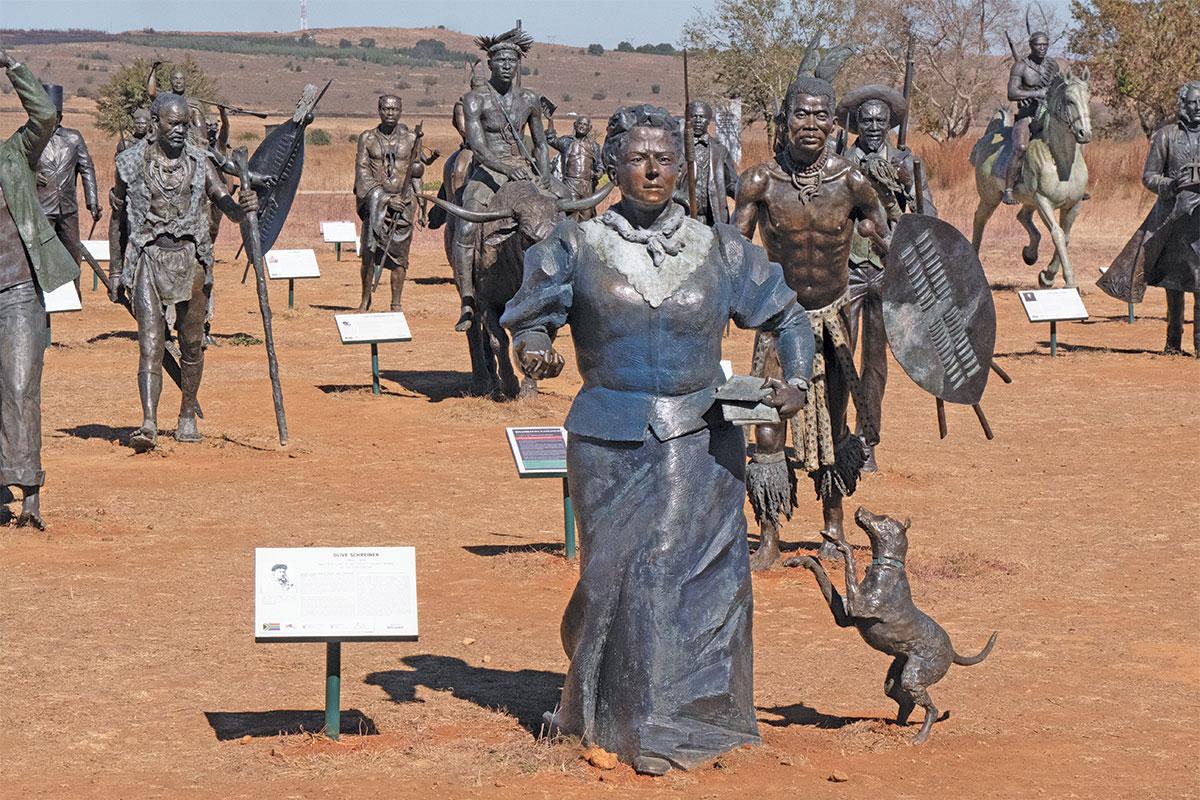
She may no longer be considered South Africa’s greatest writer, but Olive Schreiner will always remain one of the most remarkable, complicated and talented figures to grace the country’s literary and political history.
She was born to missionary parents on the Wittebergen Mission Station, some 35km north of today’s Lady Grey, Eastern Cape, on 24 March 1855. The buildings consisted of a crude shelter for the family as well as a chapel and a hall that was used for teaching by Rev Gottlob Schreiner. His wife Rebecca was active in nursing on this remote, windswept and rocky area granted to the Wesleyan Missionary Society by the Cape government.
The settlement was cut off from the civilised world, the nearest post office being over 200km away at Colesberg.
Olive and her brothers and sisters were given their education by their parents and brought up in a strict environment. The parents were soon to be aware that their ninth child was remarkable and unusual. Since birth, Emily (as Olive was then called) was to cause astonishment.
She was often seen sitting by herself in the veld talking and telling stories to make-believe audiences. She once built a small altar out of stone and was terribly disappointed when the smoke did not go straight up to heaven. Her focus then turned to nature and her surroundings. Her later writings about the heat and butterflies, the bird cries and the smell of rain on the parched rocks all pointed to this period of her early childhood.
Unusual mental capabilities
With her mother’s educational planning, Olive was able to read and write at a stage when other children are still considered babies. She demanded such early instruction and knowledge, and was capable of absorbing multitudinous details, constantly surprising her mother with her unusual mental capabilities.
In 1861, when Olive was six years old, the Schreiners moved to the Kat River Settlement, some 11km from the military post of Fort Beaufort. The journey made a forceful impression on the young girl.
It took 21 days by ox wagon to cover the 400km, and Olive was never to forget the wonder of campfires around the wagons and the snorting of the cattle as they lay down to sleep. The silent, star-filled nights frightened her as she longed for the morning sun.
Olive for the next few years gave the impression of being alone and worrying about problems she could not explain. It was during this period that her struggles with faith once again surfaced. She was also intrigued with military customs and bright uniforms, but questioned the reason why soldiers should be in Fort Beaufort at all. Her young thoughts revealed her early sympathy with the outcast and the oppressed, and her strong antipathy towards the orthodox. All her life she was to remain a deeply religious woman, although in an unconventional sense, and on her own terms on many an occasion.
Olive was about nine years old when her baby sister, Ellie, the 12th child, died at the age of two. She was passionately devoted to the little girl and her death came as a great shock.
Her grief was so dramatic that she slept beside the young body all night and was always at hand until Ellie was buried. She now spent time sitting at the grave singing and talking to Ellie and arranging petals across the grave. Olive later maintained that it was at this time that she became a free thinker.
Her unfinished novel, From Man To Man, was begun in 1876 and dedicated to Ellie, and the main theme was the devotion of an elder sister to a younger one. The devotion described is so heart-rending and passionate that it borders on the abnormal. The emotional shock of her little sister’s early death was to be sadly repeated many years later when Olive lost her only baby.
Her father now moved to Balfour a few kilometres away. He had come to the end of 27 years of missionary work. Driven by need, he took to trading, but struggled for an income. The family was destitute and once again Olive was to question the ways of man.
She was taken to Cradock in 1867 when she was 12 to stay with her brother Theo (23), who had become headmaster of the local public school. Her sister Ettie (17) was their housekeeper. The following year, Will (11) joined them.
The four remained together until 1870, when Theo and young Will went to seek their fortune on the diamond fields. Ettie stayed in Cradock while Olive became governess to the Orpen children at Avoca in the Barkly East district.
Olive appears to have started writing two stories while at Cradock, called Rain and Diamonds, but no record from this period exists to bear witness to her emergent creative brilliance. Nevertheless, it was during this period that her religious and philosophical convictions were given form.
Writing her famous novel
From 1875, she worked as governess to various farming families near Cradock. It was here that she finished her first version of The Story of an African Farm around 1880, which would later rocket her to international acclaim.
While visiting her sister in Fraserburg, Olive met Dr John Brown, the district surgeon, and his wife Mary, who was the niece of the statesman Saul Solomon.
Olive later joined the Browns in England. It is difficult to imagine what impact her new surroundings in England and Europe made on her. She visited theatres, art galleries and museums, and also finished off her novel about a South African farm set in the arid region of the Karoo.
In January 1883, The Story of an African Farm was published in England and was greeted with mild interest by the critics of the day. However, the public thought otherwise and a second edition had to be printed in July. The book also sold well in the US.
The opening paragraph of the novel reads: “The full African moon poured down its light from the blue sky into the wide, lonely plain. The dry, sandy earth, with its coating of stunted Karoo bushes a few inches high, the low hills that skirted the plain, the milk bushes with their long, fingerlike leaves, all were touched by a weird and almost oppressive beauty as they lay in the white light.”
Olive found herself famous all over Europe and the US. She was the first of an astounding list of brilliant women authors produced by South Africa, and as such holds a position of permanence and honour. Her early observations of human behaviour, coupled with her imagination, rendered an amazing story that was discussed by all and sundry. She helped open the African continent to the world.
She turned down two proposals for marriage, and in 1894 married Samuel Cronwright, who was farming on Krantzplaas near Cradock and had a similar outlook on life to her.
Through her work with local politics, she became friends with Emily Hobhouse and Elizabeth Molteno, influential women activists with similar opinions on civil and women’s rights.
They were all anti-war and deplored the occupation of land by means of force. Olive came into conflict with her friend, Cecil John Rhodes, the Prime Minister of the Cape Colony, because of his connection with the doomed Jameson Raid into the Transvaal in 1895.
The next few years were difficult and unsettled ones for Olive and Samuel. Her asthma worsened, while the couple’s only child, a daughter, died within a day. In 1898, they moved to Johannesburg. In the aftermath of the Jameson Raid, they were seen as champions of the republican cause in the face of the inevitable conflict between Boer and British. Olive tried in vain to persuade both potential warring factions about the futility of armed conflict. All her pleas fell on deaf ears. She then wrote The South African Question by an English South African in an attempt to open the English public’s eyes to the reality of the situation.
Her prophetic vision
At the outbreak of the Anglo Boer War in 1899, Olive moved to the small, isolated town of Hanover in the Karoo. As a means of distraction, she commenced with Woman and Labour, which was the first expression of her characteristic concerns with socialism and gender equality. Driven by her prophetic vision of a non-racist, non-sexist South Africa, she corresponded on many occasions with Hobhouse on the subjects close to her heart.
The last few years of Olive’s life were marked by ill health, asthma and a sense of isolation, frustration and depression. Despite this, she was still engaged in political issues and was determined to have a say about the new Constitution for the Union of South Africa. She wrote Closer Union, in which she argued for more rights, not only for blacks but also for women.
After returning to Cape Town at the end of World War I, she rented a room at the Oak Hall boarding house in Wynberg.
Sitting down to breakfast in London, Samuel opened his newspaper and sat stunned at the announcement of his wife’s death, who passed away peacefully in her sleep on 11 December 1920. Some of her letters kept arriving for him and he later stated that it felt like they were still talking.
Olive was buried in Kimberley. After the death of Samuel on 8 September 1936, her body was exhumed. She, along with her husband, baby and dog, were buried atop Buffelkop Mountain, near Cradock.
- Source: Schreiner House, Cradock, and curator Brian Wilmot; Natural English Literary Museum, Grahamstown, and curator Tom Jeffrey.
Graham Jooste was an author and historical researcher.