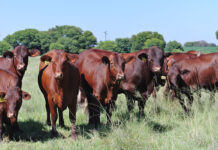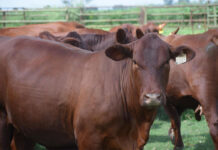
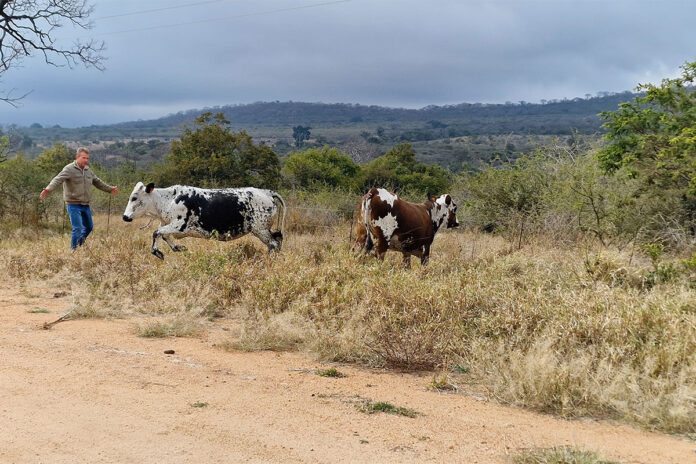
For fourth-generation farmer, Dr Doug Reed dwindling rainfall and declining water resources have fundamentally changed the business built by generations before him. As crops disappeared and farming conditions became increasingly challenging, Reed found an unlikely ally in the Nguni breed.
“My philosophy is a very simple one. My cattle must be adapted to the farm,” notes Reed. That principle has guided Reed’s farming decisions since he bought his first Nguni cattle in 1986.
Today, he runs approximately 213 breeding cows, 80 replacement heifers, and a herd of about 40 bulls through the aptly named Modjadji Nguni Stud on his 1 450ha family farm, Mooihoek.
The operation looks very different from the mixed farming enterprise developed by previous generations of the Reed family.

Four generations of adaptation
The Reed family’s roots in the area stretch back to 1890, when his great-grandfather arrived on the farm by ox wagon. Over the decades, the enterprise evolved continuously. His grandfather farmed carnations and ostriches, while Reed’s father developed tomato production alongside a respected Brahman stud.
Reed later diversified into prickly pears, eventually establishing around 88ha, with sections under irrigation and fruit destined for export markets. Today, however, cattle dominate the business.
The change was largely driven by a decline in available water. “The water seems to have depleted,” explains Reed.
Although Mooihoek lies close to the famed Modjadji area, Reed says his farm receives far less rainfall than many visitors assume. “We have less and less water, so it’s become more and more difficult to farm crops,” he says.
As water became scarcer, irrigated crop production became increasingly difficult to justify. The prickly pear enterprise was phased out and the operation shifted almost entirely towards livestock. “I’m now farming cattle only.”
Low inputs, high expectations
Mooihoek receives an average of about 450mm of rainfall annually. Warm winters, little frost, and heavy parasite pressure create constant challenges.
“Because of that, we have a lot of ticks, fleas, lice, all that kind of insects and parasites that affect cattle. It’s not a problem, but it’s a challenge,” states Reed.
Rather than attempting to compensate through higher input costs, Reed prefers cattle capable of thriving under those conditions. As a veterinarian, he believes one of the breed’s greatest advantages is how little intervention it requires.
“I hardly ever practise as a veterinarian on this farm because the cattle are just well adapted,” adds Reed. The result is a low-input production system built around cattle expected to perform under veld conditions.
Fertility drives profitability
Reed regards fertility as the foundation of a profitable beef herd. His approach is straightforward.
“I select for super fertility, that is the ability of the cow to calve within less than 12 months. When she has calved and before the calf is six months old, she’s already cycled again,” explains Reed.
According to him, that allows productive cows to produce an additional calf over their lifetime. The same standard applies throughout the herd.
“If she’s pregnant again and she’s weaned a decent calf, she stays another year. If she’s not pregnant, of course she goes,” he insists.
His selection approach has produced consistently strong reproductive performance.
“My average for my entire herd is 371 days.” That translates into a calving rate of roughly 95%.
For Reed, reproductive efficiency remains one of the clearest indicators that cattle are genuinely adapted to their environment.
No breeding season
Like many cattlemen, Reed has experimented with different production systems over the years. “I’ve been through all the different systems. Today, his bulls remain with the cows throughout the year.
The cows effectively establish their own breeding rhythm while still being subjected to strict fertility selection. He believes the approach simplifies management without sacrificing performance.
Longevity and productive cow families
Longevity remains one of the cornerstones of the Modjadji breeding programme.
“It’s not unusual to have 18-year-old cows,” says Reed. He believes longevity reveals a great deal about an animal’s value. “If a cow can get old in your herd, it means a few things. Structurally she’s correct, she’s got good teeth that last a long time, and she is fertile.”
Strong maternal lines are retained, while cows that fail fertility tests are removed from the herd. The result is a herd built around proven cow families, according to Reed.
Easy calving pays
As both a breeder and a veterinarian, Reed appreciates the value of calving ease. Difficult births during his youth helped inspire his veterinary career.
“My dad used to quite often call the local vets to help pull out a calf. He himself [my father] used to pull out calves and that became a normal occurrence. That’s actually one of the reasons I became a veterinarian,” recalls Reed.
His experience with Nguni cattle has been markedly different.
“In the 40 years that I’ve had Nguni cattle; I can remember one bad dystocia [slow childbirth or labour] and two or three other occasions where I’ve just assisted an animal that I thought was taking a bit long.”
He believes fewer calving problems translate directly into lower labour requirements, fewer interventions, and greater efficiency.
Multiple markets reduce risk
One of the strengths of the Modjadji Stud is that it is not dependent on a single market. Stud animals are marketed through breeder sales and auctions, while additional breeding stock is sold directly to farmers.
“I support the Northern Nguni Club sale where I sell 10 or 15 or 20 nice heifers every year and possibly a bull too,” says Reed.
The operation also supplies the informal meat market.
“The bulls that are not up to standard, that are not the top bulls, I sell to the informal meat market for funerals, parties, and so on,” he reveals.
Demand has grown to such an extent that Reed occasionally buys cattle for resale.
“The demand means that I don’t have enough of my own to sell like that. So, I’m actually speculating a little bit by buying cattle in and then selling them on.”
He believes the breed’s moderate frame size works in its favour.
“The Nguni is ideal because it gets fat quite easily on the veld alone,” Reed points out.
Looking to the future
Reed believes the Nguni breed has a significant future both within South Africa and internationally.
Interest in Nguni genetics continues to grow, particularly in countries facing similar production challenges, including elsewhere in Africa and Australia, according to Reed. “I think our future for the Nguni breed is very big.”
For him, the breed’s efficiency, adaptability, and fertility position it well for increasingly uncertain farming conditions.
After four decades of farming under challenging conditions, Reed is satisfied with the role the Nguni breed has played in helping his fourth-generation family farm not only adapt, but survive.
“They breed for you. They farm for you, and that’s the nice thing about them [Nguni],” Reed emphasises. “You don’t have to give them much, but they give a lot.”