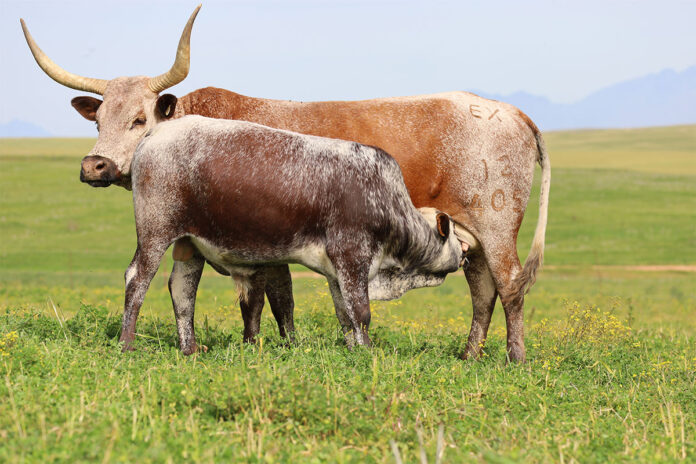
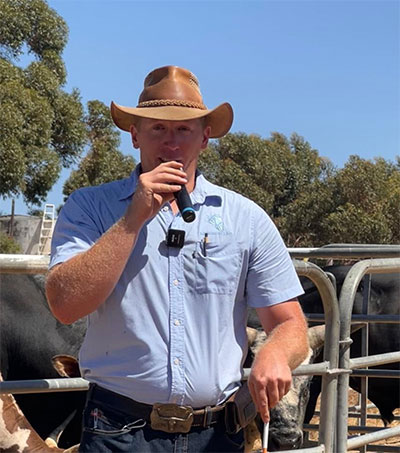
The Nguni breed is often associated with hardiness and adaptability. Eksteen believes that one of the breed’s greatest strengths is the remarkable variation found within the breed itself.
Eksteen farms near Piketberg in the Western Cape, where the Exsteen Nguni Stud runs approximately 550 breeding females as part of a mixed farming enterprise.
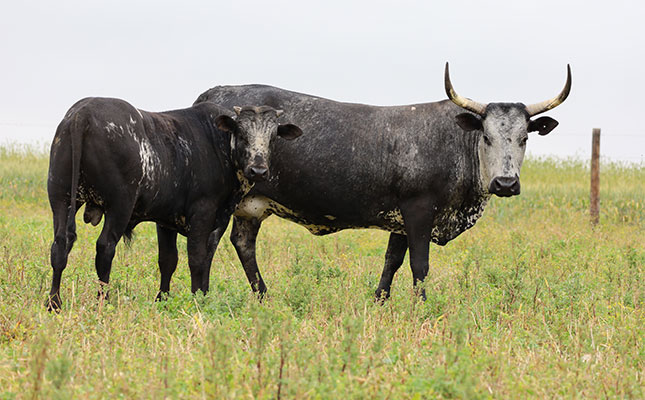
“If you look at the breed in itself, you’ll find so much diversity,” says Eksteen.
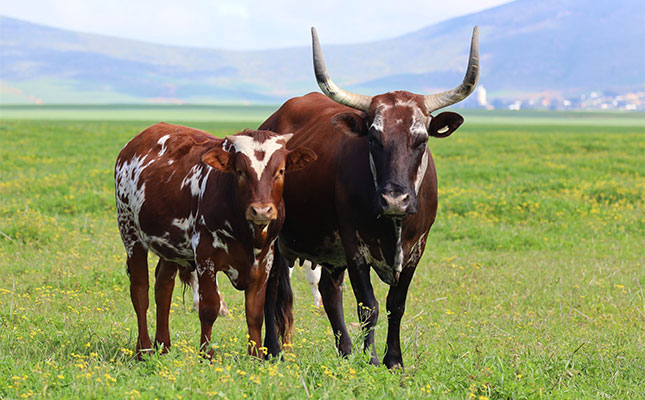
Over generations, different ecotypes developed in response to varying production environments, management systems, and breeding objectives.
“You’ve got your larger-framed cows, your heavier cows, and then you’ve got your smaller-framed cows. There’s everything in between,” he says.
According to him, that diversity allows producers to select cattle suited to different production regions, grazing systems, and management objectives.
The value of diversity
Eksteen believes diversity within the breed is often underestimated.
“There’s more diversity within a breed than between breeds,” he points out.
Different Nguni ecotypes emerged over time through a combination of geography, environment, and selection practices.
“Different ecotypes formed through epigenetics and different areas where they were farmed,” Eksteen explains.
State breeding stations also played an important role in preserving the breed and shaping different ecotypes.
“There were a lot of state development farms preserving these Ngunis, and each state farm had their own criteria for which they selected,” says Eksteen.
For him, that diversity remains a major strength because it allows producers to match cattle more closely to their production environments.
Adapted across South Africa
Eksteen says there are few breeds that are found across such a broad spectrum of farming systems.
“You’ll see Ngunis everywhere in this country due to their natural adaptability,” says Eksteen.
Whether in extensive grazing systems, mixed farming enterprises, or harsher production environments, the breed has demonstrated an ability to perform under varying conditions.
As weather patterns become less predictable and production environments more challenging, Eksteen believes that adaptability has contributed significantly to the breed’s growing popularity among both commercial and stud breeders.
Traits that matter
When asked which characteristics distinguish the breed, Eksteen’s answer is immediate.
“It’s calving ease, mothering ability, fertility, temperament, natural resilience, and feed efficiency,” he points out.
For him, these are not simply desirable traits. They are the foundations of profitable beef production.
While the Nguni is often celebrated for its ability to survive under difficult conditions, Eksteen believes its production qualities are sometimes overlooked.
“The Nguni has got one of the best meat qualities in the country,” says Eksteen.
Built for difficult seasons
Recent years have tested livestock producers across South Africa through drought, rising input costs, and pressure on natural resources.
Eksteen believes the Nguni breed’s strengths become most visible under these conditions.
“Even in the driest seasons, it appears that the Ngunis are doing even better,” he says.
According to Eksteen, resilience remains one of the defining characteristics of the breed.
“You’ve got an animal with really high resilience. I think most of that demand is coming from areas affected by drought. Farmers are realising they need to adapt.”
FMD resilience
Foot-and-mouth disease (FMD) outbreaks have placed immense pressure on South Africa’s livestock industry in recent years.
While Eksteen cautions against drawing scientific conclusions from anecdotal evidence, he says observations shared among Nguni breeders have generated considerable interest.
“As far as my knowledge stretches, there isn’t one Nguni that I know of that died due to FMD.”
He explains that the observation is not based solely on his own experience but on discussions with breeders, breed clubs, and industry role players across the country.
“There were numerous discussions regarding this topic. We have heard that some of the Nguni cattle got FMD, showed slight symptoms, and just recovered,” Eksteen explains.
However, he stresses that these observations should not be viewed as scientific proof of immunity or resistance. “I can’t prove those statistics,” he says.
What has intrigued breeders is the possibility that the breed’s long history of natural selection under African conditions may have contributed to those observations.
“There’s actually people investigating this to see if there is a natural immunity against FMD due to the age of this breed in the country and the fact that it has been naturally selected over many years,” Eksteen adds.
Until scientific evidence becomes available, he believes the observations should be viewed as encouraging rather than conclusive.
Looking ahead
As climate uncertainty, disease challenges, and rising production costs continue to reshape livestock farming, Eksteen believes the Nguni breed is increasingly well positioned.
Its adaptability, diversity, fertility, and resilience remain highly relevant to modern beef production systems.
For him, the future will belong to cattle capable of producing efficiently under real-world conditions.
“If you look at breeding objectives, they should be producing the most meat per hectare, the most fertile cows, and the most efficient cows,” Eksteen stresses.
For him, the future still comes back to the same principles that have guided the Exsteen Nguni Stud for over three decades.
“Ease of calving, natural resilience, most meat per hectare, and fertility. Those are the things that are going to make a difference,” concludes Eksteen.