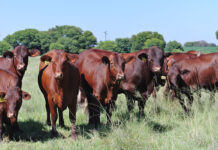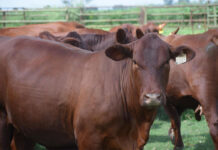
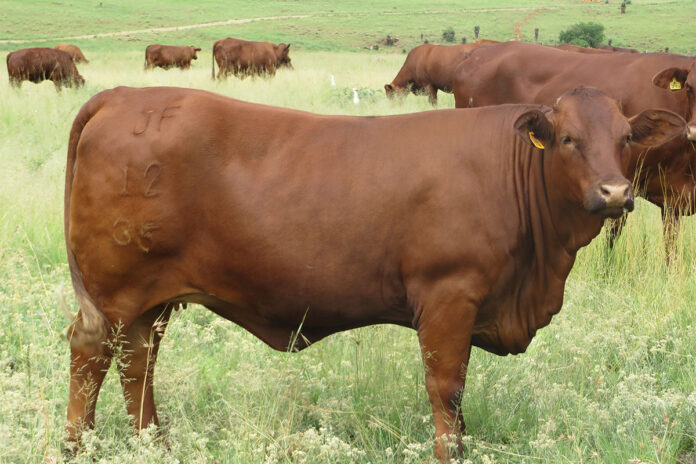
Fyvie’s grandfather imported a larger-framed, growthy type from Texas and established the Cathrew Santa Gertrudis stud. Fyvie grew up on the farm and says his interest in cattle and stud breeding was almost inherited. He bought his first cow from his father, JF080028, in 2010. That animal turned his attachment to the farm into a serious interest in stud breeding.
A few years later, he registered his own herd, Drakensberg Santa Gertrudis, as a junior member of the breed society. When he returned to Tregenna after finishing his studies, he decided to combine the two operations and rebrand them, and Five Star Santa Gertrudis was the result.
The type of animal has changed considerably since 1974, but the basic principles have stayed the same. Fyvie says his grandfather selected cows with good udders and teats, and plenty of milk. He also selected hardy, well-muscled bulls that were structurally correct and had good feet and sheaths. Those priorities still guide the herd.
Their breeding objective has changed over the years. The cattle his grandfather imported were bred for maximum growth, high weaning weights, and feedlot performance. Fyvie has moved away from that approach. He now breeds a more moderate-framed cow that can wean an above-average calf and reconceive every year on the available forage rather than being selected mainly for growth.
He describes the goal as a profit-driven animal, with profitability assessed across the production chain rather than through a single trait.
“For me, ‘profit-driven’ means focusing on producing animals that will make the customer the most money when looking at the full picture. There is always a give and take with genetics,” says Fyvie.

Breeding the all-rounder
Fyvie sees little to separate the synthetic breeds from one another. He argues that the difference between breeders is greater than the difference between breeds. He sees the Santa Gertrudis as a synthetic breed that can be bred as an all-round animal for commercial producers rather than being focused on one production trait.
He rates the breed’s fertility and longevity highly when it is bred well. He also points to its growth for feedlotters who buy weaners. The cherry-red coat is another commercial advantage. Fyvie says it is what the market favours, which benefits farmers using Santa bulls in crossbreeding systems and selling weaners.
Fertility is at the top of his list of non-negotiable traits. “If you don’t have fertility, you have nothing,” he says.
A cow that produces a heavy weaner but fails to reconceive on the available forage contributes nothing to the following year’s calf crop. Fyvie expects heifers to conceive during a 45-day breeding season, calve without assistance and have the udder quality, milk, and mothering ability to raise a strong calf year after year.
This also underpins Fyvie’s approach to management: the cow must work within the production system rather than the system continually compensating for her shortcomings. A cow that requires intervention because of poor teat or udder design, or that lacks sufficient mothering ability, is not rebred.
He does not select for mature cow size and maintenance by eye alone. Instead, he uses in-herd performance indexes and strict culling for fertility. Together, these measures remove cows whose maintenance requirements are too high for the conditions or whose efficiency is too low. A cow that performs poorly against her contemporaries is culled according to her own figures.
Structural soundness is similarly important. Fyvie examines the front legs and shoulder angle, hocks and hind legs, pasterns and feet, hips and topline. A bull has to walk comfortably, cover ground, and climb difficult terrain. Structural faults can eventually affect conception rates and lead to early breakdowns. He says structural traits are moderate to highly heritable, so he does not compromise on structural soundness.
Visual appraisal still matters before the figures are considered.
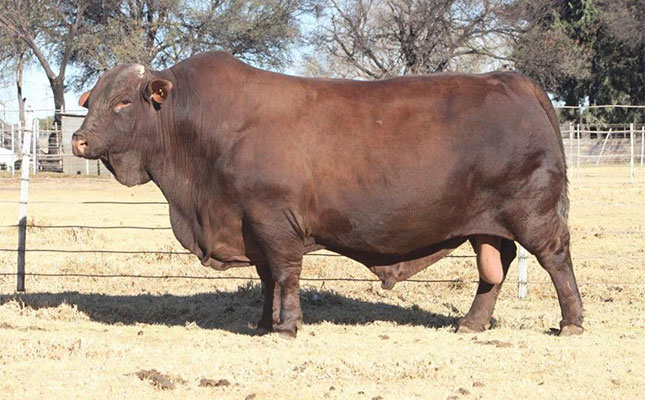
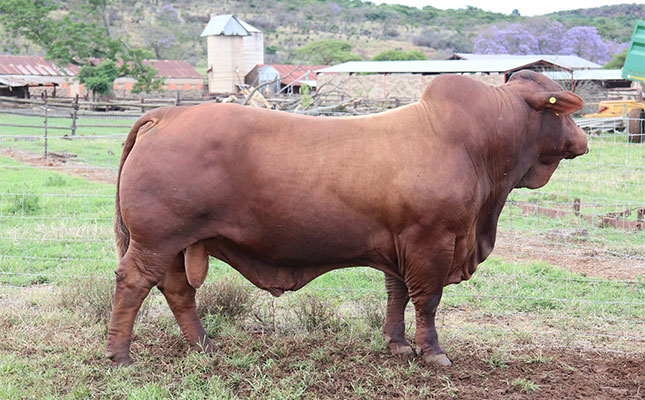
“A bull needs to look like a bull and demand your attention when you first see him. If he doesn’t have enough masculinity, capacity, and sire appeal to impress you at first, then you probably shouldn’t be swayed by his pedigree and performance figures,” says Fyvie.
Sire JL050119 has been an influential part of the herd, with more than 60% of his progeny passing inspection. His influence continues through a son, seven grandsons, and three great-grandsons used in the breeding programme.
Building fertility into the system
The operation currently runs about 275 breeding cows, of which only around 15% are stud animals. The rest are commercial cows, Basic Sections, Appendix A’s and Appendix B’s. They form part of a three-generation upgrading programme that lifts the commercial herd to stud over time. Fyvie describes the herd as “severely understocked” and wants to grow it to between 800 and 1 000 cows, with the aim of eventually having a fully stud herd.
Because the herd is understocked, replacement policy currently focuses on keeping enough heifers rather than selecting only the very best. Fyvie keeps as many heifers as possible, provided their weaning index is high enough and they are not well behind their contemporaries. He focuses more on removing underperforming cows once they enter production, using his own in-herd figures. A heifer from a dam whose Performance Index (P-Index) falls below 90 is not retained.
Once the herd reaches full stocking, Fyvie says they are likely to follow a more systematic approach to heifer selection. After the initial P-Index screening, genuine stud prospects would be assessed visually for femininity, correct wedge shape, capacity, bone, rumen capacity, and easy fleshing. He wants a medium-framed female capable of carrying sufficient energy reserves through difficult periods while keeping maintenance requirements low enough to reconceive quickly after her first calf.
The P-Index is central to how he measures the herd. It uses a calf’s weaning weight and adjusts it for the dam’s estimated maintenance requirement using the Kleiber ratio, with a small allowance for milk. Fyvie says it works much like the cow-calf ratio used by many KwaZulu-Natal farmers.
He says there is a 98% correlation between the two in his herd, but that the P-Index allows cows of very different sizes to be compared more accurately. A cow whose average P-Index falls below his thresholds over two to three years is flagged and not put back to the bull.
A further measure that plays an important role in Five Star’s selection system is maintenance-adjusted lifetime kilograms produced. Fyvie uses it alongside the P-Index to give a longer-term picture of a cow’s performance, bringing together production, fertility and longevity, while indirectly accounting for traits that can limit productive life, such as temperament, structural soundness, and disease resistance.
A cow needs to perform well on both measures, as longevity alone can still mask an animal that produces at a low margin. The lifetime measure also helps Fyvie identify lines to bring back through the artificial insemination (AI) programme, recognise daughters from consistently sustainable lines, and place genomic and estimated breeding value (EBV) information in a broader environmental and financial context.
The emphasis on measurement is also tied to how Fyvie views the responsibility of selling breeding genetics. “We are running a business and want to be able to sell cattle with integrity, that we know will make our customers money, and that is something that requires data,” he says.
Fyvie says this means being able to demonstrate where profitability is generated in the herd rather than relying on appearance or pedigree alone.
Distinct breeding seasons
He runs two breeding seasons. During the winter, heifers are artificially inseminated from 1 to 21 June, with bulls following until 5 August. Cows are inseminated from 22 June to 10 July, with bulls in until 30 September. During summer, heifers go straight to the bull in early November for 45 days. Cows are inseminated from late November, with bulls in from 10 December to the end of February. He plans to shorten the cow joining period as the herd approaches full stocking.
Heifers start their season 21 days before the main herd. This prevents them from calving too far ahead and then going without good-quality forage for two to three months before re-joining. First calvers run separately from the older cows and get preference on the best forage. Being bred 21 days earlier as heifers gives them enough extra time to reconceive as first calvers.
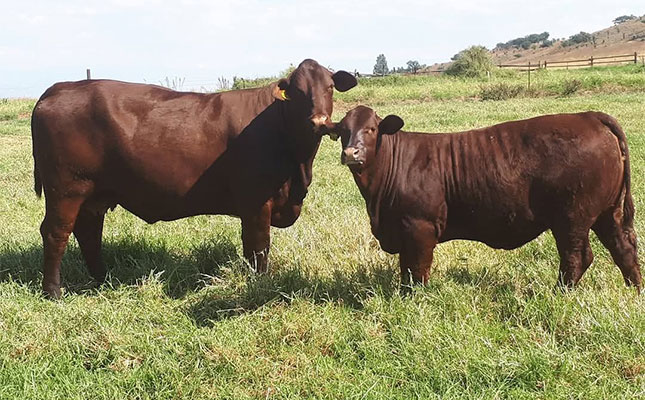
Fyvie wants heifers to weigh at least 350kg before joining. Those that reach the target by 18 months go to the bull then, while the rest are mated at 24 months. He works to the industry-standard ratio of one bull to 25 to 40 cows and uses more bulls when younger sires are in the camps. Pregnancy is diagnosed by the local vet 45 to 60 days after the bulls come out.
The herd is currently achieving a 91% conception rate. Fyvie is satisfied with this because it shows that the cows are not being given conditions that make reproduction too easy. Calving runs at around 88% and weaning at around 85%. Calves are weaned at about eight months. Bull calves average 230kg to 235kg and heifers 215kg to 220kg across both seasons. He expects these weights to increase as the P-Index removes weaker cows and raises the selection standard each year.
Culling for fertility is strict. Any female that fails to conceive is culled. Fyvie says this policy is based on experience: females that have failed to conceive and were given another opportunity have often failed again within the following few years. Cows that need a calf pulled are also culled, except where there is a genuine breach or abnormal presentation that cannot reasonably be attributed to the cow. Cows with teat or udder faults that require assistance for a calf to suckle do not go back to the bull.
Feeding the reproductive cycle
Fyvie names fodder-flow management as the biggest constraint on reproductive efficiency. The aim is to manage fodder flow so females have every reasonable opportunity to conceive, allowing him to maintain strict fertility-based culling.
Cows and first calvers calve down in good condition after summer. They move onto maize stalks within two months and then have access to cover crops from late July to the end of September. The cover crops are an important part of his system. They help maintain milk production as the calves get older and provide quality grazing once the calves start eating for themselves. Fyvie tries to have as many animals as possible make use of this period.
Calf mortality is low, but Fyvie says tick-borne diseases are the main contributor to the losses that do occur. Calves receive the necessary vaccinations and are weaned at around eight months. The herd works through the summer breeding season on veld under tick pressure, which is one reason he values bulls that adapt to the environment and hold condition while working.
Testing genetics against the market
Five Star is not yet selling many bulls because of the low stud numbers and strict selection. Most visitors to the farm at this stage are therefore stud breeders. Fyvie’s view of commercial demand comes mainly from conversations at shows and events and from the fat-stock ring.
He uses fat-stock and carcass competitions to compare his genetics with other breeders, and to check that he is still producing cattle suited to the market.
“We believe in a holistic approach to breeding. We don’t believe in taking our breeding animals and feeding them up for halter shows, so this is a nice compromise that doesn’t interfere with the breeding programme,” says Fyvie.
The competitions allow him to benchmark his genetics against other breeders and assess whether the breeding programme is drifting too far from what the market requires. Carcass performance remains less important than some of his other production criteria, but he does not believe it should be ignored.
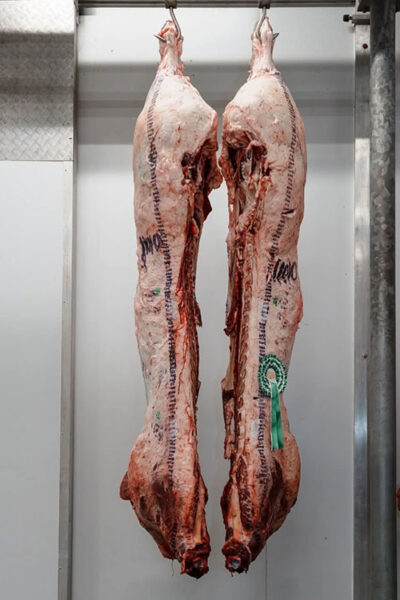
At the 2025 Royal Fat Stock Show, one of his Santa Gertrudis animals was First Reserve Champion Super Ox on the hoof before winning the Super Ox carcass competition. Fyvie says the result highlighted the importance of balancing conformation, dressing percentage, and fat distribution: an animal that impresses on the hoof will not necessarily perform as strongly on the hook if those traits are not balanced.
The competitions also influence his selection decisions. Fyvie uses them to assess how well he is finishing cattle and to identify sire lines worth watching for carcass performance. He says some animals with impressive conformation, but poorer fat distribution, are carriers of the NT821 myostatin gene. This can flag sire lines whose paternal sisters need closer monitoring to ensure that they are maintaining acceptable fertility and production performance.
He says the breed’s dressing percentages and carcass traits can also add value to cull cows. Five Star cattle consistently receive a premium in the fat-stock auction ring and have also achieved strong results on the hook. Fyvie nevertheless regards this as part of a broader measure of commercial performance rather than a reason to shift the breeding programme towards carcass traits alone.
What buyers ask for, in his experience, starts with phenotype.
“The commercial breeder still prioritises phenotype above everything else. It is a rare buyer who will be happy buying an ugly but productive bull,” says Fyvie.
This does not mean buyers ignore production traits. Once they like the bull visually, he says, they begin comparing measures such as growth, fertility and calving ease. One request he hears particularly often in KZN is for moderate size because larger cattle can struggle in sourveld regions.
The next generation of Five Star Santas
Fyvie is genomically testing all his Appendix B and stud females, as well as his retained young bulls and stud sires. He expects the information to improve his knowledge of myostatin status and EBVs and help make more informed genetic pairings.
He does not, however, regard genomics, EBVs, or any other individual measurement as a standalone selection system.
“Each of those is like a Ferrari. Used in the right way they can be powerful. Used in the wrong way and they can accelerate you in the wrong direction very quickly,” he says.
For Fyvie, these tools have to be interpreted in the financial and environmental context of the farm. Genomic information can guide breeding decisions, but Five Star’s actual culling decisions remain tied primarily to in-herd production measurements.
Ten years from now, Fyvie wants a cow herd with strong fertility and productivity that can hold condition on the available forage.
“When people visit the Five Star Santa Gertrudis cow herd I want them to see maternal excellence, uniformity, and undeniable quality. It all starts with the cows,” he adds.
He also wants his bulls to enter commercial herds, adapt quickly, and improve the buyer’s bottom line. His longer-term ambition is to see a resurgence of the Santa bull in KwaZulu-Natal commercial cattle herds.
For now, that goal starts with developing the female herd: producing cows that can perform consistently within Tregenna’s conditions and, in turn, breed bulls that commercial producers can use with confidence.
Follow Five Star Santa Gertrudis on Instagram at fivestar_santa_gertrudis and Facebook at Five Star Santa Gertrudis.