

We’re on our way to visit Howard and Judi Sheard of Weltevreden Guest Farm, via a stopover in Nieu-Bethesda village, which is slumbering gently before the Christmas tourist rush. After a year of good rains, the little village and the Karoo veld around it is Irish green, so very green that it looks a little unnatural.
But hey, you’re in Outsider Artist Country and maybe the world should look a little enhanced around here. This is where Helen Martins built her iconic Owl House and Camel Yard, a cement collection of figures and friezes taken from Biblical times and Arabian influences – all made famous by Athol Fugard’s Road to Mecca play.
The Ongeluksloot Story
We drive on to Ongeluksloot, where the famous Stone Folk hang out, courtesy of artist Ryno Greeff and a kind local farmer. Stone figures, held together in bands of wire, are all about. Why is this place called Ongeluksloot? Therein hangs a story.
Many years ago, one of the elder Sheards and his wife were returning from an event at the Nieu-Bethesda tennis club in an old bakkie in the rainy season, and the fast-moving ditch waters washed them down the ravine. Hence the name.
They were said to be carrying the proceeds from the tennis club event in a suitcase for safekeeping. This, too, was washed away in the flash flood.
“They say that if you know where to dig at Ongeluksloot, and you dig deep enough, you might well find some old coins and notes,” Howard tells us later.
Not quite the Kruger Millions but, you know, not nothing either.
A Gracious Farmstead
The road to Weltevreden is punctuated by little springs popping up everywhere. The mountains around have vanished in low cloud, but we know the awesome Compassberg lurks somewhere like a giant hiding in a large vanilla milkshake.
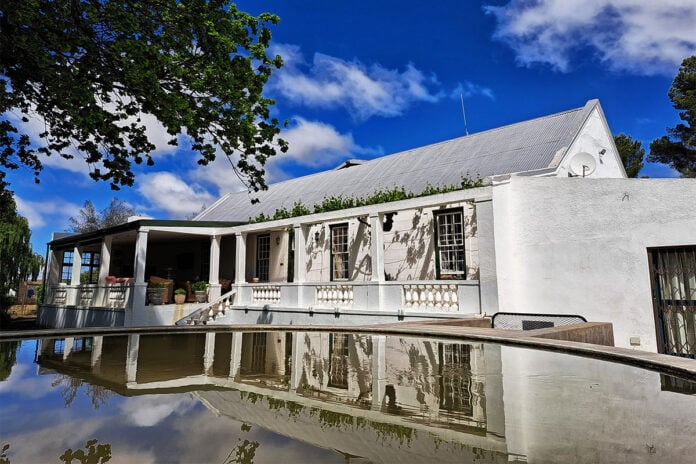
Once at the homestead, we park under some venerable old oak trees and go in search of Judi, our hostess. It turns out she has ensconced us in the spacious wing of the rather stately family home, where we will be sharing meals with her and Howard. No self-catering on this gig.
Which turns out great, because Judi cooks like a dream and Howard is the master of the stoep braai outside.
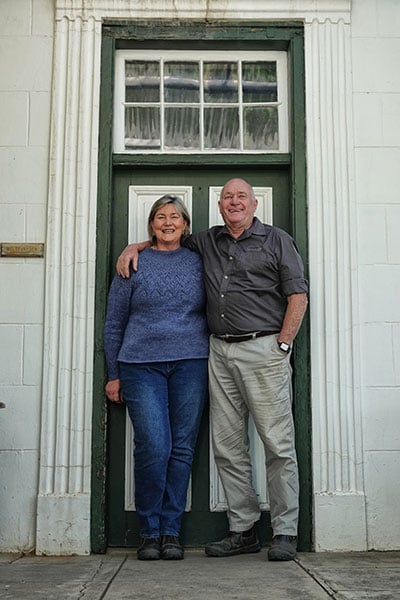
Although it looks like they’ve lived here forever, the Sheards only re-occupied the farm in 2025, after a 15-year stint working for Coastal Hire (a small equipment rental franchise) in East London (KuGompo City).
“I’d been working the family farm here for 20 years already when Coastal Hire made me an offer I couldn’t refuse,” says Howard. “But now we’re back.”
Spinning with Karoo Moon
Judi brought her thriving yarn business, Karoo Moon Wool, over from the coast and continued on the farm with the help of her right-hand woman, Nomvuyo Nikani, whom she taught the art of dyeing and winding wool.
We last saw Judi at Middelburg’s Winter Wool Festival in 2025 and 2026. She was surrounded by genuine wool rolls in the colours of jewels: ruby, rose quartz, turquoise, emerald, amethyst, aquamarine, lapis lazuli, jade, pearl, opal, and topaz.
On the farm, the Karoo Moon Factory and Shop are mere metres away from the Sheards’ office. After being cramped in a garage for so long, Judi and Nomvuyo are absolutely revelling in the space.
Spinning, Dyeing and Winding
This a true Karoo homespun industry, so to speak. There are two parts to the workrooms. In the one part there are cookers all along the walls – piles of very shiny, very large pots. Lots of ventilation. This is where Judi and Nomvuyo work their dyeing magic. It’s a bit like alchemy.
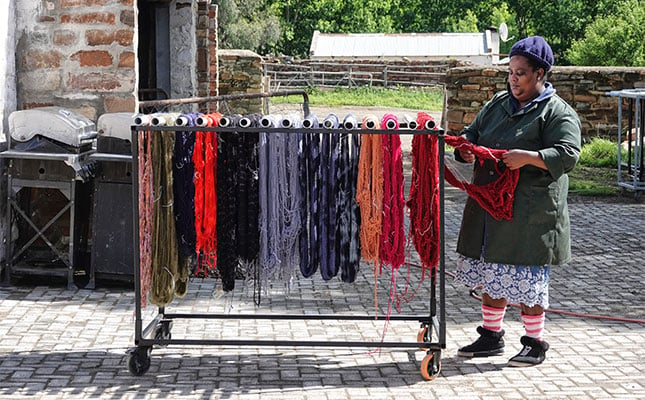
Outside on a trolley equipped with thin pipes is a proper boer maak ’n plan contraption. From it hang brightly coloured yarns, gently drying in the sun and breeze.
In the other part of the workspace there is a large interleading space with a few interesting contraptions. Then we see Jasmine Kwatshu winding bright coral-coloured wool into a skein. Her family live on the farm, and she started learning about working with wool about a year ago.
Near her, close to a sunny window, is Winston Abrahams in his wheelchair. He was partially paralysed by a spinal cord infection when he was a teenager. Under Judi’s tutelage, Winston learnt how to spin wool and to wind it. He is a man of few words, proud of his job and focused on the task at hand. In the corner is his mother Susan Olifant, winding some purplish boucle wool.
Then Jasmine, with a twinkle in her eye, asks whether we would like to see the ‘bicycle’. She leads us to a contraption draped with thick circles of wool. There is a bicycle chain on the one side. When it moves, the wool is turned into twisted skeins, like the world’s longest and most colourful koeksisters.
Jasmine deftly takes a skein from the spindle and twists it into a specific form, tucking one end into the other, nearly ready to be shipped off. Some buyers prefer receiving their wool in a twisted skein; others like it wound up in a ball.
The Karoo Moon Shop
In the nearby Karoo Moon Shop there is dazzling colour wherever you look, and luxurious rolls and skeins. Their colour names are mesmerising: Agave Bud, Bay Blue, Blazing Cerise, Cape Aloe, Dragonfly, Flowering Acacia, Grey Sky and Plink. You’ll also see Blue Mint, Bokke, Buttercup, Green Tea, Periwinkle, Bordeaux and dozens more.
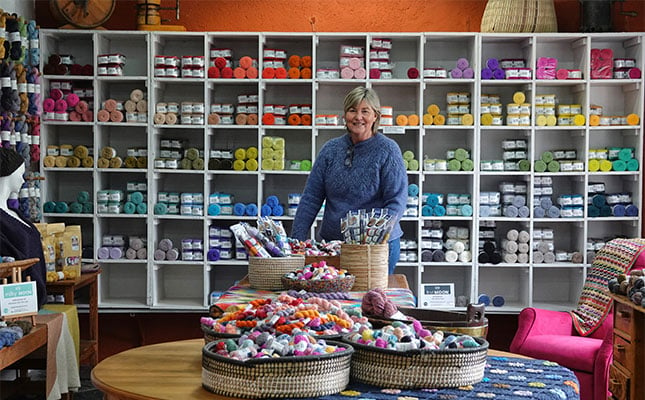
Judi has not only 110 colours but also at least six different kinds of wool. According to their different mixes and texture (including silk, baby mohair and linen) they are called Full Moon, Silky Moon, First Moon, Double Moon, Mixed Moon, and Mini Moon.
The wool-spinning and dyeing business was started by Judi’s mother, the late Sheila Knott, at their Kei Road farm in the Eastern Cape, mainly to teach skills and provide income for unemployed local women. Judi’s enterprise at Weltevreden follows that trajectory.
Out in the Veld
After a tour of Pond Cottage and the 1850s watermill nearby, we join Howard, who takes us on a drive around the farm, part of which is leased to David Short of Wheatlands down south. Howard still runs a herd of Angus-Tuli cattle high in the Sneeuberg mountain massif, where one can almost look hills and ridges in the eye.
His family has owned the farm for four generations.
“My great-grandfather, Andrew Cadle, was living with his wife Ann in Port Elizabeth,” says Howard.
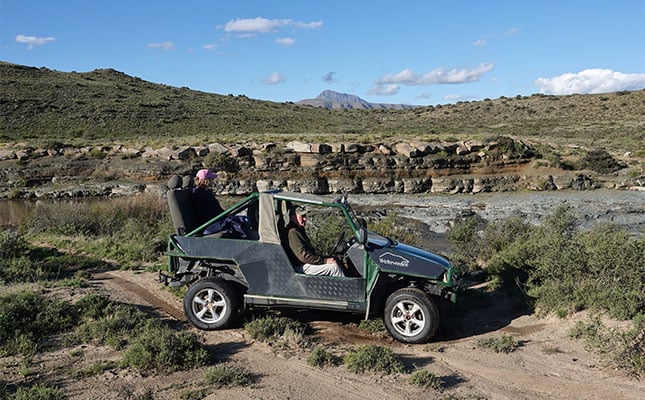
“And because Ann had asthma, the doctor advised them to move to the drier climes of the Karoo. So, my great-grandfather first came to Graaff-Reinet, in 1903, by train and cycled out into the Sneeuberg to find suitable land. He came across Weltevreden – well satisfied. The main house had been the headquarters of the military detachment that patrolled the Sneeuberg back in the mid-1800s, keeping the peace between the San Bushmen and the settlers.”
Judi later tells us that when her father-in-law, Trevor Sheard, was born in Alice (now Dikeni), his aunt picked up some acorns in the street and on returning to Weltevreden planted them on the banks of the irrigation canal that ran past the front of the homestead.
On this hot summer day, with a cold drink in hand under the great oak trees, we reap the benefits of Trevor’s aunt’s labour and foresight.
Howard follows the guidelines of regenerative farming on the principles of holistic management as advocated by Allan Savory, where livestock is left on the land only briefly before being moved on. He is trying to fix up some past damage. On the farm, there was one specific large camp where the wagon oxen were always kept, decades ago. Being in the same camp year after year meant they completely decimated the grasses.
After dividing the large camp into four smaller camps, using a ripper, Howard has created furrows into which he and his workers sowed grass seeds. He is starting to see the results.
The Prison Building
Back at the homestead, Howard and Judi show us the old prison behind the main house.
“The owner back in the 1800s was a magistrate and he would regularly bring in convicts for labour,” says Howard.
“But of course he needed a safe place to house them while on the property, hence the prison. The bars on the three windows are made from the barrel of a single-barrel shotgun, a double-barrel shotgun, and the hoop iron from an ox wagon wheel. The present-day kitchen, a narrow space, was where they were put in confinement.
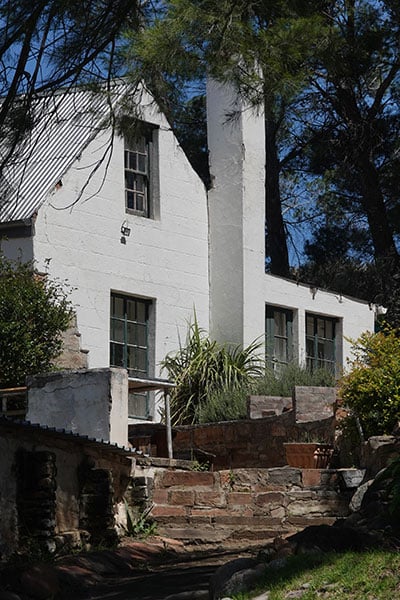
“The story goes that the prisoners would escape at night, climbing up through the chimney. They would then go and find the horses and donkeys that they worked alongside during the day. Instead of using the steeds to escape, they would drive them up and down the roads to exhaust them, so they didn’t have to work the next day.”
One of the Sheards’ many projects includes turning the old prison into a self-catering cottage. It’s obvious that agritourism is paramount on Weltevreden Farm.
A Trail Through Karoo Farms
“Another option for adventurous guests is to do the guided Stone Folk Trail, run by Anthony Rosenbaum of Wide Open Spaces,” Judi tells us.
“It crosses a number of farms around here and obviously goes through Ongeluksloot, where the Stone Folk live.”
The Sheards are also planning to present immersive skills weekends, which will include workshops to enhance their guests’ Weltevreden Farm experience.
“And then I have my eye on turning some of the other outbuildings into guest units,” she says.
And luckily for Judi, Howard is willing and able to provide the material and manpower to fulfil her dreams.
For more information, phone or WhatsApp Judi Sheard on 082 781 6882, email [email protected], or visit karoomoon.co.za.