

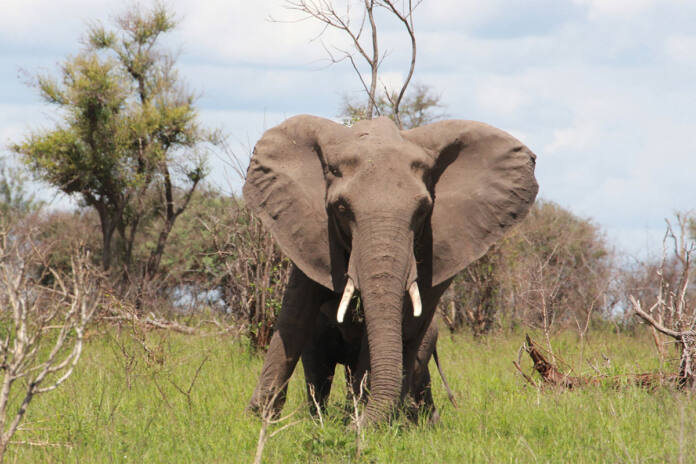
The debate about the impact of elephants on the rapid decline of big trees in Africa, specifically in the Greater Kruger National Park (GKNP) is closely followed by managers, serious ecotourists, conservationists, scientists and, of course, animal welfare bodies.
African elephants (Loxodonta Africana) are natural engineers influencing ecosystem structure and function, which can completely alter the vegetation. Of concern is that the decline in trees could negatively affect biodiversity, specifically species that are highly dependent on large trees, and ultimately ecosystem function.
Tracking vegetation change
A new long-term study discussed in a paper ‘Assessing the impacts of changing elephant densities on woody vegetation structure in private reserves within the Greater Kruger National Park’, investigated how vegetation responds to changes in elephant densities in protected areas. It highlights what managers can expect when removing fences between properties, as is happening on the western border of the southern and central portion of the park.
According to lead author Prof Konrad Wessels, of the Department of Geography and Geoinformation Science at George Mason University, Fairfax, in the US, world-renowned private reserves (PRs) have steadily been dropping fences separating them from the GKNP since 1991, allowing wildlife to move freely.
This has caused up to a 20-fold increase in local elephant numbers, largely the result of immigration from Kruger, with which the PRs form the GKNP. Many of these PRs carried very low numbers of elephants, or none at all, for up to 80 years, allowing woody biomass to increase to levels higher than those typically found in the park.
A growing population
In the 1800s, elephants were almost exterminated from the Lowveld by hunting, and in the early 1900s, were very rare. When the Kruger National Park (KNP) was established in 1927, elephant numbers were extremely low but began recovering. In the late 1950s to 1960s, the foot-and-mouth exclusion fence enclosed KNP, with elephant numbers increasing inside the park, while remaining low in adjacent, fenced-off PRs.
From the 1970s until 1994, active management (culling) maintained around 8000 elephants in the KNP, but after culling ceased in 1994, numbers had increased to 17 000 by 2015. Today there is estimated to be more than 40 000 in the GKNP, whereas populations have plummeted outside protected areas across Africa.
The study found that removing fences between the PR and KNP leads to rapid increases in elephant densities in formerly lower-density areas that may exceed the density of the source area in the short term, causing pronounced and rapid vegetation changes.
The rapid movement of elephants is likely due to the abundance of palatable tree species that proliferated during extended periods (50 to 80 years) of elephant exclusion or low densities. In addition, these smaller protected areas have a considerably higher density of artificial water sources than neighbouring KNP.
Impact on trees and grasslands
This may result in the loss of large iconic savanna trees along with their ecological and aesthetic benefits and substantial reduction in above-ground carbon stocks. Excessive loss of trees can also lead to the decline of shade-loving, palatable, productive grasses such as Panicum maximum (buffalo grass) and reduced grazing quality.
Field and satellite remote sensing data recorded an immediate impact on vegetation structure within the first four years of elephant access, causing a 50% to 60% reduction in woody biomass. Previous research in the south-western part of the Balule Nature Reserve, found that the population of large marula (Sclerocarya birrea) trees (5m to 11m) decreased by 23,8% within three years after elephant access.
This is supported by other research that found a decline in trees taller than five metres, 18 years after re-establishing elephant access, and that elephants moving into the private reserves before 2003, led to decreased tree density and woody plant canopy size in the long term.
Benefits of elephant activity
The transformation can also have positive effects like reducing bush encroachment, better visibility for tourists, and improved grazing due to reduced competition with trees. Other positive elephant impacts are improved vegetation composition, along with habitat features that may promote high biodiversity.
All this poses a controversial management conundrum to conservation agencies and private reserve owners challenged to both maintain biodiversity and protect elephants, namely the ‘elephant management paradox’.
Aggravating the situation has been the lack of evidence directly linking elephant density changes to vegetation structure changes across extensive conservation areas, a knowledge gap that this study addressed.
Measuring the effects
As elephant numbers have been monitored across PRs for the past 35 years, this study was able to scrutinise the impact of known elephant density on 11 PRs and directly link changes in density to changes in woody vegetation structure and biomass using satellite remote sensing time-series data.
The study found that when elephants from GKNP gain access to a reserve their density can rapidly rise to more than five individuals/km2, resulting in a 60% reduction in above ground biomass density (AGBD) in four years, after which their density generally decreased to around two to three elephants/km2, while AGBD continues to decrease at a slower rate.
Woody vegetation in savannas is increasingly recognised as a critical global carbon reserve and can play an important role in natural climate solution initiatives in Africa. So, there is a need for accurate long-term monitoring of woody AGBD across the extensive savannas where multiple drives, including fire, humans and herbivores, cause changes in AGBD.
Carbon storage versus conservation
Elephants play a major role in influencing savanna carbon stocks, often outweighing the impacts of humans or fire. The loss of carbon presents a management trade-off between objectives aimed at climate mitigation through increased carbon storage versus the conservation or reintroduction of elephants to reduce shrub encroachment and maintain open savannas.
The study concludes that managers should strive for large connected landscapes with variability in elephant densities, for example limiting artificial waterholes to bring about heterogenous tree cover that promotes a wide variety of grazing and browsing conditions.
After calibrating and demonstrating the remote sensing methods in the PR’s, they are now being applied to the GKNP and extended into Mozambique and Zimbabwe to monitor vegetation change and the potential contribution of changing elephant populations.
The methods are being transferred to a new radar satellite launched by NASA and Indian Space Research Organization, called NISAR, that will provide two-weekly imagery ideal for monitoring woody vegetation change, as well as soil moisture.
Footnote: Together, the KNP and adjacent PRs open to the KNP make up an interconnected protected landscape of 24 000 km2 called the Greater Kruger National Park.
* Corresponding author.
E-mail address: [email protected] (K.J. Wessels).
K.J. Wessels a,*, M.J.S. Peel b,c, I.P.J. Smit d,e, J.D. Armston f, X. Li a, P. Lal f, M. Urbazaev f,g
a Geography and Geoinformation Science, George Mason University, Fairfax, USA b Animal Production Institute, Agricultural Research Council, Nelspruit, South Africa
c School of Animal Plant and Environmental Sciences, University of the Witwatersrand, Johannesburg, South Africa d Scientific Services, South African National Parks, George, South Africa
e Sustainability Research Unit & CNRS-NMU International Research Laboratory REHABS, Nelson Mandela University, George, South Africa f Department of Geographical Sciences, University of Maryland College Park, College Park, MD, USA
g GFZ Helmholtz Centre for Geosciences, Telegrafenberg, 14473, Potsdam, Germany




