
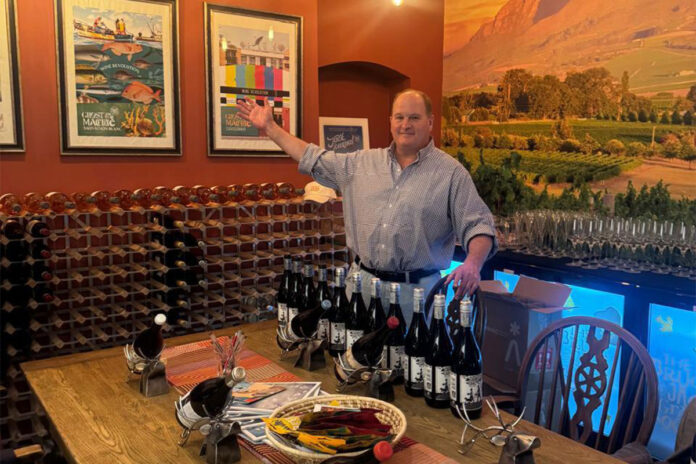
Bruce Jack arrived in the wine world carrying a quiet intensity and a talent that seemed less like education than instinct. In less than three decades, he’s built a reputation that straddles two complementary ideas: meticulous craft, and a kind of unspoken mystique.
In the vineyards and cellars of South Africa, his name has come to mean rigorous attention to terroir, a stubborn devotion to low-intervention winemaking, and the ability to produce wines that both reward immediate pleasure and the patience of ageing.
I first met Bruce around 2001 when an invitation to visit his recently established urban winery in the Cape Town Waterfront precinct landed in my inbox. I had heard of this new kid on the block who had established Flagstone Wines a few years before, and was eager to taste the debut wines under his newly launched label.
On arrival it was immediately evident that this was not going to be a run-of-the-mill producer relying on generations of family winemaking heritage, but rather a fly-by-the-seat-of-your-pants endeavour without fear of experimenting with previously untried and untested techniques and ideas.
There were no fountains or flags to welcome us, nor a fancy glass-and-steel tasting room with hand-blown stemware. Instead, the air was filled with vibrant energy and a restlessness to create something groundbreaking.
In the winery, between barrels and a basket press, stood a piano. I was duly intrigued.

My strongest recollection of the wines we tasted that evening were two Pinot Noirs: the 2000 Poetry Collection, and the 1999 BK5 (a clone usually reserved for the making of sparkling wine). These Pinots were unlike any other I had ever tasted. The Poetry Collection showed restrained elegance, soft tannins and a fruit-forwardness not usual at the time for South African Pinot Noirs.
The BK5 was a massive fruit bomb, showing the influence of Bruce’s Australian training and creating quite a controversy as to the future direction of ripeness and alcohol levels when it took the top spot in a wine magazine tasting against a line-up of luminary local and international competitors.
“At the time, everyone in the wine industry was obsessed with France. It was like we had forgotten we had some of the best farmers on the planet, and some of the best terroirs. So, I decided to make a Pinot Noir that was proud of its home – bold, ripe, delicious, and (by the way) still drinking well a quarter of a century later,” Bruce reflects on those early years.
Studying
After studying at the University of Cape Town and receiving a Master of Literature degree from the University of St Andrews in Scotland, he set off to study winemaking at the Roseworthy Agricultural College in Australia, ultimately receiving a winemaking degree from the University of Adelaide.
“Extraordinarily fired up, I returned home to South Africa in 1998 and simultaneously started a winery, a wine business and a family. Anyone who has done this will tell you it is ill-advised,” Bruce quips with a touch of irony as the chaotic art of keeping many balls in the air at the same time is what he has become known for. Apart from recently acquiring a significant shareholding in Black Oystercatcher Wines in Elim, the portfolio currently consists of a dozen ranges spanning more than 60 different wines.
Innovation and the willingness to adapt have underscored Bruce’s philosophy since the inception of Flagstone Winery, and after a decade he decided it was time to sell the company to a massive US-based drinks business. Following this he joined the corporate world as chief winemaker for Constellation Wines South Africa, looking after global brands such as Kumala that at the time was South Africa’s biggest export wine brand and our biggest in the UK.
Constellation became Accolade Wines, the fourth biggest in the world, and Bruce was the group winemaker, dividing his time between South Africa, Chile, California and Australia, overseeing the style direction of the company’s core brands. After another decade, he returned to his roots when in 2018 he left the corporate world to focus on his own projects, including The Drift Estate in the Overberg Highlands and his eponymous Bruce Jack Wines brand.
“You know what they say about entrepreneurs: 1% are real entrepreneurs, and 99% just don’t like having a boss! I actually really enjoyed the corporate world. It’s a lot easier than being a sole operator on so many levels. The best thing was the access to information a global corporate has. As a small oke, you can’t really compete on that front. And the brands had such momentum. Hardy’s was the biggest Australian brand when I was the winemaker in charge of style direction. It was like a juggernaut. It was difficult to mess that up.
“When Accolade was sold, I should have retired and gone surfing, but my kids started showing an interest in the wine business, and so I started again. That’s why I did it. It’s bloody tough, but it’s a legacy thing. It’s about generations and generational thinking, and that’s exciting because this industry is so cool and so old – at least 10 000 years old. I love it,” says Bruce.
Over the past 25 years, Bruce and I have kept infrequent contact. We bump into one another at trade shows or on airports, present tastings to small and large groups of wine enthusiasts looking for something that dares to be different, or otherwise I mark the annual Agulhas Wine Triangle (AWT) Festival as a must-do with a selection of some of the most exciting producers thrown together for this one-day event, showcasing the best the region has to offer.
As a founder member of the initiative, Bruce reflects on the underlying philosophy of starting a project that was doubted by many in the early days.
“The AWT is an extraordinary trip, physically and metaphorically. We are way down south, out of people’s way and a long way from Cape Town. Swartland benefitted from being an hour from Cape Town; we are two hours further. But this physical isolation is also a bonus. Only the truly committed stay. Great examples are David Nieuwoudt, Dave Trafford and Trizanne Barnard. This place can’t support Instagram winemakers. It’s too far away, too harsh and far too uncool. The AWT is more like a monastery of an area. You come here to be subservient to the environment, to shun the limelight, to find peace. And once a year we try to pay the bills by having an open day.”
The crossover between Bruce’s background in literature and his winemaking adventures makes for a storyteller of note. One of his more recent forays is a wine range named ‘Ghost in the Machine’, which is a nod to his belief that there is a mystical element in the winemaking process, a ghost that can enhance, or sometimes haunt, the wine.
This playful, yet profound, approach to branding is another aspect of the magic he puts into the bottle, believing that wine is more than just the sum of its parts. With the ‘Ghost in the Machine’ range, Bruce worked hand-in-hand with Rohan Etsebeth of Archival Studio, an innovative design company that focuses on creating truly unique packaging for some of the most dynamic wineries in South Africa, but also as far as Australia and Slovenia.
Bruce and Rohan came up with a world-first concept whereby each bottle goes through the labelling machine three times, thereby creating a multi-layered, unique look for each individual bottle.
Bruce is known to stand up for the underdog, such as releasing a skin contact Clairette Blanche, one of only four single variety expressions of this grape in the Cape. He also doesn’t give up easily; even though he launched his first Pinotage in 2000, it was only in 2008 that he managed to secure a spot in the Absa Top 10 Competition with his Flagstone Writer’s Block Pinotage – now the most awarded Pinotage in the world.
His Bruce Jack Heritage 2022 ‘Flag of Truce’ Pinotage, also an Absa Top 10 winner in 2025, went on to be the top-scoring red wine at the 2025 The Drinks Business’s Global Masters competition.
A heart for the people and the planet
Beyond the cellar, Bruce is deeply committed to social responsibility and environmental sustainability. He believes that winemaking should be a force for good, and this is demonstrated through his work with The HeadStart Trust, a charitable organisation established in memory of his mother, to support education and music programmes in disadvantaged rural communities. A percentage of profits from Bruce Jack Wines goes directly to this initiative, showcasing his commitment to putting back into the community and uplifting vulnerable people.
“I started HeadStart very naively. I was just trying to honour my mom, a music teacher who taught many underprivileged kids for free all her career. Lockdown was hard on a lot of us, but it was devastating to many marginalised, disenfranchised, rural communities like ours in the AWT. Many ANC municipal representatives just disappeared and switched their phones off. This vacuum allowed civic society to rise – churches, mosques, Rotary, Round Table, and real charities saved the day. It was an amazing and humbling experience. We were only involved in education before COVID-19. Suddenly we had to learn about feeding starving people. My friend Robert Graaff from Graaff Fruit donated a truckload of apples to our cause. My other friend, Scott Millar, sent weekly truckloads of fresh bread from his bakery. I’ll never forget handing out fresh apples and fresh bread in the Napier township and seeing the smile on a kid’s face biting into a fresh apple for the first time in his life. Joy in times of despair – isn’t that what life’s about?”
The vineyards that Bruce sources grapes from, whether on his own farm or elsewhere, often demonstrate a singular focus on site selection. He seeks places where the soil tells a story, and he tends to prefer old vines or low-yielding blocks that concentrate flavour without leaning on technological tricks.
Cellar tactics are also the result of a less-is-more philosophy. Long, cool fermentations retain aromatics, careful lees management add texture without muddying freshness, and gentle racking and modest sulphur use protect natural expression rather than stripping the wine of its personality.
While minimum intervention in the cellar is the mantra, Bruce jocularly comments: “It’s the never-ending repairs and maintenance on a farm that ultimately crushes us and sends us to our graves.”
Barrels are chosen for nuance and compatibility, often older oak that integrates without dominating. Ageing regimes are decided by tasting, not calendar, and when blends are constructed, the emphasis is on maintaining clarity and balance rather than pursuing a weighty or extravagant profile.
The signature styles
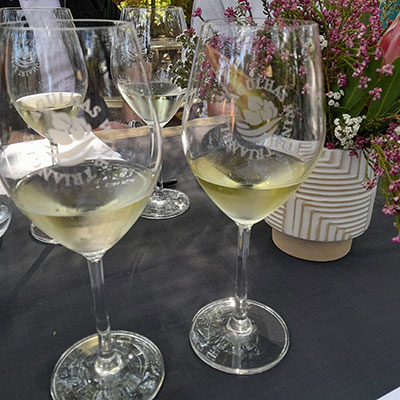
The white wines offer mid-weight concentration, defined acidity and a mineral thread that ties fruit to place. Bruce’s reds frequently show fine-grained tannin structure and a lithe sense of tension where the fruit is ripe, but not loud. For drinkers who prize wines that pair well with food, these are natural companions: acidity and texture that can hold up to a wide range of dishes without obliterating them.
“To make the perfect bottle of wine, you first have to make one that doesn’t lose you money or destroy your soul. Anyone can make a lekker wine, but at what cost? If you can construct a world where your craft is both financially sustainable and doesn’t harm anyone, then you have a chance of getting the ethereal things right, like balance, concentration, longevity and authenticity.”
Currently, the main Bruce Jack range consists of five tiers, being the estate range produced in minute volumes on his farm Appelsdrift in the Overberg Highlands, the heritage range, the reserve range, the Ghost in the Machine range, and the lifestyle Bruce Jack range that gets exported by container load.
There are also a host of other ancillary ranges and wines focused on niche markets (the Pescaluna low-alcohol, zippy white wine in the style of a vinho verde is a great wine to enjoy with fresh seafood), or to underscore specific causes (the Secret Safari range supports environmental conservation and social upliftment).
Apart from wine, Bruce also dabbles in craft cider production in a joint venture in Elgin with the Cluver family.
The Jack Journal
Jack Journal, a top-end lifestyle publication that appears bi-annually from 2019, covers an eclectic mix of topics that are close to Bruce’s heart, including adventure, wildlife, history, art, music, poetry, wine, social upliftment and last, but not least, surfing. To date, nine editions have appeared and can be found on the shelves of Woolworths, Pick n Pay, Exclusive Books and selected bookshops.
The rooftop bar: Jack@SKYE
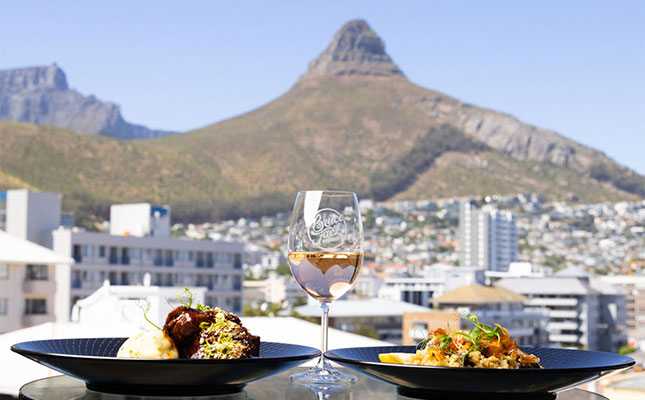
In the early days of Flagstone, Bruce and his wife Penny would be the last to leave any tasting event. It was evident that they had a passion to bring people together around wine for conversation and conviviality. With time came the realisation that this heavy touring schedule could not be sustained indefinitely, and an alternative way of creating a customer interface was needed. From this was born the Jack@SKYE Rooftop Bar at the Hyde Hotel in Sea Point, as well as the Stanford Kitchen Tasting Room.
The rooftop setting of Jack@SKYE is a study in contrasts: city skyline and ocean views with plates and pairings that juxtapose the rural origins of the grapes. The rooftop bar also plays a role in making Bruce’s wines accessible with limited-production bottlings and special cuvées that might otherwise be difficult to source being made available by the glass or in themed flights.
To become part of the Bruce Jack wine tribe, feel free to join the Jack in the Box Wine Club and receive discounts, rewards, complimentary tastings, access to special releases and magnums, exclusive invitations and club tastings with the winemakers by going to brucejack.com.
Over the past 25 years I have come to know Bruce as a brilliant storyteller, an unwavering optimist for the future of South Africa, a creative genius, someone who goes out of his way to be kind to whomever crosses his path, whether a friend or a stranger, an engaging writer and philosopher, a person who is intensely involved in the well-being of his family and community, but ultimately, in the words of Stephan Reinhardt, a German wine writer and reviewer at the Robert Parker Wine Advocate, in a comment on a Facebook post I made a while back: “Superstar! And a fabulous guy.”
The Agulhas Wine Triangle
The AWT was launched in 2019 and consists of 15 like-minded member producers from as far afield as Elim, Cape Agulhas, Malgas, Kleinrivier Valley and Napier. The original impetus for this initiative was given by legendary industry stalwart André Morgenthal, who sadly passed away at the beginning of 2026 after a lengthy illness.
The highlight of activities is the annual wine festival that this year was hosted at Lomond Wine Estate on Saturday 25 April 2026 and included two masterclass tastings focused on the signature grape varieties of the AWT, being Sauvignon Blanc and Syrah/Shiraz (the same grape variety just spelt differently).
Contrary to the popular held sentiment that Sauvignon Blanc is an early-peaking grape variety, bottles of 2007 The Berrio and Lomond Snowbush were poured that showed remarkable freshness and vibrancy.
“This area with its cool maritime climate is one of the best, if not the best, in the world for Sauvignon Blanc, even taking into consideration the difficult growing conditions experienced here,” says Bruce.
On the red side, the wine that caught my attention was undoubtedly the David Nieuwoudt Ghost Corner Syrah 2023 with its ethereal aromatics leading onto a complex and spicy palate. It is a world-class wine that ranks with the best Syrahs I have encountered in many years of tasting this variety from all over the world. The price tag of R420 may seem steep, but it’s actually excellent value for a wine of this pedigree.
Thinus Botha of Ghost Corner Wines comments that “2026 was a rock star vintage”, so it seems that there’s a lot to be looking forward to from this exciting collaboration of producers situated in and around the most southern tip of Africa.
Visit Bruce Jack at brucejack.com or email [email protected].
Agulhas Wine Triangle is available at agulhaswinetriangle.co.za or email [email protected].