
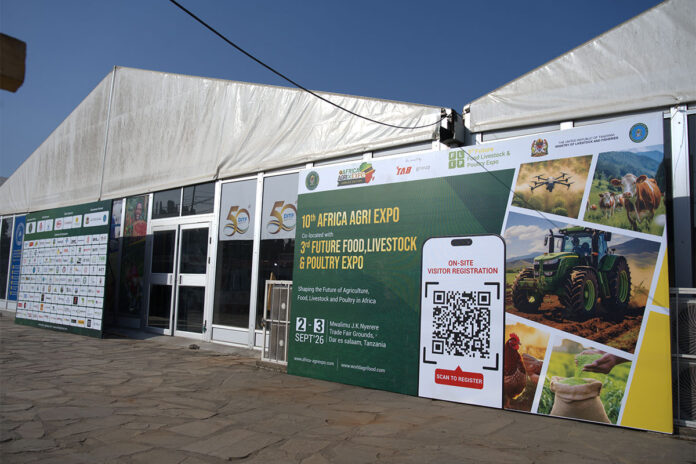
The event, held on 2 and 3 September and organised by TAB Group in collaboration with the Tanzania Trade Development Authority, brought together agribusinesses, investors, policymakers, technology providers, farmers, and other stakeholders.
Co-located with the third Future Food, Livestock & Poultry Expo, the Africa Agri Expo’s theme was ‘Driving Africa’s Agri-Food and Livestock Transformation through Innovation, Technology, Investment & Sustainability’.
Discussions focused on how Africa can move beyond primary agricultural production by improving mechanisation, irrigation, agricultural inputs, finance, digital technology, livestock production, agro-processing, logistics, market access, and value addition.
Opening the expo, Bishwadip Dey, India’s high commissioner to Tanzania, said the event could help deepen agricultural and related economic ties between the two countries.
He said the expo provided an opportunity for businesses from India and Tanzania to develop new ideas, build partnerships, and identify areas for future cooperation.
“I’m confident that this exhibition will generate new ideas, forge meaningful business partnerships, and open new avenues of cooperation between India and Tanzania.”
Dey called on Indian companies to look beyond Tanzania as an export destination and consider longer-term investment and business opportunities in the country.
He also encouraged Tanzanian businesses, institutions, and entrepreneurs to work more closely with their Indian counterparts through joint ventures, investment opportunities, local manufacturing, technology transfer, skills development, research and development, and regional distribution.
According to Dey, agriculture’s future would increasingly depend on innovation and technology, as well as efficient value chains and partnerships that put farmers and consumers at the centre of agricultural development.

Two days focused on the full value chain
The first day of the expo concentrated largely on the tools and investment needed to improve productivity.
Discussions covered government support and agricultural policies, fertiliser and crop protection, livestock health and nutrition, mechanisation, smart irrigation, digital agriculture, drones, and artificial intelligence (AI).
Finance was another key topic, with delegates examining public and private funding, agricultural insurance, agritech finance, and funding opportunities for women- and youth-led businesses.
On the second day, attention turned to areas along the value chain, including Tanzania’s agricultural and livestock potential, agro-processing, logistics, storage, sustainable fertiliser and biological inputs, livestock genetics, animal health, poultry, dairy, food safety, postharvest losses, and export readiness.
The programme also examined climate resilience, youth and women in agriculture, and how African countries can retain more value from their agricultural products.
From producing more to creating more value
Speaking during discussions on agriculture and livestock transformation, Abel Mtembeji, senior agricultural officer in Tanzania’s Ministry of Agriculture, said Africa needs to look more closely at what it gains from the resources already being used in agriculture.
“We produce in large quantities, but the important question is: how much value are we creating from every hectare, every farmer, every unit of water, and every investment?” he said.
Mtembeji said meaningful transformation requires improvements across the production system, including access to quality seed, responsible fertiliser application, pest and disease control, machinery, and irrigation.
He also highlighted agricultural research, digital technologies, extension services, and access to finance, while describing climate-smart agriculture as important for both economic growth and competitiveness.
Meanwhile, Switzerland–Tanzania Chamber of Commerce Executive Director Matthieu Rochat said Tanzania’s agricultural transformation needs to go beyond increasing production.
He said there is significant potential to create more value locally by moving from commodities towards processing, developing competitive products and brands, and retaining a greater share of the value within Africa.
Rochat also highlighted areas where Swiss expertise could support this process, including irrigation and water management, agro-industrial techniques, automation, technology, and quality standards, pointing to the possibility of combining African production and raw materials with Swiss knowledge and access to international markets.
Investment needs to create local value
The expo also sought to attract international investment into Tanzania’s agriculture sector.
Tahir Abdulbari, TAB Group CEO and managing director, said Tanzania had been selected for the 10th edition of the expo because of its agricultural potential and strategic position as a gateway to East African markets.
He added that the event aimed to connect international companies with Tanzanian businesses, policymakers, and other industry players, particularly around technology transfer, mechanisation, value addition, and partnerships.
Technology must work for farmers
Technology was a major part of the expo, with exhibitors showcasing machinery, crop-protection products, digital platforms, and other agricultural solutions.
Several participants stressed that technology is only valuable if it solves a practical problem for farmers.
@farmersweeklysa The Africa Agri Expo marked its jubilee year in Dar es Salaam, Tanzania, from 2 to 3 September 2026, under the theme “Driving Africa’s Agri-Food and Livestock Transformation through Innovation, Technology, Investment & Sustainability”. Tahir Bari, CEO and Managing Director of TAB Group, spoke to #FarmersWeeklySA at the event about how the expo has grown from a small conference into an international agricultural platform attracting companies from several countries and continents. He shared why Tanzania was selected for this year’s event, what lies ahead for the expo, and some of the other agricultural events TAB Group will be hosting. #africaagriexpo #tanzania #agevents ♬ original sound – Farmer’s Weekly SA
Agricom Africa used its ‘Beyond the Tractor’ presentation to examine what needs to happen once machinery has reached the farm.
The company showed that a machine’s value depends on whether it is suited to the job and supported by trained operators, finance, maintenance, spare parts, storage, and access to markets.
Nukta Africa, which exhibited its digital and AI-powered solutions, said the event provided an opportunity to engage with innovators, businesses, technology enthusiasts, and policymakers.
The company’s communications officer, Deusdedith Muzinza Kakorozya, said representing Nukta Africa gave him an opportunity to engage with different stakeholders, showcase the company’s work, and explore how data, technology, innovation, and digital solutions can contribute to transforming agriculture and strengthening access to information.
“One of the highlights was witnessing the interest and excitement around Nukta AI, which sparked meaningful conversations on how artificial intelligence can support information discovery and innovation,” he said.
From exhibition stand to market opportunity
For some exhibitors, the value of the event was not simply in displaying products but in meeting potential buyers and partners.
Mohammed Asif, business development executive at India’s SKM Egg Products, said participation in the expo provided an opportunity to showcase egg products and applications while meeting industry professionals, importers and potential business partners.
He said the exhibition also provided greater insight into the Tanzanian and broader African food market.
Asif described the discussions and new connections as opportunities to explore the potential of Africa’s food industry.
Women turning waste into opportunity
The role of women in Africa’s agricultural transformation was also highlighted through the participation of women-led green businesses at the expo.
The Investing in Young Businesses in Africa – Women Entrepreneurship for Africa (IYBA WE4A) programme supported nine women entrepreneurs from seven African countries – Cameroon, Togo, Malawi, Mozambique, Kenya, Uganda, and Tanzania – to exhibit their businesses at the event.
Their businesses showed how agricultural challenges can also create opportunities for innovation and enterprise.
Solutions on display included circular businesses that turn organic waste into valuable agricultural inputs, digital platforms that connect farmers with markets, and sustainable agro-processing ventures that add value to locally produced crops.
According to the IYBA WE4A project’s post-event statement, the expo gave the entrepreneurs an opportunity to showcase their green business solutions while connecting with potential partners, buyers, and investors.
They also exchanged knowledge on sustainable agriculture and green technologies and built networks with businesses and organisations from across Africa.
“The participation demonstrated that women entrepreneurs were already developing practical solutions to some of the challenges facing African agriculture, while creating businesses and economic opportunities in the process,” the statement said.