
Hosted by the Bureau for Food and Agricultural Policy (BFAP), in partnership with Germany-based Agri Benchmark, the forum brought together producers, researchers, and industry leaders from around the world to discuss animal productivity, exchange advice on globally competitive production systems, and explore common approaches to the growth and sustainability of the global livestock industry.
While the programme covered sheep, pig, and poultry production, beef farming featured prominently throughout the discussions.
Speaking on behalf of Department of Agriculture (DoA) Director-General Mooketsa Ramasodi, Jan Venter, director of plant health at the DoA, emphasised that the forum provides an opportunity for a two-way exchange of knowledge and expertise, underscoring the technical and commercial advances within South Africa’s agriculture sector.
“[South Africa is] now ranked around 30th globally among agricultural exporters. That’s no small achievement,” Venter said, adding that this “shows a sector that continues to adapt, compete, and innovate, with livestock at the centre”.
He also acknowledged ongoing challenges, particularly the impact of FMD on export trade, noting that the lessons learnt in the fight against the disease serve as a template for tackling other challenges.
“It is important to use FMD as an example not only of what went wrong but also of what went right,” he said, citing the vaccination of about 43% of the national herd, estimated at about 12 million head, as one of the successes.
The achievements of South Africa’s commercial agriculture were also lauded by Dr Claus Deblitz, deputy director of the Institute of Farm Economics at the Thünen Institute in Germany, who said the country has a competitive advantage as it “remains a relatively low-cost producer”, given rising global production costs.
Highlighting the continued dominance of the big four beef producers – the US, Brazil, China, and the EU – Deblitz noted a positive global outlook, with demand for beef shifting towards Asian countries, including China, which is struggling to meet domestic demand.
His advice to South African livestock producers is to keep an eye on disease control and strengthen animal traceability, given the country’s FMD situation and its impact on access to global markets.
Lessons from Brazil
As one of the world’s leading beef producers and exporters, Brazil was declared FMD-free in 2025 without vaccination, after battling the disease for several decades.
With FMD eradicated in that country, considerable effort has gone into slowly regaining lucrative export markets that were lost because of the disease.
“There’s no need to vaccinate for FMD [in Brazil] anymore, and this has opened up more markets for us. Last year, we exported to 145 countries, having added 24 more since 2020,” Victoria Rizzato, market and livestock cost analyst at the University of São Paulo’s Center for Advanced Studies on Applied Economics (CEPEA), told delegates.
She noted, however, that while the removal of biosecurity-related trade constraints has opened up market opportunities, Brazil’s FMD-free status has also spurred the need to shore up production efficiencies. These included “producing more with less” by reducing stocking rates on pasture and accelerating genetic improvement in the national herd.
Brazil is also working towards full national herd traceability.
“It’s a lot of work,” Rizzato admitted, adding that the programme is key to the country’s food safety goals and enhancing competitiveness in global beef markets.
Along similar lines, Red Meat Industry Services Chief Operations Officer Dr Phillip Oosthuizen reported on South Africa’s efforts to implement its own digital identification and traceability platform. He explained that approximately 11 500 animals have been enrolled to date, with a target of 40 000 by the end of the year.
Key takeaway points
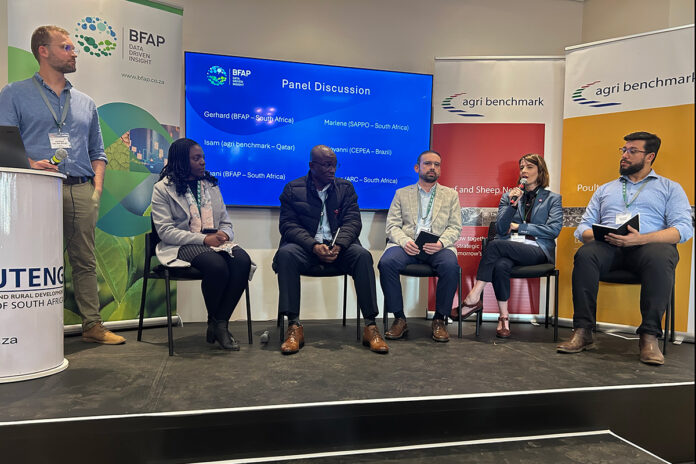
Moderated by Dr Gerhard van der Burgh, manager of the Integrated Value Information System at BFAP, a panel of three South African and two international experts focused on the opportunities and challenges shaping the future growth of South Africa’s livestock industry.
Giovanni Penazzi, researcher at the CEPEA, explained how Brazil had successfully deployed traceability not only to track livestock diseases but also as a selling point in an effort to access export markets.
On a similar note, Dr Marlene Louw, CEO of the South African Pork Producers’ Organisation, advised farmers to factor disease risk into their long-term business planning, as it is key to enabling open and transparent communication with lenders.
Meanwhile Dr Isam Almadani, agricultural economist at Qatar University, pointed to the Middle East and North Africa region as a growing export market for South African livestock farmers.
Looking beyond the forum, the panellists called for closer working relationships within the agriculture sector, with Dr Norman Maiwashe, animal production portfolio research manager at the Agricultural Research Council, calling for stronger public-private partnerships in research and innovation to ensure the country’s future livestock competitiveness.
In addition, Khani Baloyi, agricultural economist at BFAP, highlighted the need to bridge the gap between the country’s highly developed commercial livestock industry and its communal counterpart, with a focus on the new generation of emerging farmers.