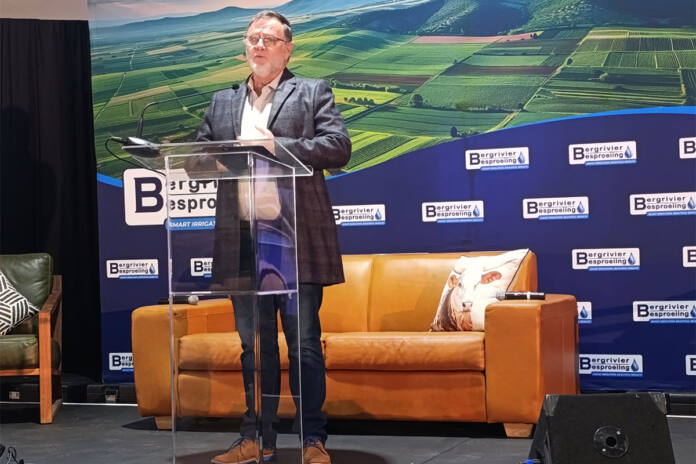
This was according to Western Cape Minister of Local Government, Environmental Affairs and Development Planning Anton Bredell, who spoke at Bergrivier Besproeiing’s ‘Passie vir jou Boerdery’ farmers’ day near Paarl on 4 June.
Severe rainfall and flooding in recent months have left farmers and municipalities across the province facing significant infrastructure damage, while environmental impact assessments (EIAs) have, in some cases, delayed urgent repair work.
Bredell said government has stepped in to speed up approvals where possible to avoid unnecessary delays in restoring critical infrastructure.
He explained that, as part of this response, the provincial government has approved 78 Article S30A applications, allowing farmers and municipalities to carry out essential flood-damage repairs through a simplified, no-cost approval process, often handled over the phone instead of waiting for another EIA.
However, Bredell stressed that the system depends on responsible use, saying farmers must not take advantage of it.
“You still need to stay within environmental laws when making these repairs. Don’t go and build deeper into a river than what was initially approved, as that will negatively impact the system, and you will face consequences if caught,” he said.
Beyond the emergency response, Bredell said government is also working on longer-term measures to reduce the regulatory burden on farmers.
These include an Environmental Management Framework in the Sandveld, which enables farmers to comply more easily with water-use and environmental regulations and reduces the need for individual assessments.
“The initiative helps reduce both the cost and administrative burden of individual compliance, and we would like to roll it out to other regions,” Bredell said.
He added that while government is working to streamline processes, most farmers already protect natural resources, as they understand that long-term damage will ultimately undermine their own production.
South African farmers, he said, are widely recognised for their water-use efficiency and for increasingly adopting technology to adapt to climate variability and extreme weather.
On the broader water security front, the province is implementing its Water Resilience Strategy (2025–2035), which aims to reduce water demand by 40 million m³ per year by 2035 and secure an additional 310 million m³ per year in supply.
The strategy also targets universal diversification of municipal water sources and aims for 80% of municipalities to achieve 95% compliance in both Green Drop and Blue Drop assessments by 2035.
Bredell said lessons from the Western Cape’s severe drought of 2017/18 had reinforced the importance of resilient infrastructure and long-term water planning.
He concluded that agriculture remains one of the province’s most important economic sectors, supporting exports, jobs, and rural livelihoods: “Cooperation between government, farmers, and industry is essential for securing future water and food security, and helping to address poverty.”