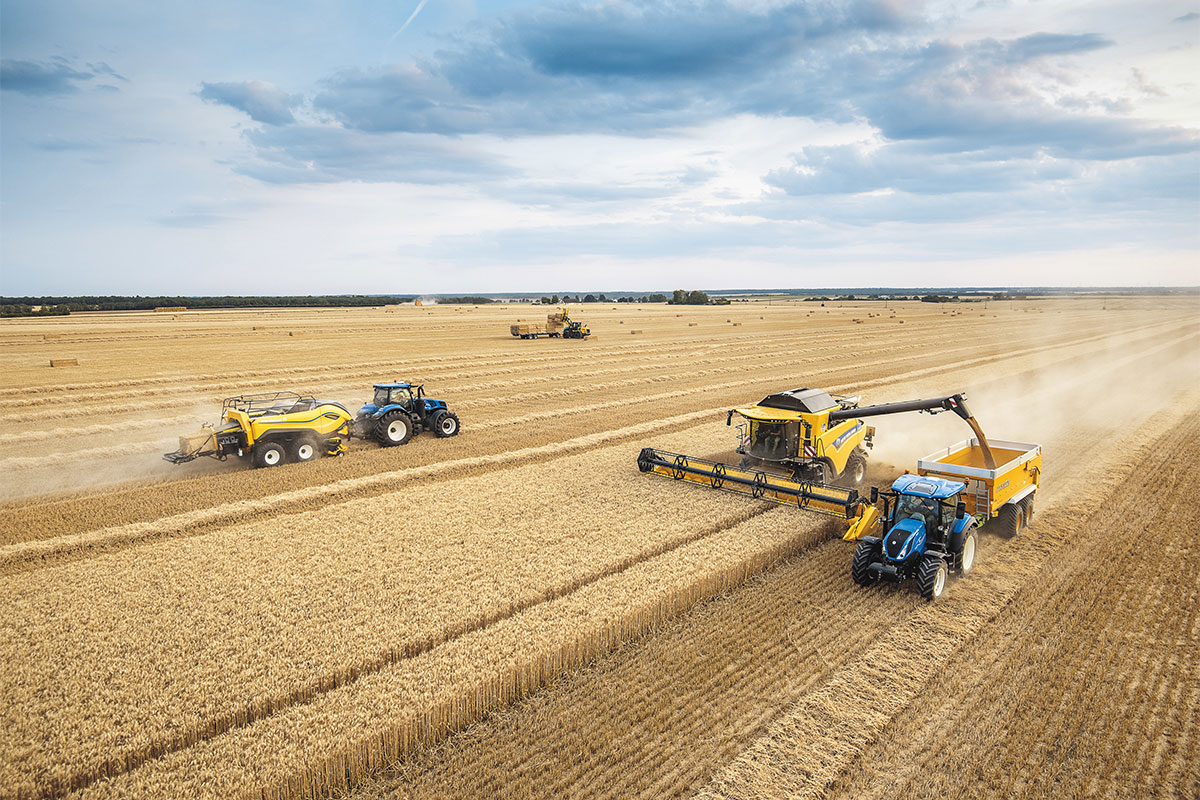
On-farm machinery is undergoing a clear shift as manufacturers move beyond incremental upgrades towards fully integrated systems designed to improve efficiency, reduce complexity and support decision-making in real time. The priority is not simply more power, but better use of that power in the field, ensuring farmers can increase productivity without expanding hectares under production.
Nico Myburgh, CNH’s head of precision technologies for the Middle East and Africa, says the direction of technology is increasingly focused on efficiency and sustainability, driven by global food demand pressures.
“High-horsepower machines are now being engineered not just for strength, but for productivity gains per hour, supported by larger implements, more accurate guidance systems and reduced overlap in the field. In practical terms, this allows farmers to cover more hectares in less time, while improving input efficiency on a per-hectare basis.”
Connectivity is also becoming central to how farms are managed. Myburgh notes that through platforms such as Case IH’s FieldOps, machines can be monitored remotely, and data shared data directly with agronomists, to enable faster decision making.
“Integration of such technology across the whole fleet is however key so that machines can work as part of a wider ecosystem, where data flows seamlessly between equipment, desktop and mobile platforms.”
Myburgh says this level of integration is part of a broader move towards simplified, fully connected systems.
At the same time, equipment design is shifting towards multi-season usability. Machines are increasingly being built to operate across planting, tillage, hauling and other on-farm tasks, improving utilisation and ensuring that capital investment delivers value throughout the year rather than only during peak seasons.
A further development is the move towards full factory integration of technology.
“Instead of optional add-ons, precision systems are being built into machines from the outset, improving reliability, simplifying servicing and reducing the need for specialist calibration in the field,” says Myburgh.
For farmers with existing fleets, aftermarket solutions remain important. Myburgh notes that technology upgrades can now be applied across different equipment generations, ensuring that no part of the farm operation is left behind as systems evolve.
Must-see equipment at Nampo
Nampo, held in Bothaville, Free State, from 12 to 15 May is an ideal event to see the latest technology in action.
At Nampo New Holland will be introducing several new solutions for farmers. This includes the CR10 combine, which has a 12,9ℓ FPT Cursor 13 engine, capable of producing up to 635 horsepower (hp). The design centres on improvements in four key areas: productivity, grain savings, residue management, and uptime.
Jaco du Preez, marketing manager for New Holland Southern Africa, notes that a significant benefit of the CR10 is its ability to handle high volumes of crop material, allowing farmers to move faster through their fields, without compromising quality.
The new T9 tractor, and the upgraded T8 will also be on display. The T9 is a high horsepower (up to 670hp) articulated four-wheel drive tractor designed for large-scale farming and heavy-duty tasks. A key feature is the MegaFlow hydraulic pumps, which deliver a total flow to all hydraulic remotes of 427ℓ /minute. This makes it ideal for high hydraulic demands like seeding and planting.
A compact tractor for orchards, the T4FS, is also being launched in South Africa this year.
At the heart of the T4FS is a common rail engine system that optimises how fuel is injected, improving efficiency and reducing wastage while still delivering the power needed for demanding field work.
Case will meanwhile be launching the AF9 combine harvester, which has a 13ℓ FPT engine with 634hp, and a 16 000ℓ grain storage tank. The harvester has been built for high-capacity grain harvesting, handling up to around 60t/hour depending on crop conditions. Wider header options of up to 12m maximises hectares covered in tight harvest windows. Strong throughput is matched with improved fuel efficiency.
Can South African farms be fully autonomous?
Conversations about future on-farm technology are increasingly surrounding autonomous equipment, and farms that just about manage themselves. Although such equipment is already in use on farms abroad, the business case for South Africa looks different.
Du Preez points to New Holland’s R4 robot that was launched at AgriTechnica last year. This is an autonomous, two-track, zero-emission robot designed for specialty crops like vineyards and orchards, handling tasks such as mowing, trimming, and spraying.
“There are farms in South Africa where it would function perfectly, so it is not that we are not geared to handle such technology. But the autonomous machines come at a significant cost and the local question is one surrounding cost effectiveness, and community support.
“Farmers in the EU struggle to find labour so an autonomous system makes sense for them. In South Africa, labour is available, and most farmers give a real consideration to providing employment for local communities,” says Du Preez.
Myburgh notes that full autonomy requires a significant change in how the farm is managed and the fields laid out. “It’s something that farmers need to consider for the future, but it’s not very practical for every farmer to go fully autonomous right now.”
Rather, he advocates for ‘assisted autonomy’, where current and near-future tools help farmers make faster, more accurate decisions that result in greater efficiencies. This includes planters that do variable rate applications (VRA) of seed and fertiliser, based on yield maps.
Going one step further, Case’s SenseApply™ technology allows for live VRA, which Myburgh says is especially useful for optimising nitrogen and herbicide applications. This camera-based, cab mounted system quantifies the ideal rate of nitrogen or herbicide as it drives over a field and only applies that which is necessary.
“Since it can distinguish between green and brown patches on the ground, it can directly target weeds or crops. SenseApply™ can replace a pre-programmed yield map for nitrogen application by acting as a live ‘sense-and-act’ system, allowing the equipment to determine nitrogen application rates in real time based on actual field conditions.”
Myburgh adds that this technology is especially useful in wet seasons, where crops like soya beans might need to be sprayed with a herbicide to speed up maturation. “Instead of doing a blanket application across a whole field, SenseApply™ can distinguish between a green and a brown plant, and then only spray the green plant, resulting in a significant chemical saving.”
Other areas where Myburgh sees assisted autonomy making sense is on grain cart tractors.
“Rather than have a driver operate the grain cart tractor, its operation can be managed by the combine harvester, to perfectly align with the speed of the harvester. Its popularity has grown in the US and it will be available in South Africa in the next 12 months.”
Better screens and affordable tech
As on-farm margins are being squeezed, the need for precision agriculture tools have become unmistakable to ensure farmers get a return on investment on every input. Although such systems can come at a significant cost, equipment manufacturers are starting to introduce budget-friendly solutions.
At Nampo, New Holland will introduce their FLEETPRO precision guidance system. Du Preez notes that its price tag is a fraction of traditional systems, and can be fitted onto any equipment brands.
Moving towards free access to farm management apps is another way New Holland and Case are working to make precision technology more affordable. Their FieldOps system has no per hectare charge or annual fees for its core functionality.
Myburgh is also excited about the integration of different systems, which means farmers won’t need to invest in multiple systems.
“Our architecture is moving towards a single integrated display and GNSS receiver platform across all machines. Instead of multiple screens and separate systems for different machines or brands, there will be one unified system that all equipment can operate through. It simplifies the in-cab experience, improves compatibility, reduces complexity and ultimately makes the system more reliable and efficient for farmers going forward.”
The farm technology of tomorrow has a strong emphasis on efficiency, integration and measurable return on investment. For farmers, the value lies not in complexity, but in systems that genuinely improve productivity and reduce costs. As Du Preez puts it, the principle remains simple: technology must pay for itself, otherwise it becomes an added expense rather than a solution.