Eskom’s fallibility and rising costs have led many a farmer to consider drawing energy from the sun instead. But moving an irrigation farm entirely off the grid and onto solar energy can be a costly and challenging process.
“The advertisements for solar energy make it seem like you can get off the grid just like that,” says Hannes Schutte, snapping his fingers.
“But the reality is very different, and far more expensive. It also requires a rethink on how the crops are irrigated to maximise energy efficiency so that you don’t overinvest in unnecessary capacity.”
Schutte farms potatoes, maize, wheat, small white beans and forage crops under irrigation in Groblersdal, Limpopo. He started his journey to gain independence from Eskom six years ago. During this time, he has gradually increased his solar energy generation and storage capacity to reach 230kW/hour, generating around 1,5MW per day when there are eight hours of sunshine.

While not entirely off the grid, he is able to run mostly on solar energy during the day, switching to stored energy for a part of the night, and only supplement his energy requirement with Eskom periodically.
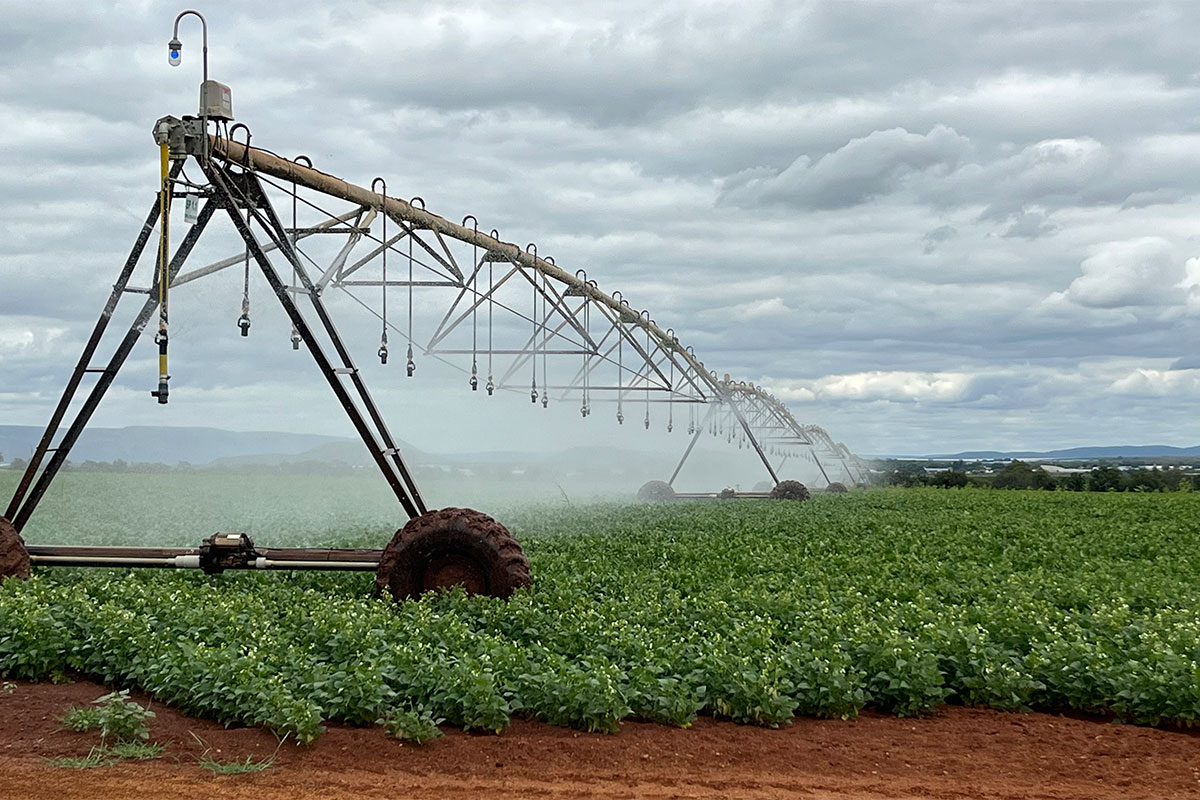
What has boosted his solar energy further is the installation of low-pressure sprinklers on his centre pivots, which drastically reduces the amount of energy he needs. Schutte notes that solar power does not limit one in terms of the type of irrigation system needed.
“But if the fields are far from the pumphouse, as is the case on my farm, then bigger motors are needed to pump the water to the field. We got around this problem by installing low-pressure irrigation.”
The Komet low-pressure sprinkler system provides more uniform droplet size, less misting, and better coverage at lower pressures.
“There is also less evaporation, so more water gets to the plant and is not lost in the air. This reduced the number of pumps needed and lowered energy and water use while improving crop performance,” Schutte explains.
Reducing the size of his centre pivots has also brought benefits, since the smaller management area has meant greater precision. Overall, Schutte has seen a 12% increase in his potato yields as a result of the improvements in irrigation efficiency.
Designing an effective system
While grid independence is the goal, Schutte notes that switching to solar energy overnight is not feasible. “It takes a lot of capital to install enough solar panels and batteries to store energy. The technology is changing rapidly, and the prices are decreasing, so a staggered approach is best to ensure you get the most bang for your buck and stay up to date with the latest advancements.
“There are a lot of learning curves involved, and it is best to approach the switch gradually so that your mistakes have a smaller effect on the business.”
Schutte notes that while solar panels are relatively inexpensive, it is the batteries in which the energy is stored that comes at a significant cost. These are needed to keep the farm running at night or when overcast days deliver insufficient sun to power the system during the day.
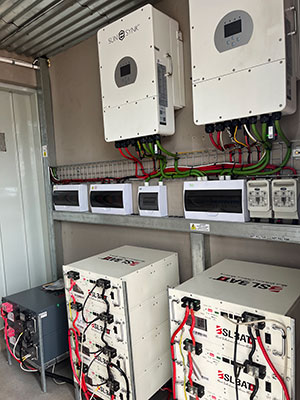
Schutte therefore has a hybrid system where Eskom electricity can be used when battery power has been depleted. A generator is also used when Eskom electricity is not available. Schutte says that the design of such a power system is not necessarily a copy-paste exercise, but needs to be tailored to a specific farmer’s operation.
“Figuring out what your needs are and which system works best takes time, which is why gradually building the system is better.”
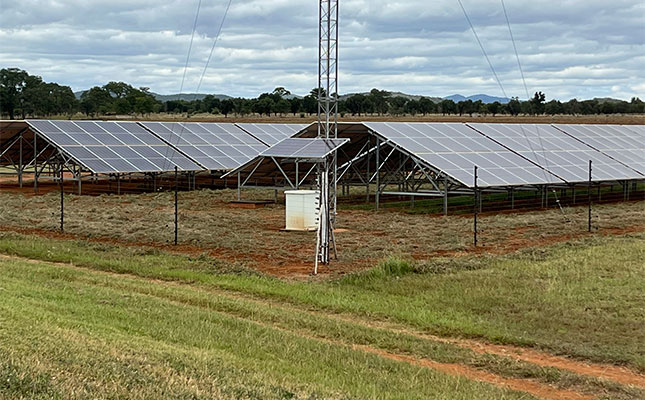
A different approach to solar panel placement has been taken on the farm. Rather than angling the panels in a north to south direction, as is conventional, half the panels are tilted to the east and the other half to the west. This means electricity generation can begin from the time the sun rises until it sets.
“Looking at the electricity generation graph, there is a vertical jump in energy supply when the sun rises. By 10am, I am off the grid completely and can continue to irrigate using solar energy until the sun sets as the very last rays are caught by the west facing panels,” he says.
While this means that east facing panels are not effective towards the end of the day, it prevents the lag in energy supply that would’ve come from having panels facing in a north-south direction. Since panels are a cheaper component of solar energy Schutte rather invests in more panels to allow for the east-west facing system.
Boosting solar efficiency through better irrigation practices
To maintain optimum efficiency within the solar-based system, Schutte had to rethink his irrigation strategy. He made two changes: installing low pressure sprinklers, and reducing the size of the centre pivots.
Schutte explains that potatoes are a high-risk crop requiring careful management of variety, land, and water. By moving from large pivot systems to smaller pivots of between 15ha and 22ha each, he has been able to maintain greater control and react more quickly to plant stress and changing weather.
Since it takes less time for a smaller pivot to be irrigated than a larger one, Schutte can complete most of his irrigation cycles during the day, when solar energy can power the system.
Smaller pivots have also reduced downtime when equipment fails and allowed more frequent irrigation cycles during heatwaves. If night-time irrigation is required, Schutte selects the smallest fields so that this energy can either be drawn from the batteries or Eskom.
“The energy requirement is less on the smaller field, and we buy time for the next day so that we can get through the other pivots.”
Schutte notes that although the smaller pivots have reduced the amount of land cultivated, since there are more isolated patches, the fields were designed to that these patches fell mostly on marginal soils. Draglines are used on these areas where needed.
Preventing large spikes in energy requirement is necessary in a solar-hybrid system. This is since the energy source would switch to Eskom if there was a sudden surge in electricity demand. For this reason, Schutte needs to prevent large motors from being switched on to pump water to fields far from the pumphouse. Low pressure sprinklers have solved this problem since they require less energy to run.
Start soon, but slow
Schutte’s advice for farmers who wish to reduce their Eskom reliance is to first get a full understanding of the farm’s energy requirements.
“Pay attention to electricity usage throughout the year, especially the peak periods – when they are and how long they last. Your system then needs to be designed to generate 30% more than that.
“Start with a grid-tied system with hybrid invertors and grow from there, making sure you understand how to get the best out of the system before scaling up. Farmers must understand that solar power requires a change in farm management. Whereas most irrigation farmers try to run irrigation at night because it is cheaper, with solar it needs to be done during the day to capitalise on the sun.”
Schutte notes that his solar system has cost three times what he was initially quoted to be off the grid.
“But we paid it off in five years through savings on Eskom costs. Every time the electricity prices go up, I save even more. So the sooner farmers start the conversion, the better. But it is important to design the system right from the start, or it will just end up costing you more money. Ease into it, get up to speed with the technology, and learn how to get the most from your solar system.”