
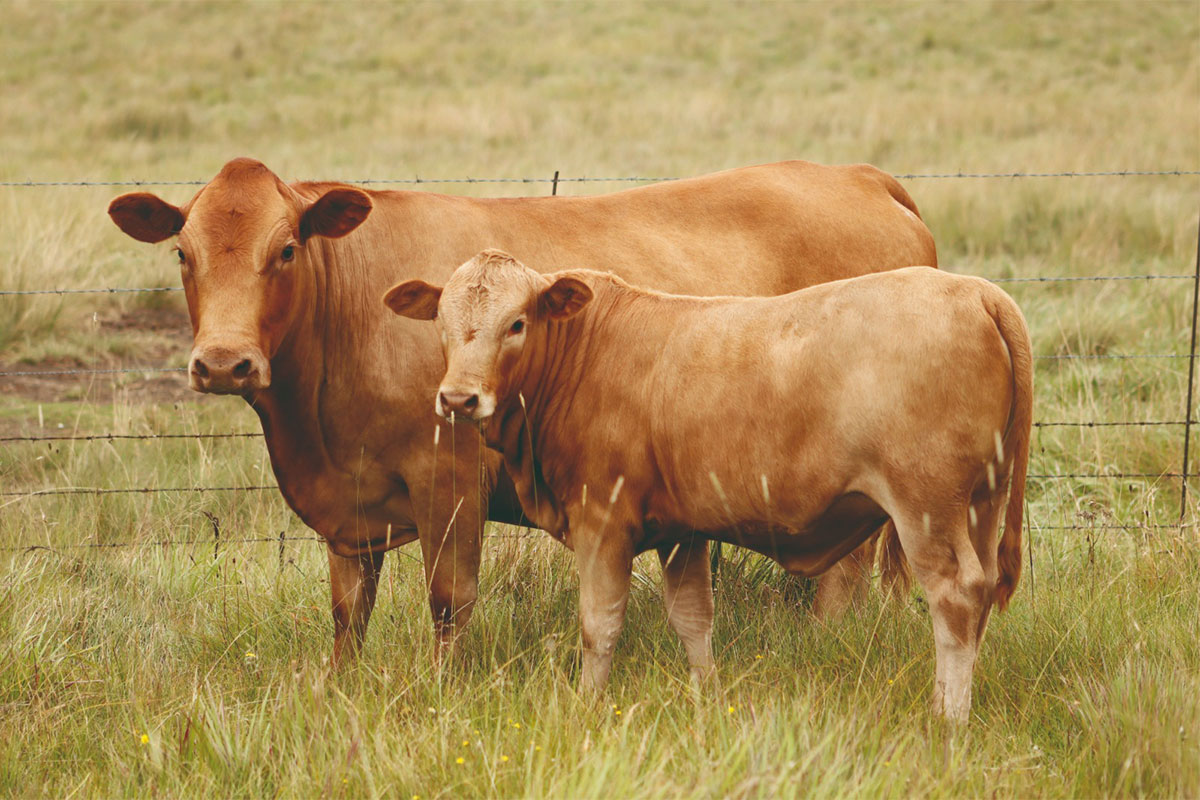
Traits like inappropriate carcass size and weight or excess external fat cover, which can lead to price penalties, can be addressed through improved genetic selection practices. Carcass traits should be an important consideration in beef bull selection. However, performance testing and selection depend on the ability to accurately measure body and carcass composition in live animals.
Measurement of carcass traits
Historically, carcass data was collected through progeny testing, requiring a bull’s calves to be placed in a feedlot and slaughtered before traits could be measured on the carcass. This was expensive and slow, and only a few sires could be measured.
Currently, several non-invasive techniques are available for obtaining objective phenotypic data on body and carcass composition, including X-ray technology and magnetic resonance imaging. As most of these are expensive, the most widely used method globally for measuring carcass traits in live animals is real-time ultrasound (RTU). It is portable, relatively affordable, involves no radiation, and requires no sedation or anaesthesia.
Ultrasound carcass scanning allows objective carcass data to be collected from live animals instead of slaughtering progeny to obtain carcass information. However, there are also disadvantages to ultrasound imaging, including lower anatomical resolution, image analysis that is not easily automated, and, importantly, its inability to measure meat tenderness.
In South Africa, carcass traits are measured by RTU scanning of calves in post-wean growth tests. In addition to growth test traits such as weight, height, and length, eye muscle area (EMA), rib fat thickness, rump fat thickness, and marbling are also measured using RTU technology. These traits significantly influence red meat yield and quality and are heritable.
Carcass traits
Carcass weight is genetically influenced and can be changed by selecting on live weight, frame size, and growth rate. Dressing percentage is also an indicator of profitability and is calculated as hot carcass weight expressed as a percentage of the live weight of the animal at slaughter. Dressing percentage typically ranges from 50% to 64% for most beef cattle, while higher values are generally more profitable.
EMA is the area of the longissimus dorsi muscle (eye muscle or ribeye). It is measured using RTU between the 12th and 13th ribs and expressed in square centimetres. According to scientific literature, EMA is an indicator of several carcass traits, including carcass yield, muscularity, and carcass weight. As EMA increases, red meat yield in kilograms also increases.
Fat thickness is a measure of external fat depth on a carcass and is measured using RTU at two sites on the live animal. Rib fat thickness, also referred to as backfat, is measured at the same site as EMA, between the 12th and 13th ribs, while rump fat thickness is a fat depot that is highly related to 12th to 13th rib fat thickness (genetic correlation exceeding 0,7). This measurement is particularly useful when scanning very lean animals, such as yearling bulls, and can be used to improve the overall accuracy of external fat estimation.
The subcutaneous fat covering the carcass minimises weight loss and protects the muscles from cold shortening, which occurs during the carcass cooling process. Conventional refrigeration of carcasses after slaughter may result in tougher meat; thus, adequate fat thickness helps ensure a higher-quality product.
It has also been shown that favourable genetic correlations exist between subcutaneous fat and reproductive traits, indicating that higher subcutaneous fat deposition is associated with earlier finishing and sexual maturity. However, undesirable genetic correlations exist between subcutaneous fat and weight gain.
Marbling, or intramuscular fat, refers to flecks of fat found within the muscle tissue and is also measured between the 12th and 13th ribs using RTU. However, it is the most difficult of all ultrasound traits to measure accurately. Sufficient marbling is important for beef tenderness, juiciness, and flavour.
Inadequate beef tenderness is regarded as an important quality challenge facing the beef industry, as it plays a key role in consumer satisfaction. Tenderness is objectively measured using a Warner-Bratzler shear force device but can only be obtained once the animal has been slaughtered. In South Africa, farmers are paid for tenderness based on the age of the animal.
Selection for carcass traits
Table 1: Heritabilities (diagonal) and genetic correlations among carcass traits in South African genetic evaluations
| Weaning weight | End of test weight | ADG | Fat | EMA | Marbling | |
| Weaning weight | 0,27 | 0,84 | 0,40 | 0,11 | 0,53 | 0,13 |
| End of test weight | 0,29 | 0,77 | 0,24 | 0,61 | 0,20 | |
| Average daily gain (ADG) | 0,22 | 0,26 | 0,35 | 0,24 | ||
| Fat | 0,25 | 0,06 | 0,27 | |||
| EMA | 0,21 | 0,19 | ||||
| Marbling | 0,20 |
It is possible to select for carcass traits, as fat thickness, EMA, and marbling are between 20% and 25% heritable (see Table 1). A larger carcass with less fat and higher marbling should receive the best price, although South African farmers are not currently paid for marbling. However, due to underlying genetic correlations, when selecting for lower fat thickness, a decrease in marbling can be expected.
According to the literature, selecting for reduced fat may also negatively affect fertility in beef females. It has been shown that daughters of sires selected for lower fat often reach puberty later, require more services per conception, and have longer gestation lengths, which may increase birth weights and the risk of calving difficulty.
Fat thickness is therefore a trait with an intermediate optimum; both extremes are undesirable. Bulls with desirable levels of performance for both lean yield and fertility should be selected. Estimated breeding values (EBVs) are an effective tool for genetic selection to improve carcass traits.

South African Tuli breeders measured RTU traits between 2003 and 2007, and again since 2013. Since 2013, between 60% and 70% of bulls tested in growth tests have also been measured for RTU traits, showing breeders’ commitment to improving carcass traits. Since February 2019, breeders have received breeding values for RTU traits and their indices, namely red meat yield (RMY) and dressing percentage (Dress.%).
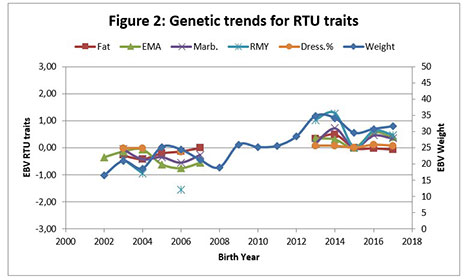
The genetic trends for carcass traits in South African Tuli cattle are shown in Figure 2. However, numbers are still low, so genetic trends are not yet stable. Combining EBVs for RTU traits with weight at the end of the test into selection indices for dressing percentage and red meat yield may also simplify selection and improve carcass traits.
The future: genomic selection
Genetic markers (SNPs), combined with best linear unbiased prediction technology, are currently regarded as the best method for identifying superior breeding animals, especially for traits that are difficult or expensive to measure, such as carcass traits, fertility, milk production, and feed efficiency.
Apart from identifying bulls, genomic testing is another tool that can be used to identify, for example, replacement heifers with greater genetic potential for carcass traits. Genomic testing for rate of gain, tenderness, marbling score, quality grade, yield grade, backfat thickness, and ribeye area is already available in the US. Breeders send in hair or semen samples for SNP testing.
These SNPs are included in routine genetic evaluations and are used to produce genomic-enhanced expected progeny differences, also called genomic EBVs (GEBVs).
Genomic testing has also commenced in South Africa, and GEBVs are already available for some breeds. Genomic selection programmes that incorporate genomic markers for growth and feed efficiency, as well as carcass quality, have been reported to result in a 32% improvement in accuracy compared with using only mid-parent breeding values.
In a technique known as single-step genome-wide association, Medeiros de Oliveira Silva (2017) identified 43, 65, and 53 genes affecting EMA, backfat, and rump fat, respectively. However, this is still an emerging field, with many further discoveries expected in future.
While this approach may not have been financially feasible just a few years ago, advances in analytical techniques have reduced costs, making it more accessible today and in the future.
References
Duc Lu, et al. 2013. ‘Genome-wide association analyses for carcass quality in crossbred beef cattle’, BMC Genetics, 14: 80. doi.org/10.1186/1471-2156-14-80
Medeiros de Oliveira Silva, R, et al. 2017. ‘Genome-Wide Association Study for Carcass Traits in an Experimental Nelore Cattle Population’, PLOS One, 12(1): e0169860. doi.org/10.1371/journal.pone.0169860
Scholz, AM, et al. 2015. ‘Non-invasive methods for the determination of body and carcass composition in livestock: dual-energy X-ray absorptiometry, computed tomography, magnetic resonance imaging and ultrasound: invited review’, Animal (2015), 9:7, pp 1 250–1 264.