
Clynton Collett, owner of the Superior Genetics Meatmaster stud near Venterstad, Eastern Cape, and the first chairperson of the Meatmaster Breeders Society of South Africa, states that the traits first decided on were, as he put it: “to help us make more money or save money.”
Because the Meatmaster was developed based on the selection for specific traits and not like most breeds on blood composition, great care had to be taken to select only for traits that make economic sense and counteract the ever-increasing cost of production.
“In late 1980s and 1990s a few of us realised that the available breeds did not offer the kind of sheep we were looking for. We started crossing various breeds, mainly Damara and Dorper, which ultimately resulted in the Meatmaster as it is known today. When we saw the success of these crossbred sheep a few of us decided to get together and formulate an official breeding strategy. Our aims were pretty simple and straightforward. The breed had to be something totally different, and thus we focussed totally on the selection for profitable traits,” says Collett.

Remarkable performance and type
Asked how the breed evolved since the 1980s, Collett points out that the first and second crosses, because of the hybrid vigour, resulted in some very impressive Meatmasters, but there was still a tremendous variation in type. However, as more and more Meatmasters reached the F4 stage, the problem with off-types became less and less.
Today, thanks to strict selection for performance and type, South African breeders consistently breed animals of the type envisaged by the society.
“It was a huge task to get the Meatmaster officially registered as a South African breed. Were it not for the support of loyal members that passionately believed in the breed from the very start, like Christene du Toit, Prof Freddie Peters and Danie Visser, now all deceased, the Meatmaster as a new breed could all have remained just a dream.
“We had to collect a huge amount of data to convince the authorities at the time that the Meatmaster was indeed something unique and not a duplication of any other breed available in South Africa. In 2005 we finally managed to register the society to function together with the Damara Society situated in Brandfort. We finally got the breed registered in 2007,”Collett continues.
The sky is the limit
According to Collett, the sky is the limit for the breed as long as the focus remains solely on the economic traits as was envisaged from the beginning. He cautioned against changing breeding strategies to satisfy fancy point selection, disregarding production and survival traits based on economics.
“We must remain focused on what appealed to commercial sheep breeders in the past to safeguard and ensure our future,” he states.
Risk mitigation breed
He described the Meatmaster as a “risk mitigation breed” given the breed’s remarkably low production cost, among other things. “Increased production cost obviously impacts profitability. The Meatmaster represents outstanding African genetics and is known for very strong resistance to ticks and virus diseases.
Meatmaster lambs are very strong and resilient at birth, with very few lambs also being lost due to poor mothering instincts. The highly intelligent Meatmaster has a strong herd instinct. These are but a few of the breeds’ noticeable traits that lead to improved risk mitigation.
According to Collett, South Africa and its farmers have for a long time been respected for the good animals they breed; because of this, sheep breeders from outside our borders soon took note of what the Meatmaster was achieving in South Africa.
As breeders of other meat sheep took note of the very positive way the Meatmaster breed was influencing economic red meat production, the breed’s own positive traits became its most valuable asset to get more and more breeders involved.
Meatmaster in Namibia and Botswana
The Meatmaster had an immediate effect on sheep production in countries like Namibia and Botswana. Having also been successful there, they soon spread to other countries in Africa and abroad.
Had it not been for our foot-and-mouth disease that led to a closure of exports, the impact of the Meatmaster in the world would undoubtedly still be greater. When exports reopen, the real boom period of the Meatmaster breed will undoubtedly take place,” Collett states.
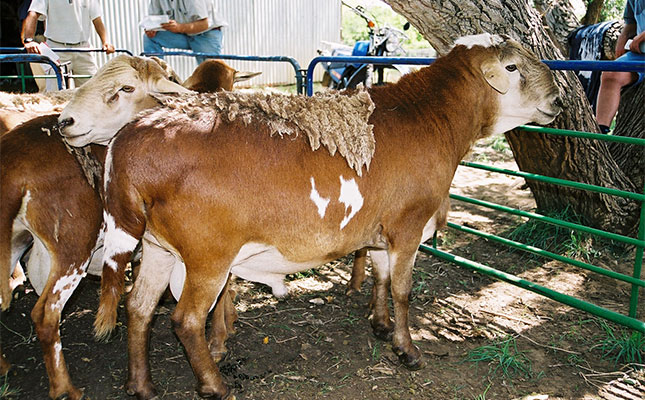
Damara and Dorper genetics
Jean du Plessis, owner of the Elandsnek Meatmaster Stud (Strydenburg) and one of the founding members of the Meatmaster Sheep Breeders’ Society of South Africa, added that the Meatmaster sheep breed was born out of the necessity for an uncomplicated, cost-effective, adaptable and low-cost breed.
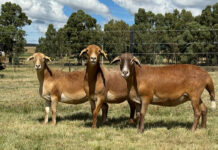
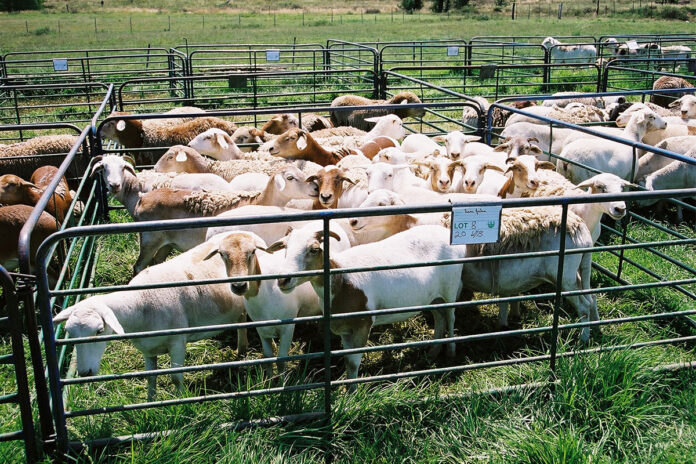
The Meatmaster sheep breed is a composite breed, bred from the Dorper and Damara sheep breeds. It is a low input/high output, mutton ideal, and hair sheep breed. Although it was mainly bred for the extensive farming conditions of the arid production areas, the breed now widely occurs in South Africa.
Match made in heaven
“In my case, I wanted to find a crossbreeding combination in order to increase carcass quality in my existing Damara flock. I started farming with Damara sheep early in the 1990s. The pure Damara carcasses were not acceptable to the market, in the late 1990s I therefore introduced the Dorper to my flock for improved carcass quality. I found the combination between the Damara and the Dorper to be the proverbial match made in heaven.
“At that time, I did not even know that other farmers were doing the same. However, as the time passed, we became aware of and started engaging with each other, which eventually led to the Meatmaster breed’s official registration in 2007, followed by the breeders’ society’s official approval in 2008,” Du Plessis explains.
Independent breeding
According to a research report published by the Central University of Technology in Bloemfontein, Meatmaster breeding initially happened independently at different localities in South Africa. All of these breeders had more or less had the same idea in mind, and that led to the creation of a new easy-care mutton breed.
They used the Damara as their genetic base in all of their breeding programmes. The predecessors of the Meatmaster of today hailed from, among others, Meyerton in Gauteng, Venterstad (Eastern Cape), Hopetown (Northern Cape), Bloemfontein (Free State) as well as Kenhardt, Loeriesfontein and Williston in the Northern Cape.
“As a basis they utilised components of the Dorper and Damara breeds mainly to form their particular version of the composite Meatmaster breed,” the report read.
No idea of a new sheep breed
Asked by Farmer’s Weekly whether he expected the Meatmaster to become one of the prominent sheep breeds in the country, Du Plessis says he never gave the idea of a new breed any thought. All he wanted was a genetic combination that would safeguard sustainability and profitability.
“I’ve not considered following the stud route in the beginning. Only after the demand for Damara/Dorper rams became evident did I decide to register the Elandsnek stud. Buyers were increasingly looking for the functional and efficient genetics offered by the crosses. Form always follows function and function also follows form. This is particularly true in the case of the Meatmaster, making the breed highly sought after by commercial producers,” Du Plessis continues.
According to him, the fact that the Meatmaster was kept true to type from the beginning added markedly to its rapid growth. Its outstanding growth, even fat deposition and fertility resulted in a well-balanced, all-rounder, sheep breed. The Meatmaster has always been bred with sound economics in mind that does not need pussyfooting about.
The CUT research further shows that as the separate breeders became known to one another, a need developed for the Meatmaster to be formalised as a breed, based on shared breeding values and ideas. The name Meatmaster as the official breed’s name was also formally recognised during that meeting.
On 15 and 16 February 2005, the very first Meatmaster production sale was held on Collett’s farm, La Rochelle. The first general meeting of the newly established Meatmaster Sheep Breeders’ Society of South Africa was held on 4 February 2005 at Brandfort in the Free State, followed by the election of the first executive committee.
The Meatmaster breed was then registered in 2007, with the Breeders’ Society being approved in 2008.
For more information, email [email protected] or visit MeatMaster.co.za.