
Latest articles
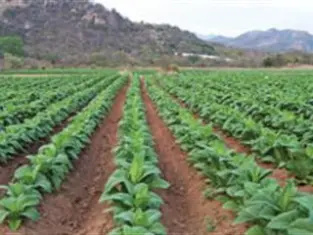
Tobacco farming – the growers’ view
New proposals from the World Health Organisation’s Framework Convention on Tobacco Control to regulate international tobacco farming have raised concerns among Africa’s tobacco growers and processors. Francois van der Merwe, chairperson of the International Tobacco Growers’ Association: Africa and CEO of the Tobacco Institute of Southern Africa, provides an alternative perspective.

Astral spreads its Mozambican wings
Integrated poultry producer Astral is stepping up its presence in Mozambique. Robyn Joubert spoke to Astral CEO Chris Schutte about its African strategy.

Orchids of Eden
Duckitt Nurseries was initially built on passion and four orchid species, but it is now the biggest cut flower and Cymbidium orchid farm in South Africa with a few hundred varieties. Keri Harvey reports.
Diversification: spreading the risk on a Tanzanian farm
Having too few production divisions can cause financial stress if markets fail. A Tanzanian operation has minimised the risk by launching a variety of enterprises in a relatively short time. Lloyd Phillips reports.

Swazi pots of gold
Eswatini Kitchen Honey is re-invigorating Swaziland’s honey industry
through the promotion of bee-keeping as an income stream for poor communities. Robyn Joubert reports.
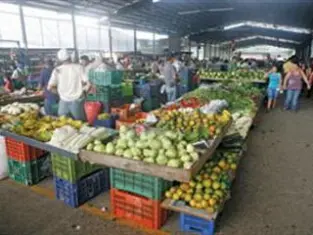
Local food markets: are they the answer?
Go big or get out is the current trend as farmers chase economies of scale. But any system which relies on shedding jobs and increasing monopolisation in order to reduce the price of a shelf item is fundamentally unsustainable, warns Luke Metelerkamp.

Keeping animals and the forestry industry alive
It may not be widely known outside South Africa’s commercial forestry industry, but problem animals are responsible for causing extensive damage and financial losses in timber plantations. Professor Justin O’Riain and his team are researching ways around this problem. He spoke to Lloyd Phillips.
Rewarding productivity lifts performance
Training and performance monitoring are key to encouraging productivity in the workforce. Labour consultant Walter Blore shifts the paradigm and puts farming businesses on track. Robyn Joubert reports.
Responsible rural citizenship
In early 2010, the South African police began work on a new rural safety strategy. The architects of that plan reached out to organised agriculture. A positive, committed response from Agri SA and its provincial organisations has resulted in a renewal of healthy relations between farming communities and the police. Sean Christie spoke to Kobus Visser, of Agri SA’s Rural Safety Committee and André Botha, chairperson of the committee, about the strategy.
Hands-on grass farming
It’s a hard day’s work for the team as livestock farmer Gary Mitchell runs his commercial Drakensbergers and stud Dorpers in the KZN Midlands with minimal labour.
Rethinking the Swedish model
Sweden’s agricultural sector is largely based on environmental
principles and organic farming. This has posed many challenges for
Swedish farmers, who are losing market share to cheaper imports.
Lindi van Rooyen spoke to Helena Jonsson, president of the
Federation of Swedish Farmers, about overcoming these challenges.
Alternative energy: Throwing caution to the wind?
Clean renewable energy or an imperfect solution? Are wind turbines the magic bullet for energy problems? Roelof Bezuidenhout reports.
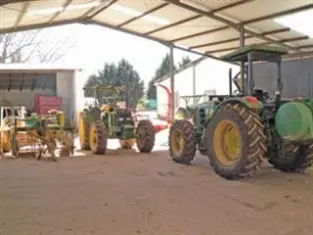
Herding tractors: managing a large machinery fleet
Agricultural machinery and implements are vital to any commercial farming operation. It’s equally important that this equipment is well managed and maintained. Lloyd Phillips reports.
Land Bank: back on track
In its recently released annual financial report, Land Bank announced that its finances were in good shape. Chief financial officer Lebogang Serithi shared the institution’s recipe for success with Peter Mashala.

When knowledge is political power
Political analyst Max du Preez says SA commercial farmers can no longer afford a laager mentality: by familiarising themselves with the political dynamics and the inner workings of the ANC, they’ll be able to tell the loudmouths from the power players, and spotlight themselves as food producers and fighters against poverty. Annelie Coleman reports.

Farming today to ensure food for the future
It’s been less than three years since Woolworths launched its
Farming for the Future programme and it has already become one of
the major focuses of its sustainability drive. Justin Smith, Woolworths’ head of sustainability, speaks to Robyn Joubert about the programme.

Game or the stock exchange?
Johan Rabie compares the investment performance of high value game species – with specific reference to buffalo and sable antelope – with investing on the JSE and other prominent stock exchanges.

In the family business
Two generations of Kotzés farm more than a dozen different lines on their historic Sandveld farm between Velddrif and Hopefield. For them, the pros far outweigh the cons of farming with the family. Keri Harvey reports.

‘There’s no alternative’
AfriForum has been among the most prominent of South Africa’s
civil society organisations in recent years. Much of their advocacy is around politically sensitive issues such as land reform and farm violence. AfriForum CEO Kallie Kriel spoke to Sean Christie
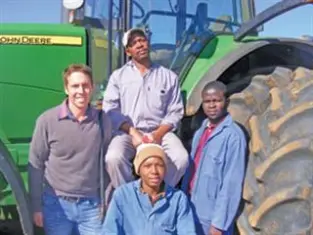
Young Free State farmer works towards partnerships
Laurens Schlebusch believes business associations between commercial farmers and farm workers will become increasingly important in the future. He talks to Annelie Coleman about grooming selected members of his staff for partnership positions.