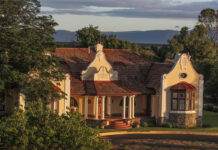
Taking a stroll around Glen Avon Farm outside KwaNojoli (formerly Somerset East) is like walking through history, right back to the days when thousands of 1820 Settlers were shipped to the Eastern Cape as an agricultural buffer between the British-run settlements and the Xhosa nation across the Great Fish River.
You proceed from paddock to paddock down a winding country lane, under a venerable canopy of oak trees.
You pass flashes of woolly Dohne Merino sheep and Angora goats, sneezewood gateposts still standing, gaunt and gnarled, beds of heritage roses, a moss-covered crypt where ancestors rest, a wood-and-cable suspension bridge across a large stream, a shearing shed that once served as a military mess, and an ancient mill that used to grind all manner of grain in its day.

The sneezewood posts, each one pocked with many holes drilled by various generations, were harvested centuries ago from the forested hills above Glen Avon and remain untouched by wood bugs or decay.
The birding is quite incredible.
About 270 species have been recorded on Glen Avon, including specialities like the Knysna Woodpecker, buff-streaked chat, striped flufftail, scops owl, and breeding pairs of Verreaux’s and martial eagles.
Fittingly, these days, you could be accompanied by a trio of Border collies called Timmy, Sammy, and Georgie, who love to walk with farm guests.
A Walk with Greg brown
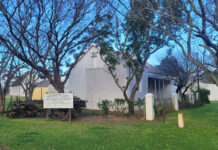
Once he’s tended to his chores, young farmer Greg Brown will take you up to the family cemetery. Ask him, and he might tell you some Gothic tales of a granduncle, or one of a wife dying and her husband committing suicide.
He might also tell you about his Scottish ancestor, Robert Hart, who came over to South Africa as a military man in 1795. In 1816, Cape Governor Lord Charles Somerset sent him to these parts to take over Somerset Farm, which supplied food and fodder to the British troops on the frontier.
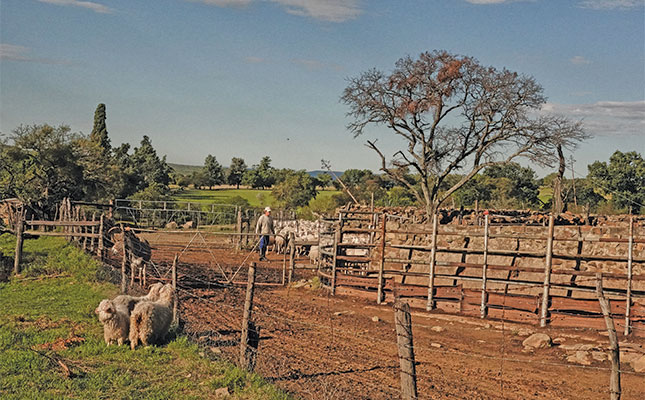
Later, when the 1820 Settlers pitched up, this was the farm that initially supplied them with grain and fruit, right up to 1825. Somerset Farm later became the site of Somerset East.
A small but highly fertile and well-watered piece of ground was granted to Robert Hart in 1821 in recognition of his services to the Crown and successfully managing Somerset Farm. He named it Glen Avon.
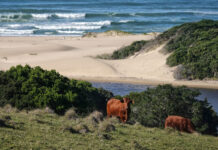
Since then, his descendants (the Harts and later the Browns) have been able custodians of this remarkable property beneath the densely vegetated Boschberg mountain.
The Glen Avon Mill
The Glen Avon ancestors left gifts for their successive generations to enjoy. Robert Hart had a massive mill built from local yellowwood, with machinery imported from Leeds in England and brought in by ox-wagon over the tricky Zuurberg Pass. By 1861, it could grind up to 4t of grain per day.
Wagonloads of mielies were brought down from places like Pearston, Ann’s Villa, and the Zwagershoek near Cradock (now known as Nxuba).
The drovers would camp for a day or two while the grain was milled, then set off again, delivering it en route.
“You could immediately hear when the mill was running,” says Alison Brown, mother of Greg. “It took on a life of its own as it rumbled and groaned.”
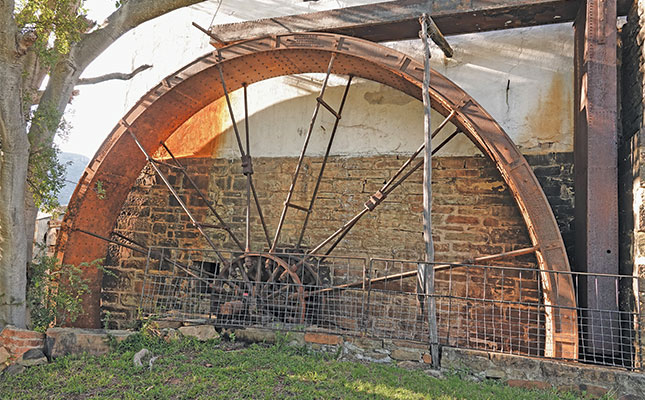
The Glen Avon mill closed down in 1992 but was recently brought back to life. The Brown family were put in touch with mill enthusiast Chester Staples, who advised and helped them. They began clearing tons of dirt from beneath the old wheel and inside the mill house itself.
“If we were going to restore it, the time was now, before things really fell apart,” says Fiona Brown, Greg’s wife.
She studied environmental management, takes a personal interest in the mill, and is immensely proud of it.
It costs R500 to get the mill up and running for demonstrations, which include a half-hour talk, seeing the great overshot mill wheel moving and the grindstone grinding.
It’s a beautiful triple-storey grist overshot mill. Woodoc, which has its factory in KwaMaqoma (formerly Fort Beaufort), also made a generous donation of its products, ensuring the woodwork gleams. And once in motion, it’s like being in a loud Victorian-era factory during the Industrial Revolution.
Pecans from Canada
Another piece of ancestral legacy on Glen Avon comes in the form of a grove of healthy pecan trees, courtesy of Lennox Brown, who had been badly gassed in the trenches of World War I and told by doctors that he did not have long to live.
He decided to make the most of the time he had left and travel the world. It was while he was in Canada that he pocketed some pecan nuts and eventually brought them back to the farm.
That pocketful of nuts led to another small income stream for Glen Avon.
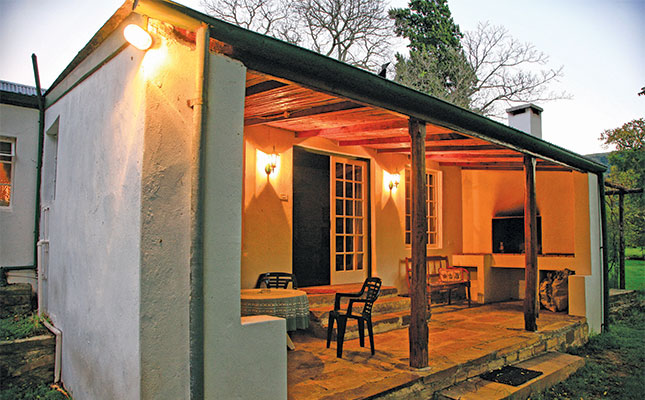
The historic Shearing Shed
If you’re lucky to visit Glen Avon during shearing season, you’re welcome to come along and watch the men with their flashing blades, working in the cavernous shed that was once a mess hall for British officers stationed in Middelburg just after the Anglo-Boer War.
The building was then used as both a citrus-packing depot and a basic shearing shed until some time in the 1990s, when the legendary New Zealand shearing facility builder Chips Reid built a beautiful shearing facility within the shed. The shearers work on a raised platform, almost like a stage, and behind each one is a door that leads into the catching pen. Also behind each one is a chute leading down to the ‘let go’ pen.
Inside the Shed
This old Karoo shearing shed has the feel of a cathedral. Built from stone and corrugated iron, there is natural light from above so the men can see in order to cut and class.
The sounds are unforgettable. The shed is filled with the metallic hum of the fast-moving electric clippers, the murmur of the shearers, and the constant bawling of the sheep or Angora goats. Occasionally, a goat will bleat in protest at the injustice of losing its warm winter coat. The sound is just like a child throwing a tantrum.
Approximately every five minutes, a shearer brings in a new, wide-eyed animal, clamping it firmly between his legs before starting on the belly and working his way around. The animals sink into a hypnotised, chicken-like trance, sitting immobile on their backsides as the wool comes off almost in one piece, like a skinned pelt.
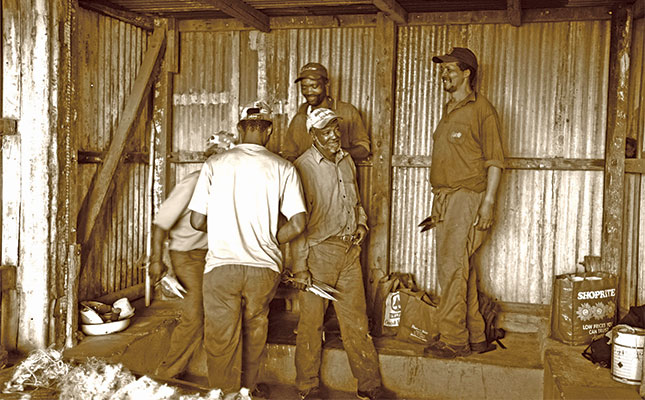
The shearer puts the dazed sheep back on its feet and gives it a commanding pat as it scuttles off down the chute to its mates.
The wool thrower brings the fleece over to the sorting table. With a dramatic gesture, he flings it onto the slatted surface, slick with decades of lanolin. The graders crowd around, burying their hands in the wool, looking at the length and fineness of the fibre.
Everything in the Glen Avon shearing shed is traditional, from the shears to the table and the wool presses.
The Australian Who Loves SA
On one of our visits to Glen Avon many years ago, we met Ros Turner, now curator of the Walter Battiss Museum in KwaNojoli.
We found her in the Glen Avon shed, amid the shearers and classers. It was time for the Angora goats to be shorn of their long, curly locks. We gently probed her about why she had left her birth country, Australia, to come and live at the southern edge of the Karoo.
“I’d rather die an exciting death in Africa than live a boring life in Australia,” was her unforgettable answer.
Turner had been a shearing judge for many years. At one stage, she even officiated at the annual World Shearing Championships, where South African and Basotho hand shearers usually come away with top honours.
She is also a top wool classer. As we were talking, a truckload of new goats arrived, and they were guided into the stalls.
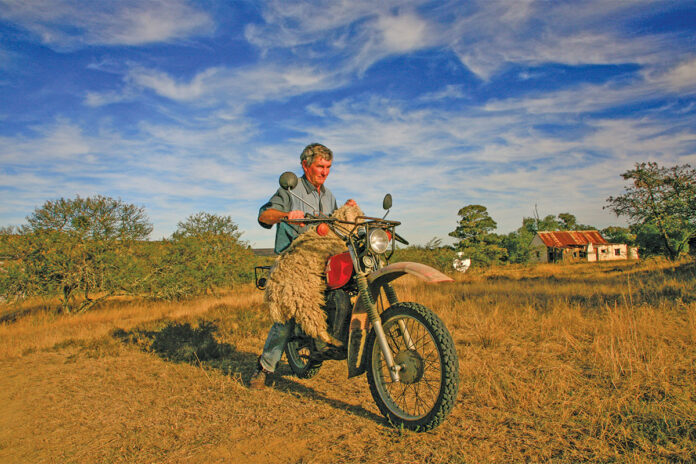
We went outside in time to see Bill Brown, Greg’s dad, arrive with a goat firmly clutched over the petrol tank of his scrambler motorbike. Just another morning on Glen Avon.
For more information, WhatsApp Fiona Brown on 074 342 9550, email her at [email protected], or visit glenavonfarm.co.za.