There was once a South African mountain farming community quite unlike any other in this country.
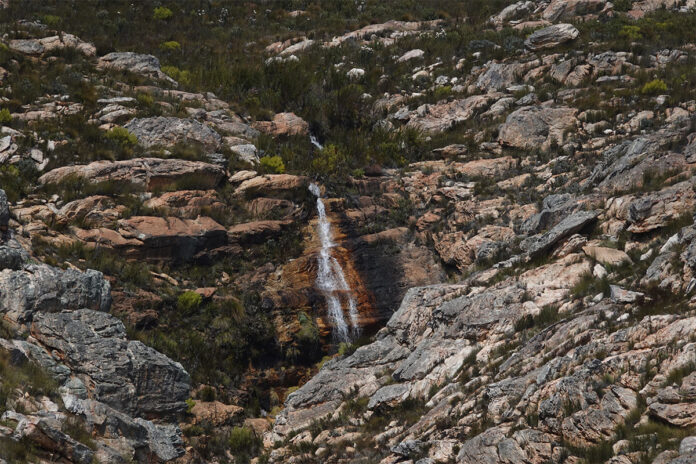
Between 1840 and 1991, they lived in a long, narrow fissure of a valley cut into the jagged heights of the Swartberg Range by the Gamka River and its tributaries. The residents called it Gamkaskloof (lion canyon) and they referred to themselves as Klowers.
It was only much later that it acquired the nickname Die Hel.
This fertile, well-watered strip of land, less than 20km long and 600m wide, had been inhabited sporadically by many people over the centuries. Old stone artefacts and rock art tell those stories.
The first recorded recent resident was Pieter Swanepoel, who settled here in the 1830s. He may have stumbled across this valley while searching for lost cattle.
By 1841, Swanepoel was joined by other families – the Cordiers, the Marais family, the Mosterts, the Nels, and the Jouberts.
So, while other Afrikaners trekked north in their oxwagons, these families found a little piece of heaven right here, far away from government, authority, and so-called civilisation. They became completely self-reliant and only later began to trade with the outside world.
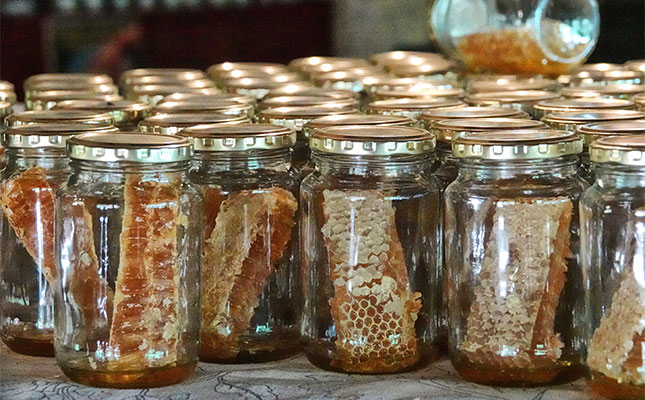
As Prince Albert-based historian and palaeontologist Dr Judy Maguire puts it: “The valley people created for themselves a remarkable home-made, self-sufficient subsistence lifestyle, based on an agricultural economy which included the production of dried fruit and honey.”
They were far from everything – wars, depressions, development, disease. They were enfolded and protected by mountains.
Also Known as Die Hel
Nowadays, Gamkaskloof is a well-known destination for those who love mountain passes, adventures, and challenging roads. The road to it starts near the top of the famous Swartberg Pass, and it is notoriously daunting, even in good weather.
Anyone wanting to experience this fascinating mountain valley will almost certainly stay at Fonteinplaas, owned and run by the only Klowers who left and then returned, the Mosterts, and the Jouberts.

Annetjie Joubert (née Mostert) left the valley before 1991, when the last permanent farmer left. She and her husband, Bennie, decided to return to the family farm, Fonteinplaas, in 1998. Among other things, they opened a shop there, supplying meals, braai wood, and every kind of jam or preserve you could think of.
After Annetjie and Bennie retired to the coast, their son Pieter Joubert, his wife Marinette, and their children Beon and Mia took over. They have converted many of the old houses on Fonteinplaas to accommodate guests, have built a few other structures, and established a camping site. From a small general farm, it now mostly serves tourists. Their many beehives also supply a good income from honey. They also produce, in the age-old tradition of the local people, a range of Gamkaskloof Herbals, good for all manner of ailments.
The hidden history
Few of the travellers who come here know the deep history of the long-gone Klowers. And much of its demographic and agricultural history might have been forgotten were it not for Prof Brian du Toit, an anthropologist attached to the University of Florida and Stellenbosch University.
In 1965, he came to do research in Gamkaskloof. At that time there were 85 people living in the kloof, in 19 different households. He chose an interesting time to come and do his study.
By then, the long road linking the valley to the Swartberg Pass, which links Prince Albert and Calitzdorp, had been opened for three years.
In 1952, before the road, the population was 95, the highest ever recorded here. Shortly after Du Toit had been there, most of the people he met would flood out of the valley into the wide world.
Du Toit later wrote a book about his studies, called People of the Valley: Life in an Isolated Afrikaner Community in South Africa. This book, written in an entirely non-academic style, provides a highly readable insight into these rather amazing people. It was published by AA Balkema in Cape Town in 1974, and is sadly out of print.
Oom Louis Nel
Du Toit writes of his first impressions when he arrived at the top of the fearsome Elands Road, which descends dramatically into the green seam of a valley that is Gamkaskloof.
“As we reach the top of the valley and gaze down into the distance it is clear that the valley is populated. One sees a few fields, a couple of donkeys, a dirt road, and a mud house with smoke lazily drifting from the chimney.
“As the first house on the floor of the valley is reached, one may meet Louis Nel sitting on the floor of his porch, repeatedly moving his hands through raisins, which he is drying on a sack. He picks out the bad ones, the black ones, and the stalks.
“His felt hat is pushed back on his head, his face is kind and wrinkled from sun, wind and laughing, his pipe is clenched between strong jaws and his hands are large and rough.
“He is a man of rough cast, hardened by his constant struggle with nature. He is typical of the people of Gamkaskloof.”
Du Toit noted that each house was surrounded by a small garden, fruit trees – typically citrus, pear, apple, and fig – a vineyard, a chicken coop, and a pigsty.
He certainly wasn’t the only person to encounter and write about the Klowers. Deneys Reitz wrote this (translated) in his memoir Commando, which was about his expeditions and campaigns with General Jan Smuts during the Anglo-Boer War.
“As we approached the huts, a shaggy giant in goatskins appeared and spoke to us in strange outlandish Dutch. He was a white man named Cordier, who lived in this valley with his wife and children in complete isolation to the outside world.
“We were received with uncouth, but sincere hospitality and helped ourselves to the goat’s meat, milk, and wild honey that was placed before us. He told us that no British forces had ever penetrated the valley and that we were the first Boers to do so.”
Photographer David Goldblatt also spent extended periods of time with the Klowers in 1967 and 1968 and documented their lives photographically.
An ‘Amish’ Way of Life
Du Toit examined how the families worked together on their farming enterprises.
Women raised children, baked bread, made preserves and jams, dressed the meat after an animal had been killed, washed clothing in the stream out front, watched over chickens, and gathered fruit and vegetables.
Men and women shared the responsibility of preparing and drying fruit, treating the raisins, peaches, and other fruit with a natural alkaline preservative made from the ashes of loogbossie, and manually sorting through them.
Men watered their fields of grain, fruit, vegetables, and vineyards, tended to the livestock (sheep, goats, and donkeys), and headed off into the bush with a rifle to find wandering livestock or sometimes shoot a buck. Since cartridges were expensive, accuracy was a highly prized skill.
They milled the wheat and corn in small ‘Norse Mills’ powered by water.
It fell to the men to take goods to market, usually twice a year, and the closest markets were Calitzdorp or Prince Albert. Both journeys entailed navigating through extremely rough terrain and a round trip of around 60km, with a dozen river crossings, generally completed in a day. One of the routes had a path so steep it was called Die Leer (the ladder).
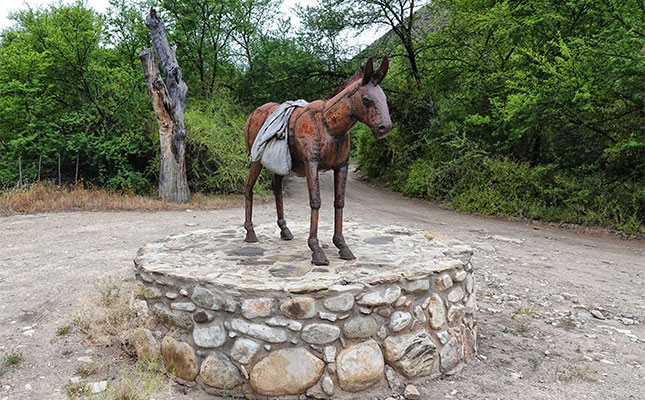
Donkeys were entrusted with the dried fruit, honey, and other goods for sale, literally carrying wealth on their backs. On the return trip, often the same day, they would carry the goods purchased, including linen, coffee, sugar, and salt. Donkeys were never ridden and were highly respected.
Du Toit writes: “In discussing donkeys and their value, the people even today recall that certain persons had especially fine donkey teams. In all cases, the emphasis was on the temperament of the donkey, the sureness with which it could travel through the Poort, and the fact that it did not drop its load, lose its balance in the water or start at something out of the ordinary.”
Du Toit’s studies showed something else that was remarkable – that these farming families, living and farming right next to one another, mostly got on well. He found them easy-going, placid, and co-operative. They helped one another with harvests, fencing, setting up sheds, and net fishing.
Meeting annetjie
Chris and I visited Gamkaskloof for the first time in 2007. The road demanded respect, but it was still well maintained by CapeNature, which also conserved and protected the Swartberg Mountains.
From 2000 to 2019, CapeNature ran much of the accommodation. People could stay in the renovated old homes of the Klowers who had left. We met Annetjie in a shop she had set up as you entered the valley proper.
In the tradition of enterprising women, she was a master of making preserves. I walked slowly around the dimly lit shop, writing down what was on the labels of the shining jars: halwe lemoene, kerrie kool, sitroen, agurkie pekel, kersies in blitz, bobbejaanknaters, kool blatjang, makataan en gemmer, druiwe, heuning, waatlemoen en pynappel, kweperkonfyt,perske chutney, ingelegte pere, ingelegte aarbeie, pekeluie, spicy hot tomato relish, apricot chutney, mostertbone, kerriebone, Ouma Hester se stringe.
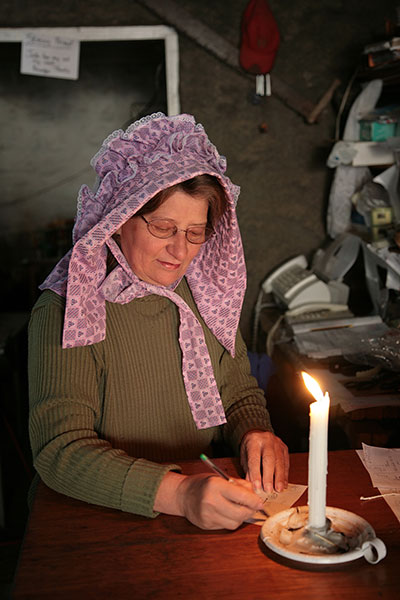
While chatting, Annetjie modelled a proper old Boere bonnet for us, and we mocked up a picture of her writing in front of a candle. She told us about a time when there was absolutely no fruit to make jam from. It was the middle of winter.
Suddenly she remembered an old story about the bitter aloe (Aloe ferox) leaves becoming less bitter when they were flowering.
She set to work and found she had made a rather delicious jam. It’s still a feature of the padstal today, now made by her daughter-in-law, Marinette Joubert.
The Formidable Tannie
We stayed overnight in one of the CapeNature cottages, and that evening we took our wine to the wooden table outside and toasted the stars and the cocoon of night and silent mountains.
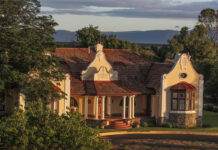
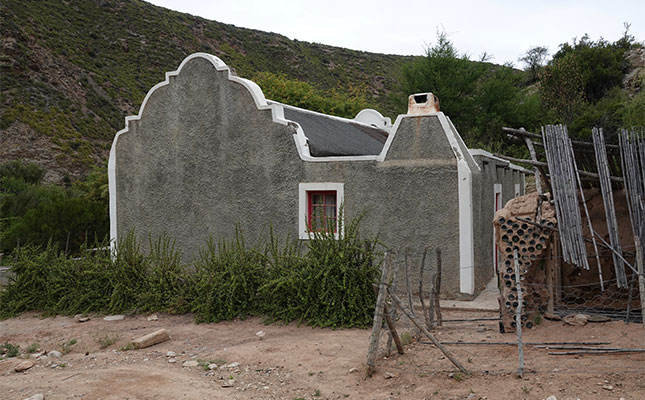
Near our cottage was a beautiful house, with distinctive gable and pebble shell borders around the windows. It had been built by a legendary Klower called Tant Lenie Marais.
According to Maguire, Tant Lenie “was a renowned baker, seamstress, flower arranger, dispenser of boereraat and herbal remedies, a builder and farmer.”
Dawn hit the valley early, thanks to its east-west axis. By 7am, the first rays had plunged to the bottom of the valley to touch us, and there was life all around. A southern boubou whistled and churred us awake. A double-collared sunbird paid house calls to every flower.
On the way out, we stopped again at Annetjie’s shop. We chatted about the distinctive local architecture, simple Cape style with bottelkaggel (bottle-shaped hearth and chimney), grey with white trim and green doors.
On the steep drive back up Elands Road, bouncing around the sharp bends, we caught a glimpse of a klipspringer that gazed at us for a full 10 seconds before it bounded out of sight.
When we stopped for pictures, it felt as if the whole veld was buzzing, moving with bees. Fynbos and Nama Karoo meet
here, and there is a feeling of wholeness and resilience, the careless beauty of an intricate Persian carpet.
Return to the Valley
We only returned in 2024, a full 17 years later. The road was more of a challenge now that CapeNature no longer ran the cottages. After a devastating fire in the valley in 2019, they never reopened them.
We adhered to the local advice: take it slow and use your gears rather than your brakes. Even so, we were pleased to get to the end, and that we had two nights here, not just one.
Marinette booked us into Oom Piet se Huisie. This was where Piet’s mother Annetjie was born, along with 10 other siblings. It was partially burnt in the last big fire. The kitchen and bathroom had to be rebuilt.
They redid the reed ceilings, said Piet, but the old historic items are gone, like the bark used for twine.
This little house, grey with white trim, sleeps six. There is no Eskom service here, but there is a gas fridge/freezer and a gas stove. There is solar lighting, a long kitchen table, and a spacious lounge.
As a bonus, next to the braai area, there is a quaint cool-off pool outside, not much bigger than a water trough.
That afternoon, we stood on the balcony overlooking this long, narrow, green valley situated high in the Klein Swartberg Mountains.
The soil is still fertile, there is good water, and the climate is healthy. A couple of bokmakieries were chanting to one another from cliff to cliff.
Breathing is such a joy in Die Hel. It has the sweetest air, so fresh and flower-scented. Every breath is a joy. It feels like you are inhaling the best air in the world.
At the shop, Marinette cooks for guests, raises children (Mia, 16, and Beon, 14), has long conversations with talkative guests, and is generally a solidly calm person with a reassuring presence.
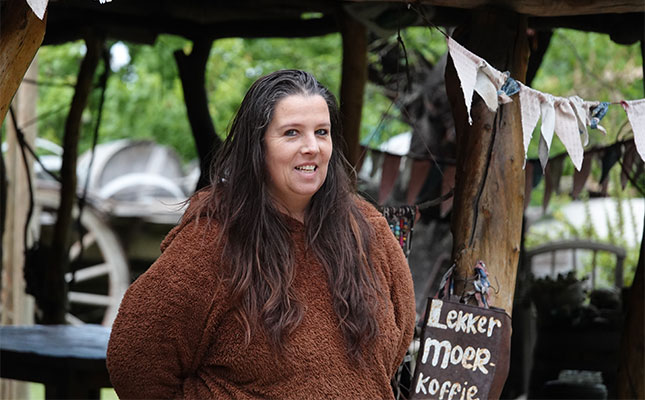
Exactly the kind of person you want to meet after a long drive that has jangled every nerve in your body.
Pieter is busy documenting the vast and varied history of Gamkaskloof. He has access to David Goldblatt’s images, and all the impressions and writings of various people who have visited this beautiful and isolated place.
Just like most of the Klowers, he is stoic, calm, and easy-going – a personality trait that comes in handy when there are weather crises like floods and fires, when travellers’ cars break down, or when the rivers come down in flood and damage the roads.
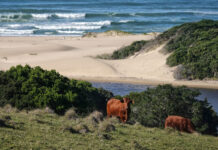
Piet used to farm sheep, but the leopards picked them off. This heavily farmed valley is reverting back to its original state.
Recently, someone sent up a drone to take an aerial shot, and a Verreaux’s eagle attacked and destroyed it. We saw a young family of kudu and heard baboons calling. The trees were full of sunbirds and bokmakieries.
Nature is gradually taking back the valley, and the travellers love it.
For more information, visit gamkaskloof.co.za. Keep an eye on their excellent Facebook page ‘Gamkaskloof (The Hell/Die Hel), run by Kevin van Blerk, who gives helpful information on the state of the road into Gamkaskloof, as well as other attractions. Email [email protected] or WhatsApp Marinette on 072 355 9623.