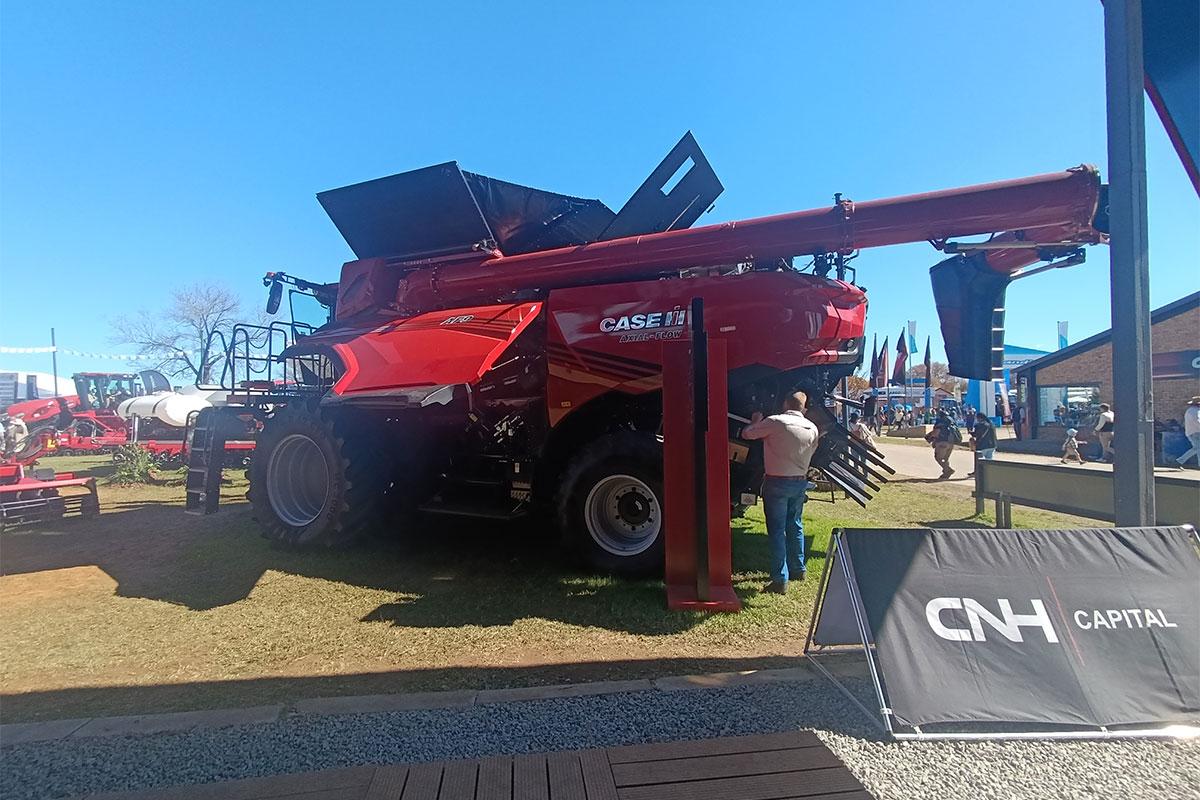
As Case IH brand influencer Reandi Grey remarked during the launch, the AF9 “has more technology than the houses of most newly-weds”. But beyond the electronics and displays lies a machine purpose-built to help farmers harvest faster, reduce losses, and improve grain quality under increasingly challenging conditions.
The AF9 is a completely new design, from the feeder house through to the cleaning and residue-management systems, while still retaining the Axial-Flow single-rotor concept that made Case IH combines famous worldwide.
Unlike conventional combines that separate grain through multiple threshing stages, the Axial-Flow system uses a single rotor to thresh and separate grain in one continuous process, improving crop flow and reducing kernel damage.
According to Bertus Barkhuizen, product specialist at Case IH, the AF9 builds on decades of refinement in grain handling, separation efficiency, and operator comfort while significantly increasing harvesting capacity.
More capacity, less downtime
One of the most noticeable features is the 20 000ℓ grain tank, currently unique to South Africa in this specification. Barkhuizen said that during harvesting trials near Middelburg, Mpumalanga, the machine harvested an average of 16t of soya bean before unloading was required.
With an unloading rate of 210ℓ/s, the grain tank can be emptied in about three to four minutes, reducing standing time and improving harvesting efficiency during narrow windows of suitable weather.
The feeding system has also been redesigned. The feeder house is shorter but larger, while the Synchronised Feed System accelerates crop flow before it enters the rotor. By synchronising feed acceleration with rotor speed, the system ensures more even crop intake and reduces strain on the threshing mechanism.
The rotor itself has been extended by approximately 860mm compared with previous flagship Case IH models, creating additional separation area through two extra sets of concaves. The result is improved threshing performance and reduced grain losses at the rear of the machine.
“You can do everything right during the season, but the combine becomes your measuring stick. You want every kernel in the tank and not on the ground,” Barkhuizen explained.
Case IH has also reworked the cleaning system to improve performance under uneven field conditions. Instead of grain simply falling directly onto the sieves, it first lands on a dynamic grain pan that moves from front to back and side to side to spread material more evenly across the cleaning area.
The system can compensate for slopes of up to 27°, compared with around 14° on previous models. Load sensors continuously monitor material distribution and automatically adjust grain movement to prevent overloading on one side of the machine.
Spreader management
The residue-management system has likewise been upgraded. Radar sensors monitor wind conditions in real time and automatically adjust spreading patterns to ensure even residue distribution across the field and prevent chaff from blowing into neighbouring crops.
Many of these functions are controlled through Case IH’s artificial intelligence-driven Harvest Command automation system. The technology continuously analyses crop conditions, feed rate, grain quality, and engine load, making real-time adjustments before the operator notices changes in harvesting conditions.
Farmers can, for example, instruct the combine to operate at a maximum of 90% engine load, after which the machine automatically adjusts ground speed and threshing settings to maintain throughput and grain quality. If conditions improve, the combine speeds up; if grain quality declines, the system automatically adjusts rotor speed, sieve settings, and airflow.
Cameras positioned inside the grain tank continuously monitor grain quality and kernel damage, feeding detailed images back to the system so that settings can be optimised automatically.
Operator comfort
Inside the cab, operators have access to dual Pro 1200 displays. One screen can be dedicated to machine performance and the other to grain quality data, harvesting information, and FieldOps connectivity. Through the FieldOps platform, farmers can also connect remotely with Case IH support teams and factory technicians for diagnostics and assistance.
But Barkhuizen said the AF9’s technology extends far beyond screens and sensors: “It’s also about the design of the machine.”
One of the biggest engineering changes is the repositioning of the 635hp (474kW) engine so that it now runs parallel with the rotor instead of across the machine. This creates a more direct power transfer to the rotor and feed accelerator, improving efficiency while reducing drivetrain losses.
The engine and feeder accelerator also work in sync, automatically adapting rotational speeds together to prevent overloading under heavy crop conditions.
Case IH has further simplified the drivetrain by reducing the number of belts, pulleys, and chains in favour of more hydraulically driven systems. Fewer moving parts reduce maintenance requirements, improve reliability, and minimise power losses.
“If the combine is standing still, it’s not making money,” Barkhuizen said.
A workhorse
Barkhuizen recommended that farmers use a 250t elevator with the AF9, especially when harvesting maize.
Fuel efficiency has also improved. According to Case IH, the AF9 delivers about 1,5% better fuel efficiency than comparable Class 8 combines, with fuel consumption of roughly 10ℓ/ha during soya bean harvesting, compared with 14ℓ/ha under similar conditions.
Weighing about 30t empty, the machine is available in both track and four-wheel-drive configurations, with buyers needing to specify their preferred set-up when ordering from the factory.
For large-scale grain producers, the AF9 signals Case IH’s intention to compete aggressively in the premium combine market by merging high-capacity harvesting with automation, improved grain quality management, and engineering designed around real-world farming conditions.