
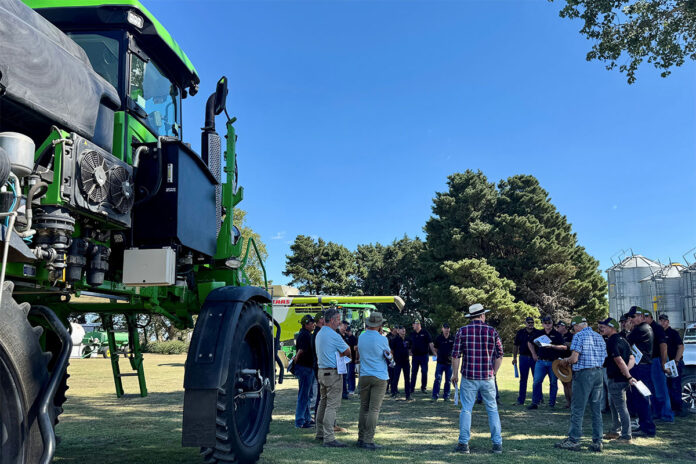
Visiting fellow farmers on other continents is high on the agenda for any farmer. This is where cross-pollination of ideas happen – in the field on another farm.
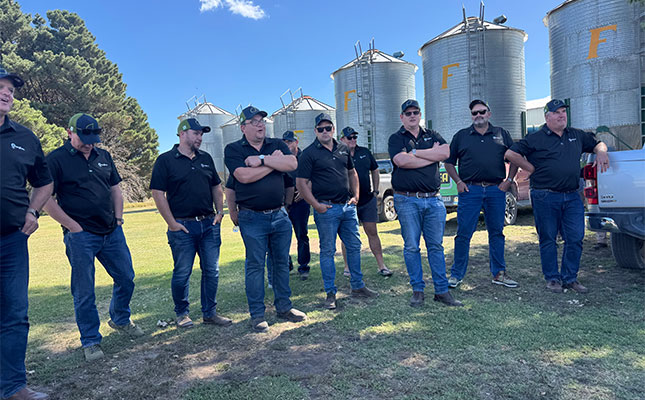
The group of South African farmers who went on a sunflower tour in Argentina with Syngenta Seeds also visited a sunflower farmer, Robbie Cameron from Cameron Hnos S.A. on the coastal belt near Necochea-Quequén, to discuss and compare sunflower production strategies and methods.
The Camerons cultivate maize, sunflowers, soya beans, cereals as well as fodder crops such as buckwheat and malting barley in a rotation system. The farming enterprise has evolved from a focus on commodity crops, to a provider of high value-added crops.
The family’s history combines tradition and innovation with an international vision and a strong commitment to rural life.
The Camerons can trace their story back for several generations, and it is one that crosses continents.
“My ancestors came to Argentina from Scotland, but before arriving, spent a generation in New Zealand. My great-great-grandfather arrived in Argentina around 1890 from New Zealand and worked in sheep farming in Tierra del Fuego, on the Chilean side of the country.
After travelling through Patagonia, he ended up buying 5 000ha in Pieres, 20km from the port of Quequén,” Robbie recalls.
The proximity to a port is still relevant today, Robbie states. His father, Sean Cameron, notes that his great-grandfather’s goal was to implement intensive sheep farming in the Pampas region, inspired by his previous experiences.

Over time, however, crop farming displaced livestock. That transformation accelerated between the 1970s and 1990s with the ‘Green Revolution’ promoted by Norman Borlaug. That brought more productive wheat, hybrid sunflowers and hybrid maize to the area.
Change from ploughing to no-tillage
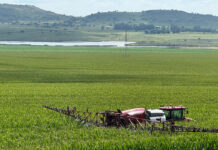
Since the mid-90s, the Camerons have changed from ploughing to no-tillage and direct seeding. Sean recalls that they changed in 18 months from a conventional system to a no-till system.
This transition was accompanied by a defined strategy: intensive production of commodities such as wheat, barley, maize, sunflowers and soya beans, with a heavy focus on reducing costs through value-adding. Robbie told the South African farmers’ group that they also installed silos, and acquired trucks and other machinery to make the model as efficient as possible.
The main idea was to stop thinking of the countryside only as a resource for commodity production, but to turn it into a sustainable production unit of high-value crops.
Innovation is in their blood. Robbie’s grandfather imported the country’s first hydraulic self-propelled irrigation equipment in 1971 and, in 1990, the first electric one. The Camerons operate 14 centre pivots, of which six are electric and equipped with telemetry for real-time monitoring.
“Under irrigation, our production is intensive and sustained throughout the year. One of the great advantages of irrigation is that it improves income and reduces risk at the same time,” says Robbie.
They also follow a rotation system designed for irrigation: sweetcorn, durum wheat, soya beans, seed maize, combined with cover crops such as white clover or vetch.
“Clover is excellent. You can harvest it, it fixes nitrogen in the soil, and can be followed up with maize without the need for inorganic fertilisation,” explains Robbie.
Cycle rotation systems
They either follow a three- or four-cycle rotation system, depending on the crops, the climate predictions for the season, as well as availability of soil moisture.
He points out that the past couple of seasons were some of the driest on record for the past 55 years.
“But in spite of that, with the practices that we follow, we were still able to realise good yields and the crops for this season are also looking quite good.”
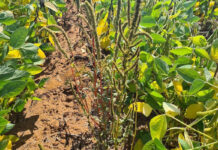
With regard to Sclerotinia, Robbie says that they do not perceive that to be a huge threat anymore.
“Through the breeding programmes of companies such as Syngenta, we have been able to get more tolerant hybrids and by planting early, we ensure that we miss the vulnerable reproductive stage of the sunflower during the hot and more humid periods in the season when the disease is more likely to infect sunflowers.”
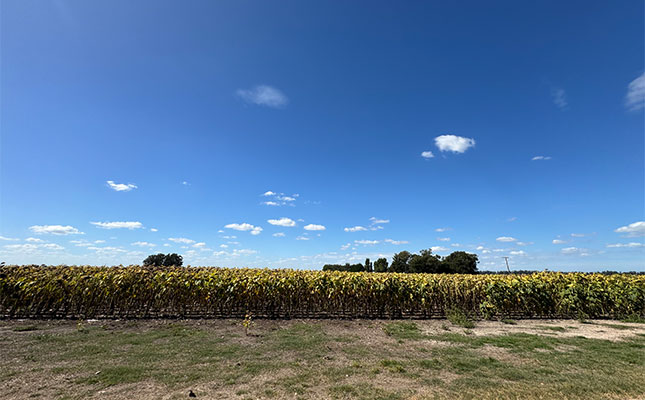
In sunflowers, as with some of the other crops, they follow a basic weed management programme. They do a broad glyphosate application of 2ℓ/ha, which they follow up 10 days later to catch those small emerging weeds before planting with another strong dose of herbicide. Because they use high-density plantings, the crops form a canopy early on and that also helps with weed control.
They implemented two different planting densities depending on the soil type. In the deeper and more fertile soils, they will plant 55 000 sunflower plants/ha and on the poorer soils, 45 000 plants/ha.
They do regular soil analyses and use the information for scripts to do variable-rate fertiliser applications of lime and nitrogen.
After planting in October, they will do the first application and then again a month after planting, in November or December. Depending on the planting date they will do a top dressing. Robbie says that is more or less at the eight-leaf stage.
“In the past we sprayed for bollworm, but lately we have a problem with hairy worms, especially at the edges of the fields.”
According to Robbie, their life is not only about productivity. They live in the country, and that changes the way in which they manage the land.For the Camerons, their presence is one of the keys to a sustainable rural community. “Sustainability is not only measured in environmental terms, but also with regard to people, society and culture. We are trying to leave something better for those who come after us.
“One of the ways to stay sustainable in the long run is constant measuring. “Measuring your output and cost, as well as your income, helps with planing decisions for the coming season.”
Plotting on a map
Another way, explains Robbie, is to analyse the business by plotting the crops on a map, measuring income, profitability, and contribution to the total business per crop. The average oil content of the sunflowers produced on the farm is measured according to the percentage bonus they receive from the crusher.
“We look at each crop and plot the hectares planted and combine that with the gross margin that a product realises at the end of the season, together with the percentage of the total contribution towards total farm income.
“When we look at irrigation maize, it constitutes an area of 88ha, and when we calculate gross income, it constitutes 7% of our income.
Sunflowers, as another example is 491ha and consitutes 27% of our gross income.”
For more information, email Robbie Cameron at [email protected].