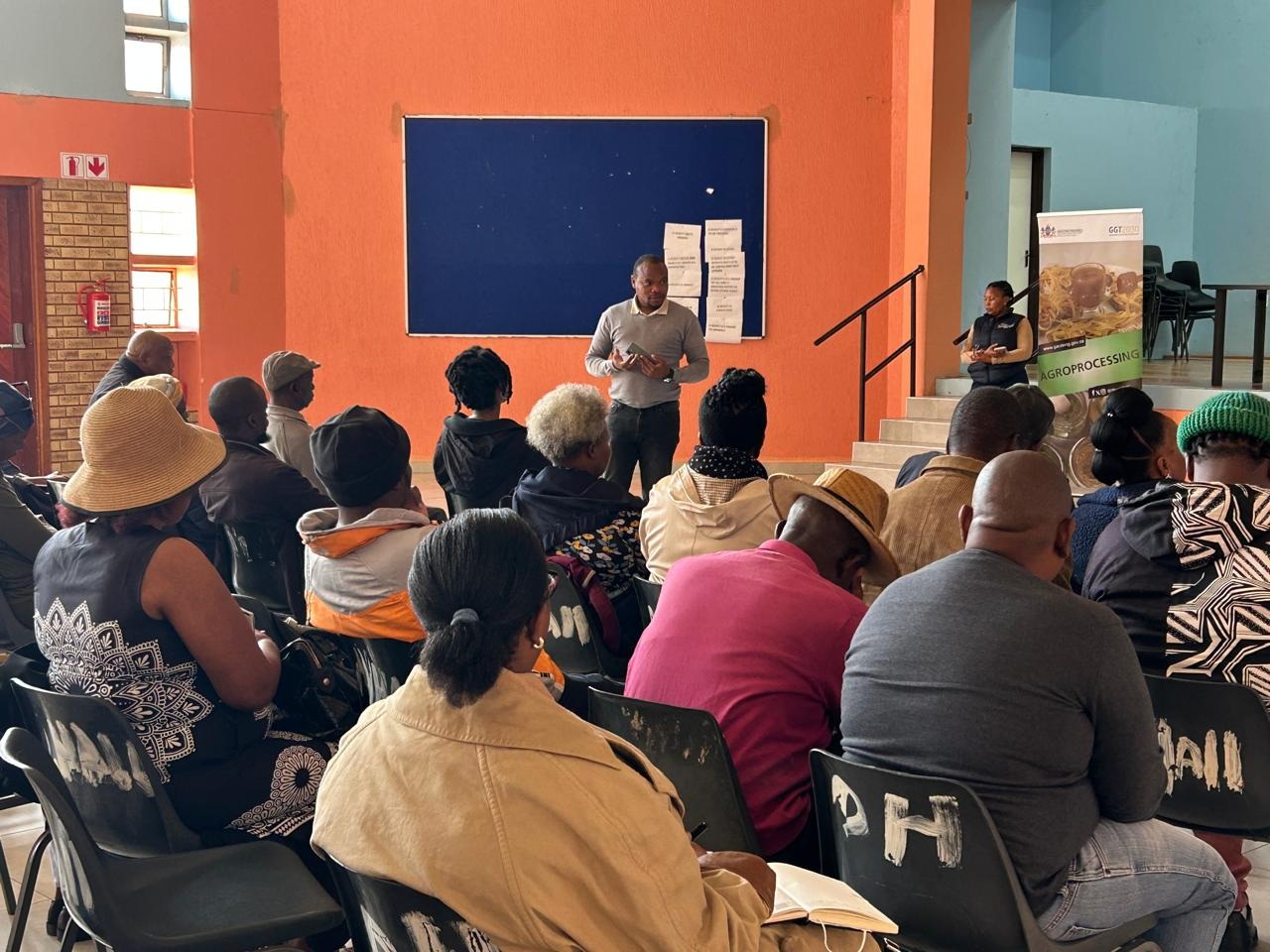
The subdued uptake formed the backdrop of a Gauteng Department of Agriculture and Rural Development (GDARD) and National Empowerment Fund (NEF) Agro-Processing Blended Financing Roadshow held in Diepkloof, Soweto, on 15 May.
The engagement formed part of a broader outreach campaign for the GDARD/NEF Agro-Processing Blended Finance Programme, which included webinars held in December 2025 and April 2026 ahead of successive application deadlines. The programme is planned to run over three years.
Launched at the inaugural Gauteng Agro-Processing Convention and Expo in July 2025, it was introduced to support emerging farmers and agro-processing businesses seeking entry into commercial agricultural value chains through a R100 million funding facility.
Yet, despite the scale of the funding available, programme officials acknowledged that many prospective applicants were struggling to meet the administrative and compliance requirements to access the facility.
In a presentation aimed at increasing the number of applicants ahead of the 22 May 2026 deadline, NEF senior investment associate Lindiwe Shikwambana said the overall number or value of applications received would be made available at the end of the financing application cycle.
Highlighting concerns about the limited participation of the youth and people with disabilities, Shikwambana revealed that of the four agro-processing businesses approved so far, three were female-owned.
During a finance application support webinar, held on 23 April 2026, Anthony Moloto, director of the GDARD’s Agro-processing unit, highlighted the difficulties that farmers and agripreneurs had experienced with their applications.
He said that while most of them had the requisite technical know-how for their chosen businesses, they struggled to provide supporting data, such as financial statements, which are required for successful applications.
Applications are submitted online only and require documentation across eight broad compliance categories, including business plans, tax compliance records, financial statements, and sector-specific certifications, totalling more than 30 separate supporting documents in some cases.
For many small agro-processing businesses, however, the challenge is meeting the technical, financial, and compliance requirements to access the facility.
Several participants at the Soweto engagement said the compliance burden was disproportionately heavy for smaller businesses with limited administrative capacity, while others expressed appreciation for the support offered in the next rounds of applications.
“Maybe your business is not ready to take up a loan right now, and that is fully understandable. One of our [successful applicants] said the best thing you can do for your business is to have your admin and compliance in order, because it makes access to opportunities a lot easier,” Shikwambana said.